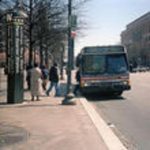
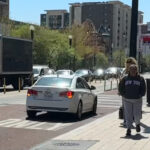
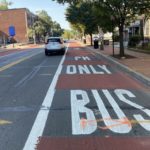
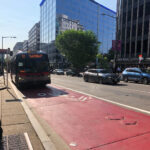
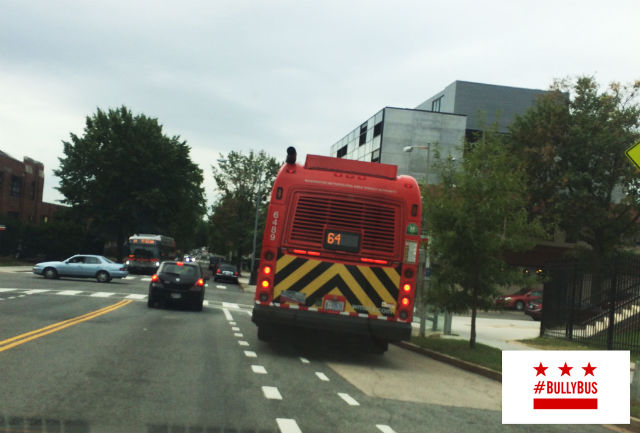
 Via BullyBus.
On an average weekday, more than 1,200 Metrobuses are on the streets of the D.C. area, serving over 11,000 bus stops. “The number of times a Metrobus pulls into a bus stop on any given weekday is greater than 500,000,” according to a spokesperson.
These buses encounter a number of roadblocks, from illegally parked vehicles to construction, that prevent drivers from unloading passengers next to the curb. But are bus drivers making enough of an effort to ensure they’re fairly sharing the road? The man behind the new Twitter account DCBullyBus would say “no.”
Corey Snyder, who commutes by car from Columbia, Md. to U Street NW, started the account after observing buses blocking multiple lanes instead of using designated concrete pads for over a year. Snyder’s used both 16th Street NW and New Hampshire Avenue to enter the city. “Everyday, or nearly everyday I come across these WMATA buses that stop diagonally across multiple lanes of traffic and or bike lanes creating dangerous traffic situations and wasting D.C. tax dollars,” Snyder said by email.
Snyder said he created the account to start a conversation with the goal of reaching “someone [who] can make a change or enforce D.C. buses to stop properly on bus pads at all D.C. bus stops.”
“I’m not just an angry commuter that is trying to publicly shame WMATA, even though right now some of my tweets, all-be-it in its infancy, may appear to be that way,” he said. “It is however the best way to reach out to others on Twitter to show that they are not alone. That someone else out there sees this as an issue, is willing to take the time to mold a message for a cause, and take action.”
WMATA’s standard operating procedures manual details three types of service stops, but notes “there are many variations depending on location and available space.” The curb lane service stop, done when the zone is not obstructed, calls for the front door to be within six inches of the curb and the rear to be within the lane line.
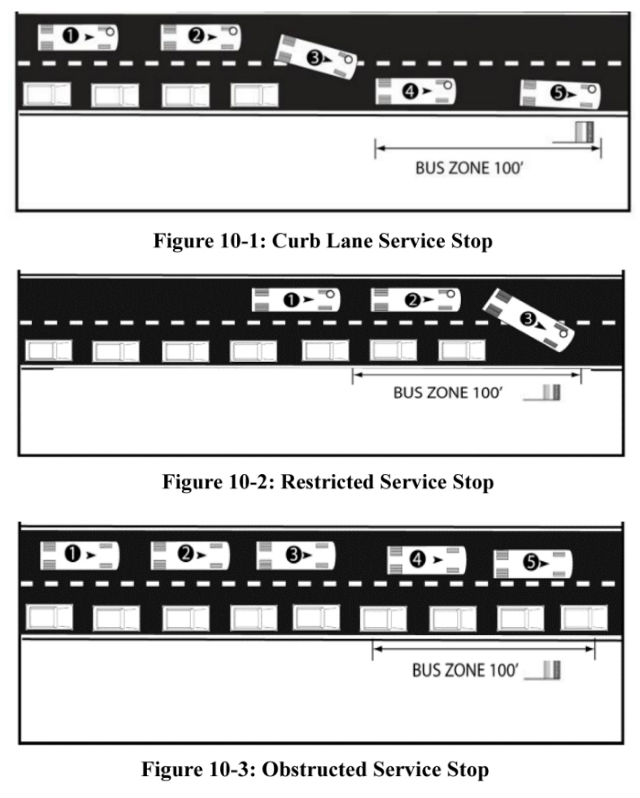 Via WMATA.
“Ideally, every bus would be able to make a full curb-lane stop every time, but that is not reality,” Metro spokesperson Dan Stessel said by email. “Often, illegally parked or standing vehicles or other obstructions make that impossible. So there are procedures in place for bus operators to handle those situations.”
When the bus is unable to pull to the curb, Stessel said “the best advice for bicyclists is to stop behind the bus and wait for it to pull out. Most bus stops are served in 30 seconds or less.”
Even a seeming violation of a policy may not be one, according to Stessel.
Take the first picture posted by DCBullyBus, which shows a 64 bus stopped diagonally while a concrete bus pad is unobstructed. While it appears the bus should have been able to pull to the curb, Stessel said there several reasons why the driver may have made the decision.
“The white van does appear to be parked illegally, limiting the amount of space for the bus to pull all the way out of the travel lane,” he said. “The van is also a high-profile vehicle, which can block a bus operator’s view of the bus stop to know whether the bus is pulling over. If the operator notices a waiting customer late in the game, that also can result in something less than a curb-lane stop.”
.@WMATA buses stop across multiple lanes, creating dangerous traffic conditions. RT to curb the #BullyBus @drgridlock pic.twitter.com/zsXS8ZI6Yc
— BullyBus (@DCBullyBus) September 16, 2014
Of course, this isn’t apparent to a driver or cyclist who may encounter the bus. Stessel said that complaints are “sent to the superintendent of the appropriate bus division,” of which there are 11. “In cases like this, the superintendent would likely interview the operator, and if warranted, put the operator through refresher training in the bus simulator,” he said.