

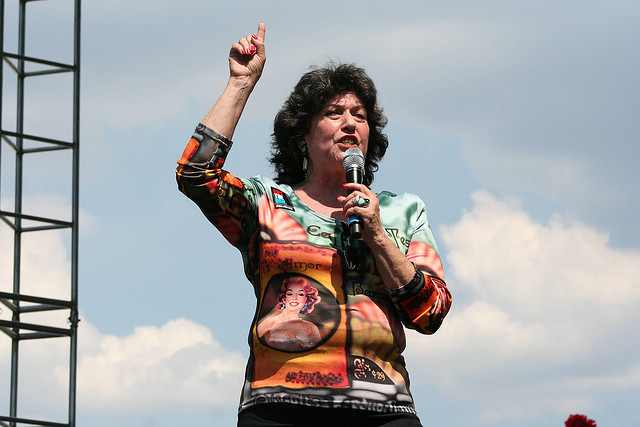
 Photo by Elvert Barnes.
By DCist contributor Jonathan Neeley
Carol Schwartz may be the underdog, but she’s not a new name. With forays into D.C. politics that date back to the ’70s — including a run for school board that put her on the first Home Rule ballot — Schwartz held the D.C. Council’s Republican At-Large seat twice, from 1985 to 1989 and then again from 1997 to 2009. This is also Schwartz’s fourth mayoral race, and her earlier runs are nothing to sniff at. As she tells DCist, she got over 40 percent of the vote in 1994 — against a post-prison Marion Barry — and the least she ever garnered was 30 percent.
Still, it’s hard not to call Schwartz the race’s third wheel. Her June 9th campaign announcement, which came months after At-Large Councilmember David Catania announced he would run as an Independent and Ward 4 Councilmember Muriel Bowser won the Democratic nomination, feels especially late when considering her five-year absence from District politics. Some have asserted that her campaign is really about derailing Catania, a long-time rival.
But hear Schwartz tell it, some good, old fashioned door knocking, a bit more press, and everyone getting over the David Catania thing — she wasn’t here to talk about that, she said sternly as we sat down together near her Dupont home last Monday — will go a long way.
Our interview, which has been condensed, edited and rearranged for clarity, is transcribed below.
Could you summarize what brings you back to D.C.’s political sphere?
Well, I didn’t want to leave in the first place. I had been a Councilmember for 16 years.
I had given sick leave to workers, I had led the way on that issue. … I appreciated giving people who work — not just able-bodied, able-minded people who sit in bed and watch TV all day — but actually get up and go out and work. And then they have to work two part-time jobs and neither job gives them any sick leave, any vacation any benefits whatsoever. I think that’s an abomination.
…
So I ran with it and brought it forward and worked with the business community and the hospitals and universities, and I took their concerns in where I could. They wanted the bill to die, I wasn’t going to let it die.
Still, the garage guys were upset about having to give any sick leave at all to their workers, so they joined together and formed a PAC. In a primary where only a few thousand people voted, they spent about $750,000. … My voters thought I was fine so they didn’t vote, and so I lost the primary. I tried to wage a write-in and got 40,000 votes. And if we had done a recount, because a lot of the names you couldn’t really decipher, it would have probably been 50,000 people.
So I didn’t want to leave public life. I know this is a long answer to your question, but it’s an important question. I did try to retire gracefully. I was at an age, retirement age, when after what I call my wound-licking period, I decided I would travel and enjoy life because I, thank goodness, have the wherewithal to be able to do that. Not only financially, but also I have a multitude of friends and they are gay couples, “Carol, come out and play with us.” And I have single women friends and women friends who are married and their husbands don’t like to travel, so I’ve got lots of friends I like to travel with. And I’ve got children, two daughters in New York and a son and daughter-in law. Three daughters now in New York as of two years ago, and a son and daughter-in-law and two grandbabies in California, so I went there and I continued to do my charity work. I’ve always done charity work whether I’m in office or not in office.
…
A combination of having the break and really seeing what was happening to the city. Three members of the Council spending at least some jail time. I got more and more concerned about our reputation and all of that. So that was one reason, our reputation. Another reason I wanted to return was that I never wanted to leave in the first place. I wanted to be mayor, that’s why I’ve run four other times, the last time being 2002. It’s been 12 years. … Not liking retirement and the volunteer work—but when you’ve been able to deliver sick leave to workers, such a universal thing, it’s hard to go to back doing volunteer work. And as I walked around town all these years, I’ve had all these people say, “We miss you!” Bus drivers hug me and say, “Please come back, we miss you, run for mayor, we need you!” And I’m a person who if I’m needed, I want to be there. So all of those reasons are why I’m back.
You’ve been gone long enough – [Schwartz: “Five and a half years.”]—just long enough for new residents of the city to not know who you are.
I know from having gotten so many of my own petitions signed. I needed 3,000 and we got nearly 6,600 done by all volunteers. We didn’t pay one petition circulator one penny. … I did a little over 2,000 myself to introduce myself to new voters and reintroduce myself to the not-so-new voters.
So I think it’s a concern, but I am out and about all the time, trying to introduce myself to the new people in town. I know I have some work to do there, but I think … I’ll gain more and more support as you in the media put my positions out there. For a while there I had a hard time getting media attention because they were doing the two leading candidates—the two this, the two that. But now I’m finding that I’m certainly in that number and deserve to be. I mean I’ve run for mayor four times, as a Republican. I’m an Independent now, but as a Republican in a city that was 11 to 1 Democrat to Republican, I should have gotten like 7 percent of the vote if every Republican voted for me— and I was too liberal for a lot of them— but the least I ever got was 30 percent of the vote.
You’ve run four times. What has that taught you that you’re putting to use with this campaign?
The more I think about it, being a Republican in this town I can’t believe so many people voted for me for mayor.
Do you still consider yourself a Republican?
No. I’m an independent. The party left me long before I left it. I kept my voter registration, because I’m a fiscal conservative. I will return tax money to you faster than I’ll spend it. … I want to find waste, fraud, and abuse so we’re not just taking all of your money and throwing it down a bottomless pit, or even worse somebody’s stealing it.
So I’m a fiscal conservative, and on the other issues I’m moderate to liberal. But I stayed a Republican because we have Congress sitting there. And when they did a rider against gay and lesbian adoptions, I was able to personally go down there, get the meeting because I was a Republican and it was a Republican from California who put the rider on there, and I got it taken away. If I had been a Democrat, I couldn’t have done that.
Being a Republican wasn’t necessarily helpful to me politically in town, and actually it was probably hurtful, very hurtful. Everybody says, “If you’d just become an Independent all those years ago, you could have been mayor.” But it was helpful to the city, and I always put the city above me.
Can we go back to what you’ve learned from your other mayoral campaigns?
Well, this is probably a harder one because the other ones, I ran as an incumbent Councilmember. This is the hardest one because I’m not an incumbent and I have been gone for five years. There was actually one [election] in 1994 where I got 44 percent of the vote and I had been gone five and a half years. I left the Council in 1989 after the death of my husband, and then in June of ’94, I announced for mayor. So exactly the same thing. At five years gone, I got 44 percent of the vote.
…
I have less money than I’ve ever had before because, when you’re not an incumbent and you’ve been out a long time, it’s harder to raise money, and I’m not a good fundraiser. I’m a good fundraiser for charities and I’ve done it for a lot of them, but I’m not a good fundraiser for myself, and I don’t want to spend my time and energy doing it, so we’re just operating out of my apartment.
…
You know the posters you see around? People pay people to put those posters up. I have all volunteers. We haven’t paid one nickel to put a poster up, and we didn’t pay one nickel for a petition. So that’s pretty extraordinary to have over 500 volunteers. So we’re running a poor person’s campaign, but we’re doing OK. And even my poll numbers, considering [Bowser’s] been out there for a year and a half spending millions of dollars—and look where they’re coming from. And [Catania’s] been out there for eight or nine months, and I know from friends that he called them a year earlier than that, so he’s been out there in one form or another for the same amount of time and has got … I know he’s aiming for a million and he may be close to that by now, I don’t know. And I’ve got less than $100,000 dollars.
I’m a young, but I’m getting to the point where I think about putting down roots, and I’d love to do that in D.C. But when I look at what I make and the cost of housing here, it doesn’t feel very realistic. What would you say to encourage me?
Two things I’d say to you. I’m going do a lot of affordable housing for all kinds of income levels. I bought into the city 48 and a half years ago. … Read my announcement; I talk about how our glorious diversity is being threatened as we become a boom town. I don’t want people to feel pushed out or left out. I want to have all income levels here. I have lots of ideas, including tax credits for people who used to live here but moved out. I want them back. And we also have a first-time buyer’s tax credit too that I cannot take credit for.
So one, I’d look at the first-time buyer’s home credit if I were you. The other thing is, go way down on your expectations. And I practice what I preach. When my husband and I got married and we were a young couple, $30,000 in D.C. got us three of the tiniest bedrooms you ever saw. Our master bedroom, which is a joke to call it that, we had a double bed and one night stand because we couldn’t have two in that tiny little room. The third bedroom was like a closet. We had one toilet for the whole house. No entry closet, no finished basement, no garage. So we went way down in our expectations, but we decided it was better to have the vitality of a city than go to the suburbs and get far more for our money. So that’s why I’m saying to you, dumb down. Dumb way down.
But even small hole in the wall houses seem like they cost upward of $600,000.
Yeah, but go to some of the outskirts with good public transportation. Because let me tell you: we never lost a nickel. The money I have today … In D.C., you’re not going to lose your money. So dumb down, go out, make sure you’re not too far from public transportation, and then you’ll inch your way up. That’s what we did.
But I’m also going work on the affordable housing unit to make sure. A lot of times we ask developers to promise all this affordable housing, and then they’ll get waivers and this or that or the benefit and then they don’t always live up to what they promised. And I’m going make sure that they get fined so much that it’d be cheaper to live up to what they’re promising.
Right now the Post has your trailing Bowser and Catania by quite a bit. How do you plan to make up that gap?
I think the more I’m out and about, and the more I get equal treatment by the media— even though some of the articles, be careful what you wish for. I’m writing a letter right now because that was not an accurate article that was in Saturday’s newspaper. It made me look like I just don’t remember what I did. Not only do I remember what I did, I’m accurate about what I did. They should have done some fact checking.
Do you see a lesser of two evils between Bowser or Catania? Is there one that’d be better for the District?
No. [Laughter]. No.
In the first debate, you mentioned that D.C. General could be a suitable place for housing the city’s homeless population if it got cleaned up.
Not homeless. The families. You’re going to need a sizable facility to house families. … I think when you’re dealing with families and children, there are so many wraparound services you have to give for the children to have play areas, to have the nutrition they need, and the companionship. If they’re off in their own little individual apartment, how are we going get all those services there? They’re very hard to get there. If there could be a good—I’m not saying D.C. General in particular, but it is a sizeable facility that does have ground around it where there can be playgrounds and such. I think with the right type of security—and obviously in the Relisha [Rudd] situation, the background checks, that guy was a janitor there and the mother lets him, you know, the whole situation there was so sad and so awful. But I think with the right kind of security and the cleanliness… I would make a nice place. And you could get so many wraparound services there: job training for mothers, daycare for the kids, playgrounds. It’s not D.C. General per se, but I can’t think of another facility off the top of my head that would work because I’m not saying a permanent home for anybody.
Also, I think women who end up homeless, many of them in domestic violence situations… sometimes they can help each other as they deal rather than be isolated off in their own apartment, where the person who caused them domestic violence can get to them. Sometimes it can be a safer, more secure—and I don’t mean secure as in prison, I mean secure and loving, secure in getting help. Better their lives, help them get jobs, help them if there’s drug abuse or alcohol abuse. And the kids would be there, being well taken care of by professionals. What’s wrong with that rather than off fending for themselves?
Have you visited D.C. General recently?
No, I have not. But I certainly am aware of what’s going on there. I’m aware from people who do volunteer work there, and I know it’s rat infested and dirty and it’s awful. And I wouldn’t think of continuing that for five minutes.
Yeah, that was my question: What at D.C. General specifically you’d want to clean up?
We’d find a place to house people and I’d get in there … and just renovate the whole thing. Clean it up, and it’d be a nice, good environment. And not permanent for anybody, but certainly a place large enough to have people be together, to help each other as they go through all these life changes, and the kids to have companionship and a better tomorrow.
Is winning realistic?
Uh-huh. I believe it is. And I’m not on anything. [Laughter.]
In those four races, I got 200,000 votes combined, which is still an average of 50,000 per election. And that’s when our population was not as big as it is today. So I don’t think I’m being totally unrealistic. If I can get equal treatment by the media… And you look at the money I have, which is that much compared to that much [uses her hands to gesture “small” and “big”]… I am leading by example. I’m not taking corporate LLC money. And I think they were wrong not to do it, but they’ve got so much money coming in so that’s going certainly give them the ability to do more advertising than I can do. But I’m out on the street more.
If you don’t win, do you intend to stay in city politics? Would you run for Council?
No. Listen, I’ve served on the Council for four terms. … I love D.C., it’s my home, and I’ll continue to be a part of the fabric of the city, but I would not run for the Council again.
Jonathan Neeley is an editor for Greater Greater Washington.


