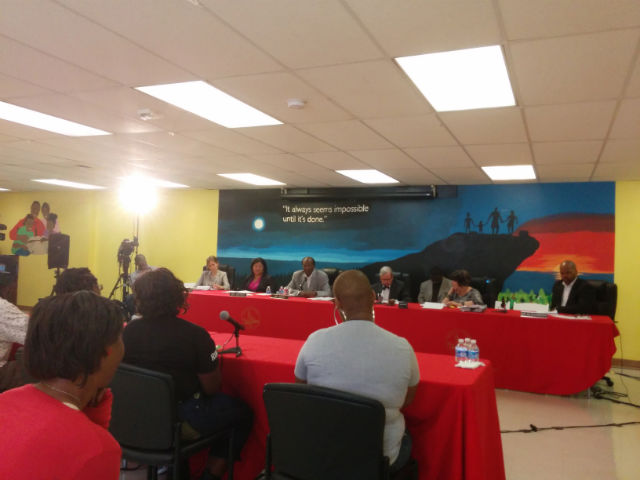
 Photo by Sarah Anne Hughes.
The District of Columbia released a plan today to replace the city’s aging family homeless shelter with smaller community-based shelters, with the closure of D.C. General occurring as soon as fall 2015.
But at a hearing held at D.C. General today on a resolution to close the shelter, Councilmember Jim Graham, head of the Human Services committee, first said he had not seen the report, released to the public about one hour before the hearing began, and later said he did not believe it could be achieved by next winter.
After asking a witness from the Washington Legal Clinic for the Homeless, who had only seen the report an hour earlier, to brief him on its contents, Graham asked “What kind of behavior is this?” to a Department of Human Services representative who told him a hard copy was being printed for him.
Once he reviewed it, Graham flatly said that he didn’t think the plan would accomplish its goal by 2015.
The report presents two options for one-to-one replacement of the building’s 288 units: Leasing or buying six buildings with 40 and 50 units, or leasing and buying a combination of buildings with between 40 and 50 units, and 60 to 100 units.
To lease sites, the annual operating cost for 40-unit buildings is estimated at $23.556 million and $24.996 million for 50-unit buildings. To replace the units with D.C.-owned property, the city estimates a one-time cost of $48 million and an annual operating budget of $18.266 million a year to operate the six buildings.
A solicitation to private developers seeking buildings to lease went out on September 26. The solicitations will be open until DHS has enough units to replace D.C. General’s capacity.
Brian Hanlon, director of the Department of General Services, said at the Council roundtable today the operating costs in the report are “conservative figures” that will depend upon market reaction. Leased options are preferable, he said, as it will take less time to get them ready for families.
The feasibility of the plan, which depends upon the availability of millions in capital dollars, was called into question by Graham.
“We have to build a schedule based on something. We cannot predict how and when the market will respond,” Hanlon said. When pressed by Graham, he said 180 to 240 units would be ready by September 2015. “I’m just guessing. I don’t know.”
“We need all eight Wards to participate,” Hanlon continued, adding that city agencies need to “link arms” to achieve the plan’s goals. “Communities will thrive with these types of units in them,” he said, later admitting, “The NIMBYs are gonna come out of the woodwork.”
The lack of a concrete plan to re-program the between $18 to $22 million Hanlon, when pressed, estimated is needed this year to replace D.C. General units also left Graham with concerns.
Based on his experience with the D.C. government, Graham said he doubted the plan could be accomplished, especially with a change in administration’s coming in January.
In the near-term, D.C. General is expected to be at-capacity again this winter, with no funding provided for overflow sheltering in hotels and 40 fewer units because of a court ruling. “Wait until hypothermia season begins next month,” Graham said. “The numbers will go up and up and up.”
There are 135 families currently at D.C. General., including 38 families who moved recently from hotels. Sixty-five were anticipated to move, but only 45 did, some to other housing, according to Michelle Williams from the Department of Human Services.
Graham read from the letter that informed families of their impending move, faulting it for the matter-of-fact language used.
“We’re not talking about animals here. We’re not talking about cattle,” Graham said. “We’re talking about people.”
Eighty-five families are still at hotels. With no budget provided for homeless families to stay in hotels for fiscal year 2015, which began in October, money from TANF is being used. “I have no idea how much money there will be to draw upon,” Williams said of the current fiscal year.
Marta Beresin, a staff attorney at the Washington Legal Clinic for the Homeless, testified that D.C. General will be filled up again this winter. “We’ll have to rely on motel rooms,” which Beresin posited would be paid for by DHS with re-programed funds from other areas.
Beresin said the city’s policy to not provide shelter for families year-round causes at least some of the onslaught of families looking for shelter in November. As one of the goal’s from the city’s D.C. General closure plan calls for, Beresin said D.C. should have “adequate shelter capacity” and “adequate housing placement rates” year-round.
The mayor’s 500 Families, 100 Days program, launched on April 1, identified 459 units that passed inspection and housed 198 families by the deadline. As of yesterday, 827 units were identified, 656 passed inspection and 382 families had been housed. The majority of the families were housed through rapid re-housing, but also through permanent supportive housing.
There’s $10 million budgeted for rapid rehousing in fiscal year 2015, while $20 million was spent in fiscal year 2014, according to Williams.
“If you connect these dots, there seems to be a looming crisis,” Graham said of the lack of money for hotels rooms in this budget year.
“It’s my hope that we don’t have to fill up D.C. General because of our preventive measures,” Williams said, adding that DHS is ramping up its effort to connect families with services before they are in crisis. “That should reduce our shelter intake.”
But when asked if she believes D.C. General will be full this winter, Williams said “yes.” As for where the city will put them, she said, “I’m going to look for the best possible overflow options for families.”