By DCist contributor Caroline Baxter
Welcome to a new column, one that amplifies an otherwise unheard music voice — classical music. No, no, don’t turn the dial! Don’t close the tab! Classical music is the bedrock on which modern music has been built. No Mozart, no Magnetic Fields; no Bartok, no Brubeck. We want to explore why that is. This column will highlight an upcoming concert at the Kennedy Center, National Cathedral or other venue, and give you some context for the performance. It will also feature what to listen for if (when!) you decide to go and hear it.
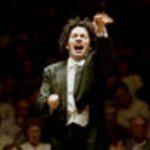
 Photo by Kevin Harber
What: The Reformation Symphony — Felix Mendelssohn, Symphony No. 5 In D Major, Op. 107
Where: Kennedy Center, October 30 to November 1, 2014. Tickets $10 and up.
Who: The National Symphony Orchestra with conductor Christoph Eschenbach.
A note from the author: Many years ago, when my parents were dating and my dad was in a semi-professional choir, my mom took some friends of hers to see his choir perform the Bach B-Minor Mass at Carnegie Hall. At one point, one of her friends whispered, “When’s the good part?” Mom shared this story with my dad after the concert, to which he frostily replied, “It’s all ‘the good part.”
That exchange is the basis for this column. Classical music can be tough. It has a reputation for being long, dense, and maybe a little pointless. Sometimes it merits the stigma, but not often. Nevertheless, if you don’t know much about classical music, but you know you like some of it, it can be daunting to find out more.
Also, for those of you who are unclear on various musical terms, Naxos provides an excellent glossary:
Quick Facts
Mendelssohn dates: 1809 to 1847
Composition date: 1830
Length: ~30 minutes
Mendelssohn nationality: German
Other works: “A Midsummer Night’s Dream,” “The Hebrides Overture”
You’ll like this if you like music that’s: melodic, emotional, dramatic, cathartic
Mendelssohn was born to a Jewish family, but his father converted and baptized the family into the Lutheran faith in 1816 when Mendelssohn was seven-years-old. He spent the rest of his life as a devout Protestant.
It’s worth pausing for a second to review the specifics of the Protestant Reformation (its influence will be obvious later). The Reformation, spearheaded in Germany by Martin Luther, argued that there should be no earthly intermediary between an individual and God — that people have a right to a direct and private relationship with God. This caused centuries of violent upheaval throughout Europe and around the world and permanently altered global politics. Through minimizing the role of the church and translating the Bible from Latin, which only the elite understood, into the vernacular, the Reformation empowered the individual. One of the capstone documents of this movement was the Augsberg Confession, written in 1530.
Mendelssohn wrote this symphony in celebration of the document’s 300th anniversary. The format Mendelssohn chose to celebrate this occurrence is itself Protestant in nature. Its four movements run a fairly restricted emotional gamut, from stern and stately, to joyful yet restrained. Even more demonstrative still is Mendelssohn’s decision to base the final movement, usually the triumphant coda of a symphony, on the hymn Luther himself wrote, “A Mighty Fortress is Our God.” Importantly, he did not make it a choral movement. Without lyrics, the listener has an authentic reaction to the music, not at all unlike the Protestant idea that an individual has the right to have a personal, direct relationship with God without interference.
What you’re hearing, and what to listen for
The first movement opens slowly, built by the strings and topped off by the woodwinds and brass. It is a purposeful beginning It sounds like a ship coming out the fog or the curtain rising on a stage. About a minute into the first movement, a series of horn pulses heralds an upcoming change, and the hopeful-sounding beginning shifts into minor key. Sure enough, the rest of the first movement is stern, turbulent, and fearful, with the strings throws into a even more turgid, chaotic series of runs and arpeggios. The first movement’s intensity alludes to the Reformation’s troubled beginnings.
The second begins almost as if the first had never happened. This is a classic Mendelssohn movement; it’s a light-hearted, buoyant waltz. Listen to the opening of “Midsummer Night’s Dream,” or the first movement of the Italian Symphony.
The third movement is the darkest. It is saturated with anxiety and regret. It’s also the shortest movement in the entire symphony, clocking in around three minutes depending on the conductor’s tempo. It also has the greatest emphasis on melody of the first three movements, with the entire string section playing one line. The melody is a solitary voice, alone in the wilderness, until a solo flute, way up high, offers the reassurance that the thee melody isn’t alone after all.
Guess who is believed to have played the flue throughout his life? Martin Luther.
That solo flute gets pride of place at the beginning of the final movement playing the first few notes of the melody of Luther’s hymn. Soon the flute is joined by the whole woodwind section, and then strings fill out the melody until it blossoms. The first eight notes are repeated by various groups of instruments until the culminating minute. Throughout much of this movement, the strings return to the turbulence of the first movement, reminding the listener of the difficult path trod to reach this triumphant conclusion.
In about thirty minutes, you’ve taken a musical journey through the history of the Reformation, through the eyes of one of Western music’s major composers. Not bad for an evening out.