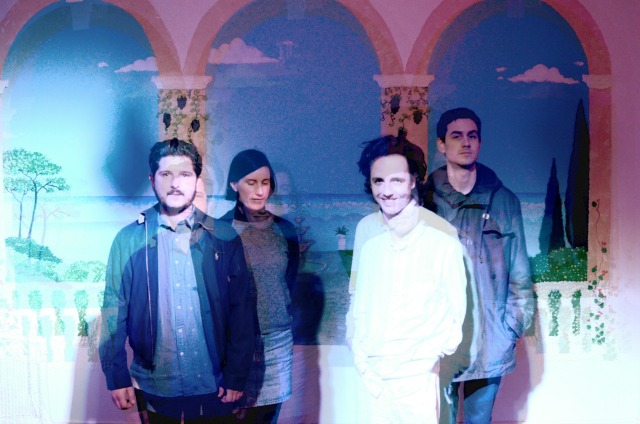
 Photo by Patrick Leonard O’Brien
The music of Australian quartet Twerps is proof that cheerful-sounding music doesn’t have to come from a cheerful place. There’s definitely some melancholic tracks on the recently release Range Anxiety, but there’s also angular pop gems that coat frustration and heartbreak in sugar to make them easier to swallow. It’s an old twee trick, but Twerps’ music doesn’t feel soft, even at its most pleasant moments. If twee bands listened to more Unrest and The Clean, they’d probably come out with songs that sounded more like “Conditional Report” and “Heavy Hands”—and the music world would be better for it.
Twerps will play DC9 on Sunday night with Ultimate Painting and Expert Alterations. We talked with Twerps’ singer/guitarist Julia McFarlane about the effect that new band members have had on their music and touring with Belle & Sebastian.
DCist: So this is not your first time in the States?
Julia McFarlane: It’s our fourth. We’ve been here three other times. Our last time here was about two-and-a-half years ago. So it’s been awhile since we’ve been here and we’re really quite pumped to land on your shores.
DCist: Is there anything specifically that you’re looking forward to doing while you’re here?
JM: I think I’m most excited about the driving and kind of ending up in small towns. I know, that’s such a cliche. But as much as New York is really fun and I’m having a cool time here, it doesn’t feel real to me, if you know what I mean. I suppose ‘cause we’re on holiday and that’s not real life. We’re not going to a job—I guess we are sort of doing a job but I’m really excited about getting in the van and starting the tour and going to places like Minneapolis and D.C. At the moment, we’ve got a couple of days off before everything starts. I enjoy the drive. We don’t have any internal fights because we want to see the country.
DCist: I know you’ve got two newer members of the band. What has the transition been like?
JM: Really easy. Well, Alex [MacFarlane, drummer] has been playing in the band for two years now. So it doesn’t feel that new. It still feels a little bit new. But Gus [Lord] is our new bass player and he was subbed in for Rick [Milovanovic], who has played bass for us for about six years—from the beginning. Rick was advocating very highly for Gus to be his replacement, which we were really kind of happy that he was doing that. Also, Gus is a good friend of ours and he plays in a band with Alex called The Stevens. But they already play in a band together—Alex and Gus—and they’ve been friends since they were like, babies. So, it’s been very easy and it kind of feels normal. Gus has only played a handful of shows with us, but it feels like he’s part of the family. A very long-winded answer, but, how is it going? It’s going very well!
DCist: Is this your first time headed through SXSW?
JM: We’ve done that twice before and this time we decided to keep it pretty chill. I think we’re playing six shows. It could be much less or it could be a couple more but compared to other times it’s going to be very chill—a couple of shows, max, per day and maybe only one a day on one of them. We’ve got the Panache Party which is always fun. We love Michelle [Cable, owner of Panache Booking] and she puts on a good party so we’re pretty excited about that one. Are they official SXSW events? I don’t think they are.
DCist: I don’t think so?
JM: It doesn’t really matter. To be honest, I don’t get SXSW. I don’t really understand. I get it on an immediate level—we go there, we play shows and it’s fun. But I can’t say that I really understand the kind of administrative side of things and what’s official and what’s not and what’s the aspirational point of it all. But I’m super psyched to do the shows.
DCist: How does songwriting work in a group where there are two of you singing? Do you write songs separately and bring them to each other or do you two tend to work together?
JM: Marty [Frawley] and I tend to not work together at home. It’s kind of funny. I think for a couple of years I tried to push it, like, “Why can’t we just jam at home, Marty?” We’ve been together, we understand each other really well, but for some reason we always fight when we work on songs at home. So we do it kind of very independently from each other and then just bring them to everybody at rehearsal. That’s kind of just the way it works. Marty and I both operate on a pretty intuitive level with our songwriting and I think we only really write songs when we’re bummed out or frustrated about something.
DCist: I feel like that was suggested a bit by the album title, Range Anxiety. Is that where that title ultimately came from? From being frustrated and bummed out?
JM: I guess it fit. It definitely felt like it fit when it was suggested and we all thought it was funny too. Specifically, it describes a clinically recognized phobia or something that an elderly person has about worrying if their scooter has enough battery life to get back from the shop. So, I think it’s used in that way these days, but it applies to a broader and more general idea about running out of gas. I think it’s pretty descriptive. I think it’s autobiographical about the creative process. It’s self-conscious, I guess.
DCist: I had read that the songs on Range Anxiety are actually a little older than the songs on Underlay. Does it feel weird to regularly play songs that you’ve been sitting on for awhile?
JM: For some of these shows maybe we’ll chuck in one more from Range Anxiety. On our shows we’ll always want to have a couple of brand new ones in the set, we’ll always play a couple off our very first release. It’s kind of a mix of things, so it doesn’t feel like we’re—we’ll always have a few from everything in the set anyway and it’s not wholly about Range Anxiety. The main thing is that it feels a little bit weird talking about Range Anxiety as if it’s our newest thing. Like, I’m really super-proud of that album and it’s really a document of us at a certain time where we were going through lineup changes and trying to sort of figure out the new way of operating in the band. So I think it’s a good documentation of that. But yeah, we have newer material for sure. [Range Anxiety] is not necessarily descriptive of where we’re at now. So yeah, sometimes it feels weird discussing it because what’s more on my mind is Underlay or where we go from there.
DCist: Do you have newer songs in addition to the Underlay tracks that you’re playing live?
JM: We’ve got a couple of new songs. I’ve got a new one and Marty’s got a new one. So yeah, there will be two brand new ones.
DCist: How are those a progression from both Range Anxiety and Underlay?
JM: With the addition of Gus, we’re again trying to figure out what kind of band we are, which is something I enjoy. I think that’s why having new members has been really good for us. There’s a new style of playing and with that, I play differently. Hypothetically, let’s just say Gus is a stronger bass player than Rick, only in a virtuosic sense, not creatively or whatever. Maybe he’s technically more skilled or something like that. My guitar playing might get a bit more relaxed. I can fuck around a bit more. We’re still kind of trying to figure that out, but my new song is focusing on layering. I’m into kind of it being a bit sparser with everyone focusing on when they’re not playing and what they’re not doing rather than what they are. I suppose it’s a bit more minimal with an interest in writing a hook.
Sorry, it’s kind of hard to use words to talk about music. I find that hard sometimes. Maybe I need to work on my barbecue version a little better. I just stumble on my words. Even people being like, “How would you describe your sound?” To me, I don’t even know what to say to that. I guess guitar pop is a good way to put it, but I don’t know. It depends on who you’re talking to.
DCist: How has it been working with Merge Records?
JM: Really excellent. They seem like super nice people and like they’re from the same field of understanding as what Chapter Music are. Chapter is our label in Australia, who we’re all quite close with I guess. We all sort of live out of each other’s pockets a little bit, maybe because they’re a smaller label that we were with before we did label stuff. So, I kind of look at Merge as a natural extension. We feel like they’re like us. Fairly often, they seem pretty relaxed about things but they also seem creatively focused as well.
DCist: How was touring with Belle & Sebastian?
JM: It was really good. They were so lovely. I have this hang up about conversing with people who have that kind of fame. It always feels pointless and forgettable for everybody involved. For that reason, I was managing my expecatations. But I was very surprised, it was really easy and they were all super generous with their time. They seemed to pay attention to what we were doing which was really nice. They were really fun to watch. They play quite a range from their entire career and just have their live show down pat. It’s so impressive—including the banter and everything, it’s just a kind of impressive mechanism, the whole thing. They’ve got a massive team. It’s a massive crew that tours. But yeah, it was really fun and I think their audiences were something that I appreciated specifically on that tour—very kind, attentive audience who were focusing on us as well, which was very nice. I loved hearing hits like “Boy With the Arab Strap” and stuff like that so it was really fun.