 Photo by Travis Mitchell
By DCist Contributor Travis Mitchell
Most of the time, describing something as bitter is not a compliment. In the cocktail world, at least, that’s changing.
Bartenders are increasingly using bitter spirits and liqueurs to craft drinks with complex flavors. And that doesn’t just mean they are shaking a few extra drops of bitters into drinks.
There are many types of bitter liqueurs and spirits, but Italian amaro is one variety having a moment in D.C. Restaurants and bars are making it a point to incorporate amari in cocktails, and that is likely to lead to some questions about what flavors and brands to expect.
Taken from the Italian word for bitter, an amaro is an Italian liqueur made from a mixture of earthy ingredients like herbs, roots, flowers and bark. Amari range in flavors depending on the recipe. They are traditionally enjoyed as apertifs or digestives with meals, either taken straight or with a bit of juice or soda water. Even better, they can be used to create fabulous cocktails.
Here’s a basic primer to help drinkers better understand cocktail menus around D.C.
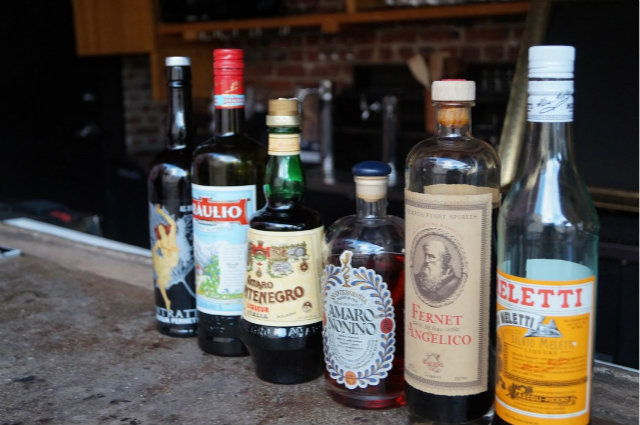
Averna: One of the more frequently encountered amaros, it’s fairly sweet and has a thicker consistency. Averna’s herbal flavor profile makes it a versatile liqueur, and it’s often enjoyed on its own or in a cocktail.
Braulio: This amaro has only recently become available in the U.S. It has one of the better balances of bitter and sweet, with a touch of minty afternotes. It’s aged in oak barrels for two years before being bottled at 42 proof.
Campari: This amaro is citrusy and very bitter, lacking the subtleties and herbal elements of other brands. It’s most commonly used in the negroni. It’s 48 proof in the U.S.
Cynar: Pronounced “chee-nar”, this amaro is made from artichokes. It’s dark in color, syrupy and quite bitter. It’s only 33 proof, but it’s heavier than most amaros and not recommended as a straight drink.
Fernet-Branca: Arguably the most popular brand of fernet. It has a subtle floral taste and prominent notes of mint and black licorice. It’s commonly enjoyed as an after dinner digestive or in cocktails. It packs a bit of a punch at 80 proof.
Montenegro: This amaro is beginning to find it’s way into bars around D.C, and for good reason. It’s sweeter than the average amaro, and it has nice flavors of orange and spices. At only 46 proof, Montenegro is easy drinking at 46 proof.
So, where can I try these?
Start with something basic like a negroni (gin, vermouth, amaro) or a boulevardier (rye whiskey, vermouth and amaro).
The extensive menu at Copycat Co. (1110 H St., NE) includes an entire section dedicated to bitter drinks of all kinds. One of the most bitter cocktails is a pairing of Cynar and bitters. And the 3 bitters cocktail #2 is made with Averna, Montenegro amaro and Aperol.
Another option is Vinoteca (1940 11th St, NW), which carries a variety of Italian amari, some of which are hard to find elsewhere. Head to the back patio once the weather warms up to enjoy a refreshing amaro and soda or one of bartender Horus Alvarez’s creative cocktails.
The cozy speakeasy Dram & Grain (2007 18th St, NW) is likely to have some interesting bitter liqueurs on its shelf. Browse the standard cocktail menu along with the frequently changing list of specials. You can also ask one of the bartenders to whip up something amaro-based.