 Rachel Sadon
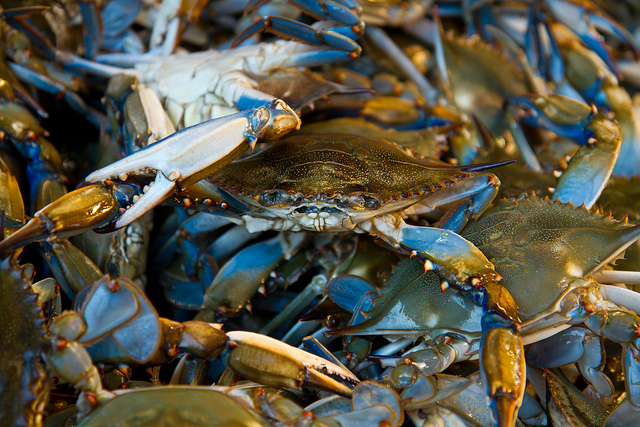 Photo by Keviikev
So, you thought that crab cake was from Maryland. Of course, you did, it says it on the menu. Your server told you it was during his four-minute monologue about the restaurant’s home-brewed, smoked, aged-for-three months version of Old Bay.
Well, Oceana is here to burst your bubble again (in a study last year, they found that 33% of shrimp products in D.C. were mislabeled or didn’t include shrimp at all).
The environmental advocacy group spent last year’s crab season going around to restaurants in D.C. and Maryland to test their claims that the star ingredient in the crab cakes was actually from the Chesapeake Bay. Around the region, they found that 38 percent weren’t.
And Oceana only tested crab cakes that were explicitly labeled on a menu as “local,” “Maryland,” or “blue crab,” or if a server said they were. Unlabeled or “Maryland-style” crab cakes weren’t tested, since they could conceivably just be referring to the seasoning.
Apparently the problem is worst in the capital of a state that has a “state crustacean” (yes, it is the Blue Crab). In Annapolis, 47 percent of the samples the group tested were mislabeled. That compares to 46 percent in Baltimore, 39 percent in D.C., 38 percent in Ocean City, and 9 percent on Maryland’s Eastern Shore.
“It’s disappointing to see that so many restaurants weren’t truthful but its not really surprising,” said Steve Vilnit, the fisheries marketing director at the Maryland Department of Natural Resources. “Maryland can’t produce enough crabmeat, and imported meat is a necessity. But they should be honest about it.”
The study was apparently inspired by a 2012 article in the Washington City Paper on the origins of the main ingredient in the “Maryland crab cakes” at local restaurants.
As Jessica Sidman noted at the time:
More than 43 million pounds of crab meat are imported into Maryland each year, but the Maryland crab meat industry only produces about 700,000 pounds. That means less than 2 percent is from Maryland. The rest is shipped in from Venezuela, China, Vietnam, the Philippines, Indonesia, Mexico, and the Gulf Coast.
So do diners need to turn into a Portlandia sketch to find out anything about where that crab cake is actually from?
One alternative is to look out for the 200 or so businesses that are a part of Maryland’s True Blue program, a voluntary labeling initiative run by the state.
Restaurants and caterers submit their invoices to the Maryland Department of Natural Resource, which audits them a couple of times a year to make sure they are actually buying local crabmeat.
“The important thing is there is integrity in the supply chain” Vilnit said. That way, “consumers can vote with their fork about which crab they want.”
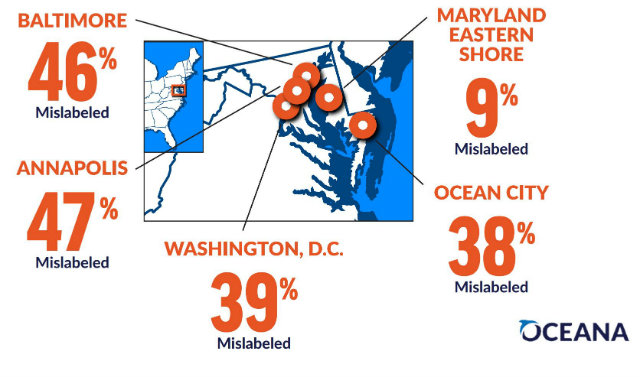 Courtesy of Oceana.