 Rachel Sadon
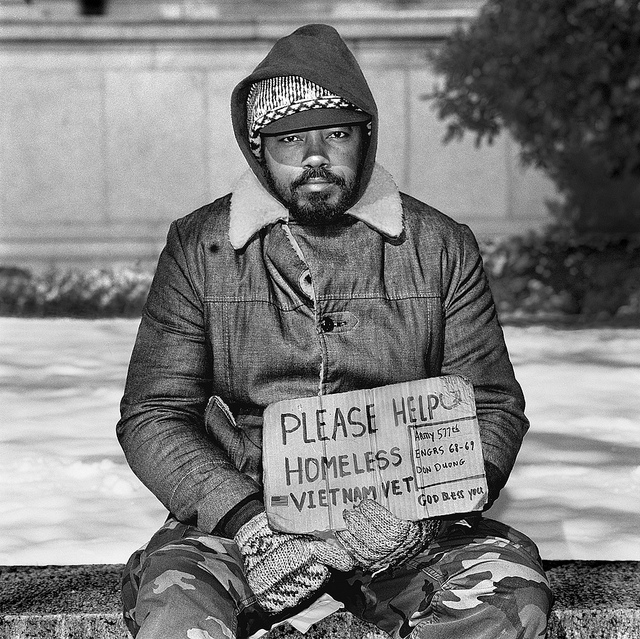 Photo by Gerald L. Campbell.
The number of homeless people in the District decreased by 6 percent between 2014 and 2015, according to the annual point-in-time count. It is a bright spot in a seemingly relentless stream of grim news for a city struggling to care for its most vulnerable population.
But even with that modest improvement, the District’s homeless population is still up by 11 percent from 2011. And family homelessness in D.C. is still up by 29 percent from four years ago.
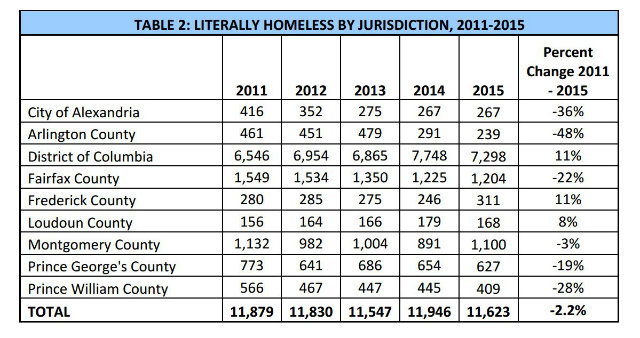
The annual survey took place on January 28, when staffers and volunteers searched the city and neighboring jurisdictions (Alexandria, Arlington County, Fairfax County, Frederick County, Loudoun County, Montgomery County, Prince George’s County and Prince William County) to take count of the people out on the streets, as well as those that had taken refuge in shelters. The results, released by the Metropolitan Council of Governments today, measured a total homeless population of 11,623—29 percent of whom are children.
Across the region, homelessness is down 2.7 percent, with Arlington County marking a significant decrease. The report attributed factors like “the region’s increased supply of permanent supportive housing, increased use of rapid re‐housing, and homeless prevention and diversion efforts” for the overall decline. Montgomery and Frederick county, however, each saw increases of more than 20 percent.
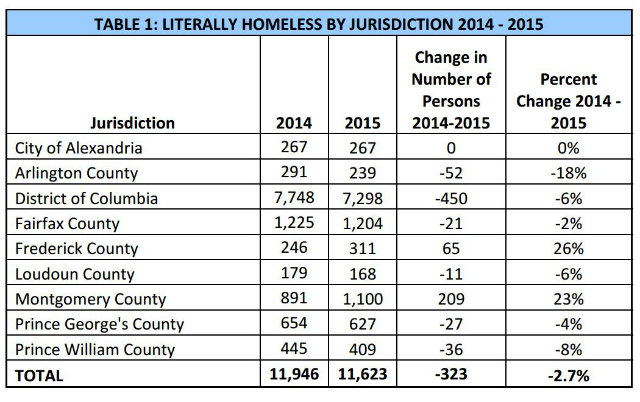
As in past years, the majority of the region’s homeless population are in D.C., where 11.1 out of every 1,000 residents are homeless.
Efforts to decrease chronic homelessness, defined as “as an unaccompanied adult with a disabling condition who has either been continuously homeless for a year or more or has had at least four episodes of homelessness in the past three years,” have seen particular success. D.C.’s chronic homeless population has fallen from 2,093 in 2011 to 1,593 in 2015, a drop of 24 percent. Across the region, chronic homelessness has fallen by 31 percent in the past four years.
Despite the improvements, the report’s authors warn that the region’s high housing costs and lack of affordable housing will be a major challenge in their efforts to end homelessness.
“Increases in the region’s already‐high rents make it very difficult for extremely low income households to find or maintain housing that they can afford. In addition, wages have not increased to keep pace with the rising cost of housing. A shortage of living wage jobs compounds the difficulty in finding and maintaining affordable housing. Federal spending cuts due to sequestration enacted in 2013 have frozen or reduced the availability of Housing Choice Vouchers throughout the region.
A lack of affordable, permanent housing opportunities remains the most significant and persistent obstacle to ending homelessness in our region.”
Nearly 40 percent of adults in homeless families, and 20 percent of single adults, are employed, according to the survey.
And, as in past years, the study doesn’t count people who don’t have a home but are staying with friends or family. “Homelessness is often the next step for such households once the family members or friends who have been sheltering them can or no longer will do so,” the authors write, adding that service providers are worried many more residents are at risk of experiencing homelessness due to “the high housing cost burden and
reduced affordable housing options.”