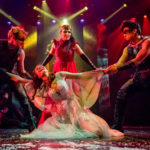
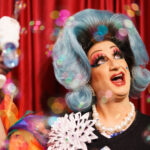
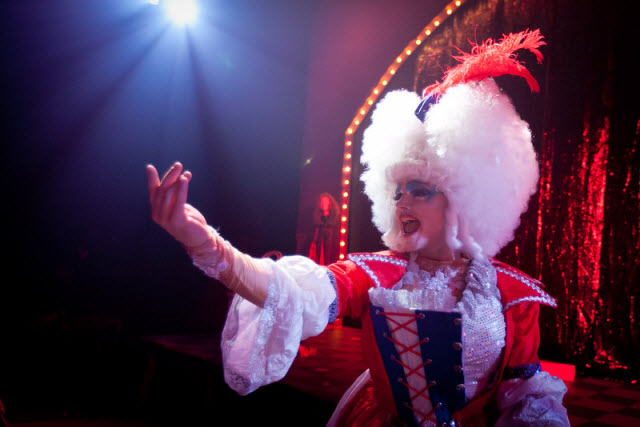
 Alex Mills as his character Jerry’s Drag persona, Betty-May. Photo: Koko Lanham.
By DCist Contributor Anya van Wagtendonk
Kendra Rai had no idea there were so many rules to being a drag queen.
The veteran D.C. costume designer has produced costumes for Shakespeare plays, fairy tales, and classics from around the world. She won a Helen Hayes award for her work on The Green Bird, an 18th century Italian commedia dell’arte.
But when she was tapped to design A Tale of Two Cities, opening May 13 at Synetic Theater in Crystal City, Va., she faced a host of cultural norms she had never encountered. For example: what does a drag queen wear around the house in the middle of the afternoon?
If you’re scratching your head trying to remember at what point the drag queens show up in Charles Dickens’ French Revolution epic—well, this isn’t your 10th grade English class’s Tale.
Adapted by Everett Quinton, an actor, writer, and drag performer long affiliated with New York’s Ridiculous Theatrical Company (think downtown, East Village camp, a la Rocky Horror Picture Show), the Two Cities playing at Synetic is actually a one-man show. Jerry, a hairdresser by day and drag performer by night, played by Synetic company member Alex Mills, finds a crying baby at his doorstep. To keep the child quiet, he acts out the entire Dickens saga, playing every single character—wigs and all.
The wigs posed some of the first challenges for Rai, who was tasked with assembling over 100 costume pieces for all of Mills’ quick changes. Having watched her fair share of RuPaul’s Drag Race, Rai knew: “The big thing is, you cannot lose your wig.”
“If you lose your wig on RuPaul, you can lip sync for your life,” she laughed. “But you’ll pretty much be the one that’s sent to go home.”
Mills, a gymnast, tested that first rule of drag a few times as he flipped and spun around the stage. But the wigs stayed on—even the two-foot-high showstopper that closes the play. Next, Rai stuck him in some six-inch heels. She assumed he’d be able to take them off for some of the crazier stunts.
She says her assistant Allan Samanek*, a performer and coach in the D.C. drag scene, was horrified. Losing your shoes is, Rai learned, considered tacky at best.
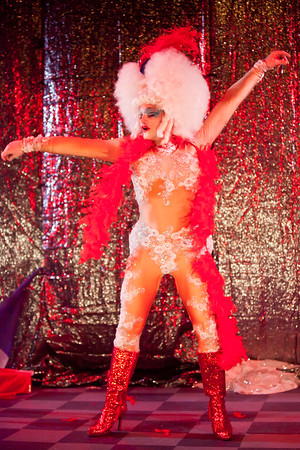 Photo: Koko Lanham.
“I said, ‘You know he’s going to be flipping,’” Rai recalled, “and Allan said, ‘Oh yeah, one of my queens does that, so don’t worry, it can happen.’”
When Quinton first adapted the show in the 1980s, drag and other gender-bending performances were more subversive than they are now, said Serge Seiden, the play’s director. He stage managed a production of Two Cities at Studio Theatre in 1991.
“In those days, when Studio did it, it was the kind of thing where some people were offended,” Seiden remembers. “They couldn’t really observe the play, because the idea of a guy in bra and underpants was too upsetting.”
These days, though, RuPaul’s Drag Race is in its eighth season on TV, and Hedwig and the Angry Inch —a rock musical about a German gender-bending performer—is on Broadway. Shows like Transparent help establish a baseline vocabulary for gender issues, so that even your mother knows: “transgender” is different than “transvestite,” which is different than “drag.”
In some ways, says Seiden, this means that some of the more transgressive elements of the play—the 1980s politics of “This is me, get used to me,” as Seiden puts it—are not as charged as they once were. Instead, the political is more personal, more subtle. The audience watches Mills’ Jerry transform into different characters. They watch his ritual of applying makeup, of adjusting his straps, of becoming his drag persona.
“I think he does challenge the audience to see him, to really look,” said Seiden. “It’s not that he says it in a direct way, but the way in which that activity happens on stage, there’s a lot implied.”
Present, too, is the enduring value of Dickens’ foundational text. Even for those who never read (or completely forgot) the original novel, underlying themes of being an outsider and the search for redemption shine through Jerry’s interpretation. The epithet émigré, for example—“immigrant”—can easily stand in for a gay slur, and protagonist Sydney Carton’s ultimate sacrifice mirrors Jerry’s final, no-holds-barred, two-foot-wig-required drag performance.
With its radical edge now largely stripped away, Seiden said, audiences will focus on the core pleasures of the play. Watching Mills run and leap about the stage, changing characters as readily as he changes costumes, is “a wonderful theatrical pleasure that you only get at the theater.”
“It’s like the circus,” he added. “It’s just shock and awe.”
When Rai began mapping out her costume designs, she kept one piece of Seiden’s advice in mind: Jerry isn’t acting out the Dickens novel so much as its 1935 classic film adaptation. Old Hollywood has long inspired drag performances, and the melodrama and pathos of that version appeals to a campy sensibility, Seiden said.
But Rai was glad that, in a modern interpretation, that campy style didn’t have to be the central focus.
“Of course we have the camp, of course we have the fun, that’s definitely part of it,” she said, “But I also didn’t want to go too far, where it was just so silly that we’d almost be making fun of it.”
Rai* added her own rule to the list: remember that, underneath the layered dresses, the wigs, and the towering heels, “it’s a real person.”
A Tale of Two Cities opens tonight at Synetic Theatre. Tickets are available here—including the new “single” ticket option Synetic is rolling out starting with this show.
*Names have been corrected