

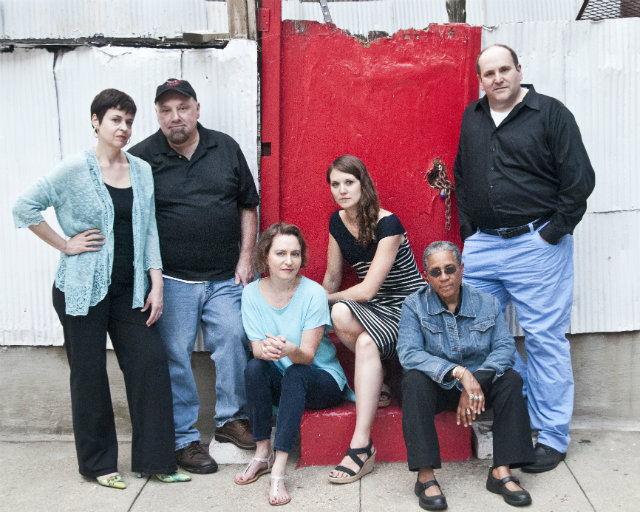
 Photo by Teresa Castracane/via The Welders.
By DCist Contributor Anya van Wagtendonk
There are all kinds of reasons for a D.C. resident to invest in a community-supported agriculture program, or CSA. There’s the immediate, tangible reward: a weekly delivery of delicious food. There’s the financial act of buying into a small business’s production cycle and supporting your local economy. And there’s the personal opportunity to express a specific set of social and political values, to improve your health, and to contribute to the vibrancy of your planet.
The Welders, a D.C.-based playwright collective, want to harness all those reasons for supporting your local nonprofit — but replace the ‘A’ in CSA with art.
Starting with their upcoming production of happiness (and other reasons to die) by Welders member Bob Bartlett, which begins previews today at the Atlas Theatre, community members are invited to buy a “share” of the production. The Welders hope this project empowers local art lovers of all backgrounds to sustain and maintain theater, born and bred right here in the District.
“We’re only made possible from the support of our community, who believe in what we do,” said Jojo Ruf, the group’s Executive and Creative Director.
What the Welders “do” is fairly simple. Besides Ruf, a dramaturg by training, the other five founding members are all local playwrights. Over the course of three years, the writers—Bartlett, Renee Calarco, Allyson Currin, Caleen Sinnette Jennings, and Gwydion Suilebhan—each receive six months at the helm as Artistic Director, during which time they can mount any original work, employing the actors, directors, and designers they want.
In this way, Ruf says, the playwright sits at the center of the development process for new works of theater. An artistic CSA then becomes a means of linking the work, and by extension, the writer, directly to its audience.
“We want to have … more of a direct relationship with the people who support us,” said Suilebhan, the Welders member who often handles marketing and development, and helped launch the CSA. “We’re trying to close the distance between artist and audience.”
This fundraising approach is similar to “crowdsourcing” platforms like Kickstarter and Indiegogo. They allow fans to come together and chip in a little bit toward a creative project; in exchange, they receive exclusive content. For $25 a share, participants in the Welders’ CSA gain access to special events, such as open rehearsals or post-show conversations with the creative team.
But Suilebhan believes the benefits for theatergoers go beyond the tangible perks.
“There’s also the foster benefit of being able to say, ‘I helped make this, I own a piece of this, I’ve invested what I have to give’.”
“All too often, theater is funded and supported by a small number of large-scale donors or foundations,” he went on. “We wanted to be more ‘of the people and for the people,’ which meant creating a low entry point but still meaningful and resonant way for people in our community to support us.”
Such a localized fundraising system seems a natural fit for a collective dedicated specifically to D.C. artists, who may not receive the kind of instant support from regional theater companies that writers coming from major hubs in New York or London do. That’s a paradigm that Bartlett, the current AD in rotation, more or less accepted as a given after he received his MFA in playwriting from Catholic University. To be taken seriously in his own hometown, he thought that he would first have to leave and produce works elsewhere.
“My goal was not to be produced in D.C., my goal was to be produced someplace else, so D.C. might finally take an interest in me,” he said, chuckling at the irony.
By offering writers space and resources close to home, collectives offer an antidote to that old model, giving playwrights control of their own creative process from start to finish.
When Bartlett first brought his script of happiness to rehearsal, he knew it was too long. In another context, he might have caused a bit of a panic, “because this isn’t a workshop, this is a production,” he said.
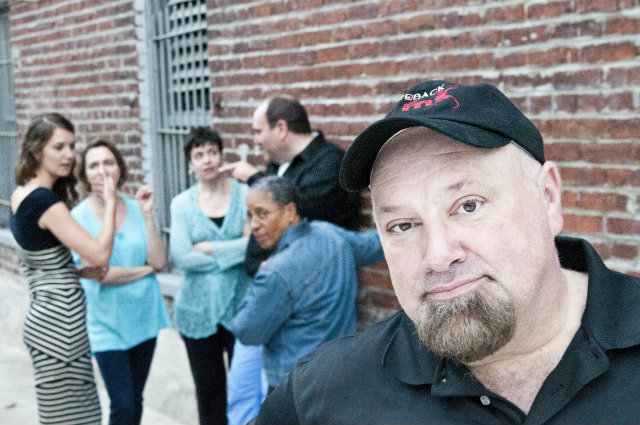 Photo by Teresa Castracane/via The Welders.
“But the actors who we hired, the people that we work with understand that this is playwright-driven work, and that we’re here to serve the playwright and ultimately the play, so it’s whatever the play needs. My play needed to cut 25 pages.”
The built-in support system of the collective model, too, is critical. By establishing a strong network of local writers, these groups fight against one of the hardest parts of being an artist: isolation. Getting a play to the point of production under traditional methods can involve months, if not years, of largely solitary labor; but the collective unites writers with one another for emotional and practical support.
“When I’m talking about problems with the play, or if I’m talking about blocks that I’m having, I’m talking to other writers,” Bartlett says. “We’re all speaking the same language. We’re speaking the language of a playwright.”
The Welders are one of a number of similar organizations that have sprung up across the country in recent years. There’s Orbiter 3 in Philadelphia; Workhaus Collective in Minneapolis; Boston Public Works; and Seattle Theatre Works, among others. Most are at least partly modeled after 13P, a New York-based collective that voluntarily ended in 2012, and many also plan to fold once each member has completed his or her work.
This is where the Welders diverge completely from their collectivist peers. Although the founding members will indeed depart after each has had his or her turn at the wheel, a new generation of Welders will take over. In a month, these new Welders’ identities will be announced, although they’ve already been chosen, said Suilebhan, and the behind-the-scenes transition—of everything from the website to the bank account—has begun.
It’s an unusual move for a nonprofit, perhaps, but one that mirrors the Welders’ reason for establishing their CSA — to help foster a strong, local arts economy built on give-and-take between artist and audience.
“We didn’t want to be as focused on ourselves,” Suilebhan says. “We wanted to focus on the future. For us, the Welders is a generosity play. It’s about giving stories to our community, [and] giving an infrastructure to future generations of playwrights. It’s about service.”


