 Rachel Sadon
 Courtesy of HAND.
Public transit riders have been admonished not to sexually harass fellow passengers, encouraged to wear condoms, and told of the dangers of synthetic weed. Now, a reminder that D.C. has an affordable housing crisis has been added to the mix.
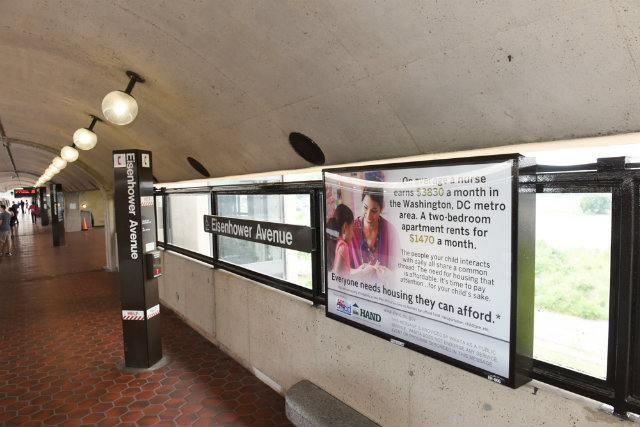
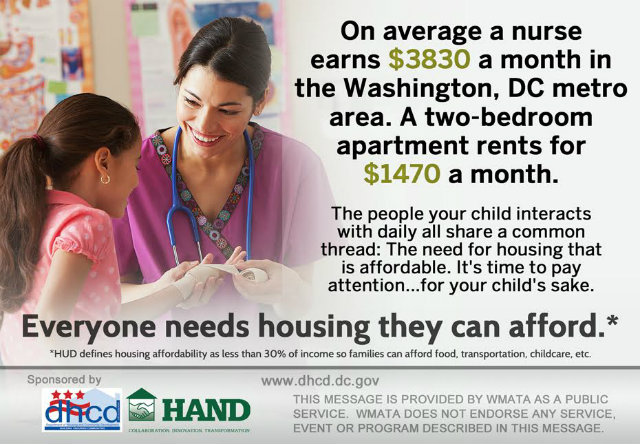
The latest public service announcement to grace the sides of buses and Metro stations comes courtesy of Housing Association of Nonprofit Developers (HAND), in partnership with the Department of Housing and Community Development. It features a nurse kindly bandaging up a child, and points out that the average nurse would have to pay nearly 40 percent of her salary to afford a two-bedroom in D.C.
“The goal is to get the word out. We wanted to change the perception of who actually needs affordable housing,” said HAND’s executive director, Heather Raspberry. “In this specific concept, it is a school nurse. Others include bus drivers or teachers—people who work every day in D.C. that can’t afford to live in this area without being housing-cost burdened.”
The ads also serve as a reminder that housing affordability is defined by the U.S Department of Housing and Urban Development as less than 30 percent of a family’s income.
The concept is meant to pull at the heartstrings by looking at people who are affected by high housing costs through the eyes of a child. HAND—a membership group for businesses, non-profits, and others working to increase the region’s supply of affordable housing—plans to put more ads up in the coming months through Metro’s PSA program.
As long as the non-profit teams up with a government agency (in this case DHCD) WMATA doesn’t charge them to place the adverts. Although Raspberry wouldn’t put a figure on how much the rest of the campaign cost to put together, she said it wasn’t much beyond the printing costs.
But isn’t the word about the housing crisis already out?
“The PSA is to show that this is still an issue and it needs to remain front and center, the same way that we prioritize education or transportation,” Raspberry said. “Affordable housing certainly has as much of an impact on the region’s economy.”
Raspberry said that the ads aren’t meant to advocate for any specific policy prescriptions. In fact, she said that HAND’s members and government officials are all hard at work on solving the problem. “We think that a lot of the jurisdictions are putting in place good policy,” she said. “The issue is more that the need still continues.”