 Rachel Sadon
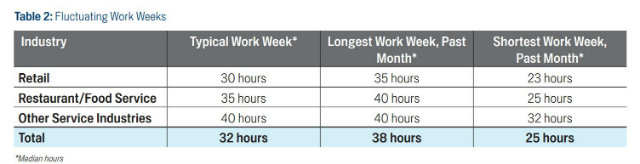 Via “Unpredictable, Unsustainable: The Impact of Employers’ Scheduling Practices in DC.”
Mirroring the national trend of a rise in unpredictable incomes and schedules, service sector workers in the District are struggling to make ends meet amid an unstable working environment.
According to a new report, the typical service employee works for a median hourly pay of $10.00 for 32 hours a week—earning an annual income of about $16,600. To reach those figures, the authors of “Unpredictable, Unsustainable: The Impact of Employers’ Scheduling Practices in DC,” surveyed 436 nonsupervisory hourly employees. The report was put out by DC Jobs with Justice, the DC Fiscal Policy Institute, and the Georgetown University Kalmanovitz Initiative for Labor and the Working Poor.
They also found that in a typical month, the typical worker’s schedule varied greatly—ranging from 25 to 38 hours.
And things are getting worse. In 2010, workers in the non-food retail sector had a 35 hour median workweek, according to data from an unpublished survey conducted by Georgetown University’s Kalmanovitz Institute for Labor and the Working Poor. In the 2015 survey, though, retail workers reported a median 30 hour work week (though wages did go up by about $0.11 when adjusted for inflation).
While it is commonly assumed that many of those positions are held by teenagers or college students, the median age for service workers is the same as D.C.’s average employment age across all sectors: 36. Workers in cleaning and maintenance tend to be older (median age: 47), while retail employees and food service employees tend to skew a bit younger (median ages of 34 and 31, respectively). About half of those workers said they receive their schedules less than a week in advance.
While about a fifth of the employees surveyed said they had been penalized for requesting a different schedule, the problem is worse for women. Women who asked for a different schedule or limited their availability were five times more likely to be threatened with losing their jobs as men and twice as likely to receive fewer hours, the report found.