 Rachel Sadon
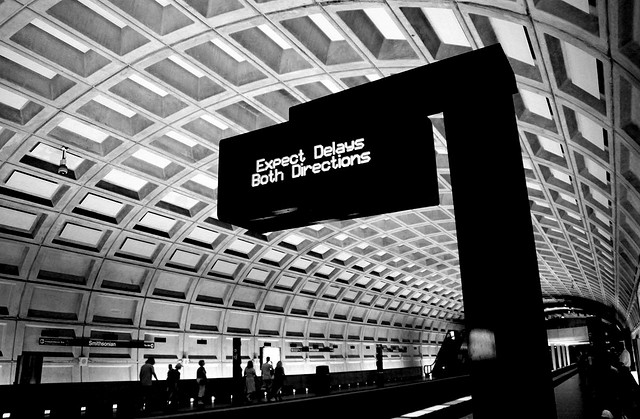 Photo by Barbara Krawcowicz.
Four Democratic Senators from Maryland and Virginia voiced their concerns about Metro this afternoon, and they held little back.
The overarching theme of the press conference was the safety culture at the transit agency, or the lack thereof. “Safety has to have a higher priority,” said Sen. Mark Warner (D-Va.) “I’m disappointed with the response since the L’Enfant incident. There are still some NTSB recommendations that have gone unfilled.”
Those remarks precede a major report due out tomorrow by the Federal Transit Authority.
The FTA’s analysis “is troubling in many ways,” said Sen. Benjamin Cardin (D-Md.) “It points out a gap between Metro’s own standards and what Metro is able to implement.”
And in the National Transportation Safety Board latest, densely worded report on the Metro smoke incident, there’s some clues as to what might have caused the electrical malfunction that lead to the death of one rider.
According to the Post, the NTSB’s latest report says that one of the most likely causes of the electrical malfunction that caused two Metro trains and the L’Enfant Station to fill with smoke was because of “‘a number’ of power-cable connections throughout the rail system [lacking] ‘sealing sleeves’ [designed] to keep water, grime, metal dust, and other substances away from electrical current.”
At the end of the report, NTSB acting administrator Christopher A. Hart said that Metro should address this issue immediately, in order “to prevent accidents and save lives. Metro’s response? From the Post:
Metro’s public response was clear in one respect, yet vague in another.
“We fully embrace this recommendation from the NTSB and will apply the resources needed to complete the work in a timely manner,” said Troup, the transit agency’s No. 2 manager and top engineering official. “We recognize this as being an improvement to our construction methodology and also an important safety initiative.”
In addition to deep concerns about safety at the transit agency, the senators have another battle at hand: a federal fight over funding for Metro.
For the past six years, the federal government has given Metro $150 million for safety upgrades, as it has been authorized under the Passenger Rail Investment and Improvement Act of 2008 (that law also requires a dollar-for-dollar match of $50 million each from D.C., Maryland, and Virginia). But this year’s budget only allocates $100 million.
“The requests that we make are not for shiny new toys, gadgets and gizmos,” said Sen. Barbara Mikulski (D-Md.) “We’re talking about implementing the basics to ensure safety and reliability.”
Added Cardin: “The notion that you could starve Metro into a better safety situation is something that gets debunked quickly.”
In related news, the transit agency said today that they have completed an inspection of all of the 4000-series cars—a batch that has caused considerable trouble since they were introduced in 1991—after several reports of the doors opening while the train was in motion.
But while there was “no evidence of a systemic or emergent safety hazard,” their condition is at a “low level of acceptable tolerance in terms of meeting Metro standards,” WMATA said. Mechanics will continue to do door maintenance work before gradually reintroducing them back to the fleet. In other words, six-car trains will continue to be the norm while that work is ongoing.
The 4000-series will be the first to be replaced with 7000-series after the transit agency retires its oldest cars (the 1000-series), but the board hasn’t yet received approval to purchase the additional cars.
The senators also expressed dismay that Metro has failed to find a new leader in the months since Richard Sarles announced his retirement in September. The FTA report is “one more indication of a failure of leadership at Metro,” Warner said. “This is not the kind of operating systems that we should have for a system that is this important.”
To sum the senators’ words up: Metro’s safety culture is lacking, Congress really shouldn’t be cutting funding right now, and why in the world has it taken this long to find a new leader? They might as well have been reading tweets sent to @unsuckdcmetro.
“This is a moment in time when the desire to use public transit is increasing,” Sen. Tim Kaine (D-Va.) said. “That makes getting this right even more important.”