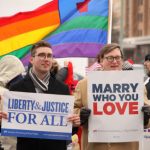
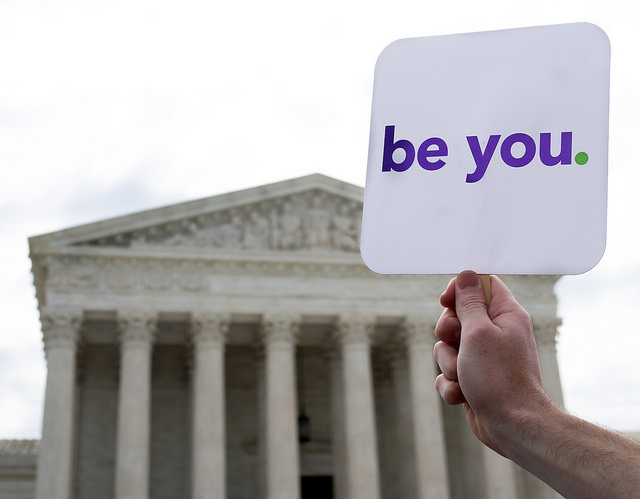
 Photo by Victoria Pickering.
Per a Supreme Court ruling issued Friday morning, same-sex marriage is now legal in all 50 states. Under the ruling of the case Obergefell v. Hodges, it is now illegal for any state to ban same-sex marriage.
“The majority bases its conclusion that same-sex marriage is a fundamental right on “four principles and traditions,” Justice Anthony Kennedy wrote in the majority decision that divided the justices. Those four principals and traditions the Supreme Court ruled is “(1) [the] right to person choice in marriage is “inherent in the concept of individual autonomy”; (2) “two-person union unlike any other in its importance to the committed individuals”; (3) marriage safeguards children and families; (4) marriage is a keystone to our social order.”
The landmark decision handed down today will affect the 14 states that still bans same-sex marriages, in Alabama, Arkansas, Georgia, Kentucky, Louisiana, Michigan, Mississippi, Missouri, Nebraska, North Dakota, Ohio, South Dakota, Tennessee, and Texas.
It was a 5-4 ruling that found justices Ruth Bader Ginsburg, Stephen G. Breyer, Sonia Sotomayor, and Elena Kagan joining Kennedy in the majority opinion. “The court now holds that same-sex couples may exercise the fundamental right to marry. No longer may this liberty be denied to them,” Kennedy wrote.
Naturally, all four of the court’s most conservative members—Chief Justice John G. Roberts Jr. and Justices Antonin Scalia, Clarence Thomas and Samuel A. Alito Jr.—dissented.
“If, even as the price to be paid for a fifth vote, I ever joined an opinion for the Court that began: ‘The Constitution promises liberty to all within its reach, a liberty that includes certain specific rights that allow persons, within a lawful realm, to define and express their identity,’ I would hide my head in a bag,” Scalia—who always has quite a way with words—wrote in his dissent. “The Supreme Court of the United States has descended from the disciplined legal reasoning of John Marshall and Joseph Story to the mystical aphorisms of the fortune cookie.”
In a rare move, all four dissenters wrote separate opinions on the ruling, including Chief Justice Roberts, who read his dissent from the bench for the first time, the Post reports. “This is a court, not a legislature,” he said.
But the majority opinion found that every person should have the right to marry who they want and rejected the claim that marriage is about procreation. “This is not to say that the right to marry is less meaningful for those who do not or cannot have children,” the majority decision reads. “An ability, desire, or promise to procreate is not and has not been a prerequisite for a valid marriage in any State.”
Of course, the reaction to the historic ruling has been nothing less than celebratory.
Today is a big step in our march toward equality. Gay and lesbian couples now have the right to marry, just like anyone else. #LoveWins
— President Obama (@POTUS) June 26, 2015
Everywhere you can get gay married in the United States, in one stunning map pic.twitter.com/ysDDsVsURH
— Judd Legum (@JuddLegum) June 26, 2015
— Todd Zwillich (@toddzwillich) June 26, 2015
Dang, universal healthcare AND gay marriage in America by 2015 pic.twitter.com/tVou0FXMDM
— Ryan Broderick (@broderick) June 26, 2015
Joe is running through the halls with a rainbow flagged tied on like a cape high fiving everyone. #MarriageEquaility #LoveWins #SCOTUS
— Jill Biden (@JillBidenVeep) June 26, 2015
Proud to celebrate a historic victory for marriage equality—& the courage & determination of LGBT Americans who made it possible. -H
— Hillary Clinton (@HillaryClinton) June 26, 2015
Gay men’s chorus of Washington DC singing national anthem outside Supreme Court steps pic.twitter.com/vud3h7eSUN
— Sabrina Siddiqui (@SabrinaSiddiqui) June 26, 2015
Today marks a victory for equality, perseverance and love.
— Tim Cook (@tim_cook) June 26, 2015
.@margaretcho said it best: “I believe that a government that would deny a gay man the right to bridal registry is a fascist state.”
— Matt Waitkus (@matticusUK) June 26, 2015
Well, not everyone was thrilled:
Once again the Bush appointed Supreme Court Justice John Roberts has let us down. Jeb pushed him hard! Remember!
— Donald J. Trump (@realDonaldTrump) June 26, 2015
This is nothing more than a constitutional convention by an unelected committee of five. #Arrogance #marriage #SCOTUS
— Cong. Tim Huelskamp (@CongHuelskamp) June 26, 2015
This flawed, failed decision is an out-of-control act of unconstitutional judicial tyranny –> http://t.co/WMborH3TxB #SCOTUS
— Gov. Mike Huckabee (@GovMikeHuckabee) June 26, 2015
From a moral standpoint, 6/26 is now our 9/11.
— Bryan Fischer (@BryanJFischer) June 26, 2015
Also, a shout-out to the Hill interns who brought us this ruling:
Run, news interns, RUN. http://t.co/m9or9Ee3he
— SimonNRicketts (@SimonNRicketts) June 26, 2015