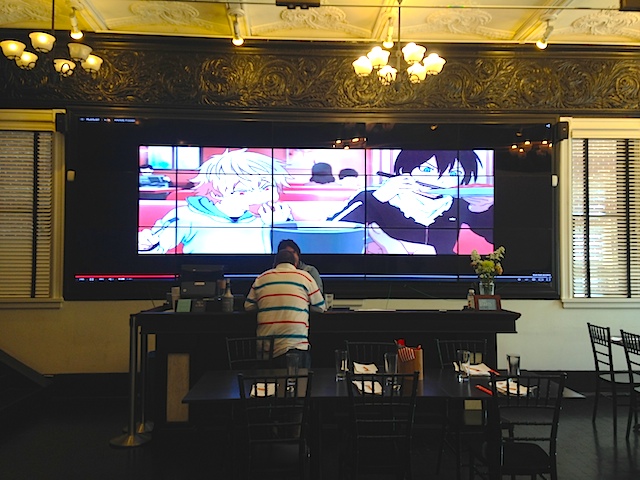
 The United States of Ramen is one of several pop-ups in residency at Prequel (Elizabeth Traynor).
By DCist Contributor Elizabeth Traynor
Despite being housed in a building originally built in 1890 (and boasting a cage elevator to boot), Prequel (918 F St NW) represents a litany of firsts.
With 18,000 square feet of restaurant space, Prequel is one of the first food destinations of its type, where customers have a chance to provide direct feedback to chefs debuting new ventures. It’s also the city’s first equity crowdfunded restaurant, bringing an entirely different model of fundraising to the rapidly growing D.C. food scene.
A few months after Prequel’s opening, which was funded by over $200,000 in capital from D.C. residents, the team at EquityEats, its parent company, remains confident in their model.
“You are allowing people to give you money and become your best customers. And it’s working,” said EquityEats CEO Johann Moonesinghe. “Ultimately it will be a no-brainer for restaurants,”
That’s not to say the initial launch hasn’t come without small bumps in the road. The concept’s been refined, he added, adjusting for what his team’s learned during Prequal’s short tenure.
“What we kind of underestimated was how financially difficult it is to do short pop-ups,” Moonesinghe said. “It’s hard to make money, or even cover your rent doing that.”
The group quickly adapted to answer that challenge, moving its focus from short-term pop-ups to longer residencies. Visitors to Prequel can now expect tenants like Bluebird Bakery, a current popular pop-up in the space, to stay for six to nine months.
The residencies will be supplemented by one-day pop-ups. Rising Stars, announced this week, will give local sous-chefs a chance to shine by running their own kitchen for a night. Every Monday, a different chef will create a menu for a 40-seat dinner.
Different two- or three-day pop-ups will rotate throughout Prequel, as well. The first, featuring Sri Lankan food, will come at the end of July. And in keeping with the tendency of the EquityEats’ crew to wear multiple hats, the chef will be Moonesinghe ‘s mom.
“His mom’s cooking is insanely good and the general public should have access to it. This is a space not only for professional chefs but people who are great chefs and want to do something inventive, and fun and unique,” said Steve Lucas, VP of Strategy at EquityEats.
Currently, Prequel’s four floors are occupied by Brick & Mortar, a bar and cocktail lounge, the Fourth Floor Wine Bar (which features 50 percent off bottles on Tuesdays), Bluebird Bakery, United States of Ramen, and Lighthouse, which serves up lobsters, burgers, and booze.
The model is working. Revenue in June was three times that of May, Moonesinghe said. So far, maintaining a rotation of concepts has proved sustainable, mainly because Prequel provides built-out kitchens with low overhead.
“We’re super close to finalizing a deal with a particular chef who has an amazing pedigree,” Moonesinghe said. “The fourth floor has a beautiful dining space, in the front of the building, which we have to build out. We have a goal of launching that around the beginning of September.”
But it’s not only the food concepts under a lens at Prequel. While the roots of the restaurant’s funding is a new approach, its founders say the crowdfunded aspect of Prequel is its biggest plus.
While it may take time to build a brand—and draw in a steady audience—when a restaurant opens its doors with hundreds of investors, Moonesinghe says, it automatically has hundreds of interested customers from day one.
“In terms of [the investors] booking private parties, coming all the time, bringing people here, being brand evangelists—it’s really worked,” Moonesinghe said.
Still, investors haven’t seen a return yet, though Moonesinghe said that is pretty typical for a restaurant’s financial timeline. He anticipates that Prequel’s investors will see returns within the next six to nine months.
Meanwhile, concepts taking up residencies in Prequel will continue to crowd-fund on their own. In the end, the EquityEats team hopes that Prequel’s success will be its biggest draw for potential clients; once budding restaurateurs see the value of sourcing hundreds of investors, the idea is that they’ll jump at a chance to test their concept in front of that community.
“What we want to do is crowdfund for people who really understand the value of 500 investors. And that’s what we found here at Prequel,” said Moonesinghe. “Our investors really are our best customers.”