 Rachel Sadon
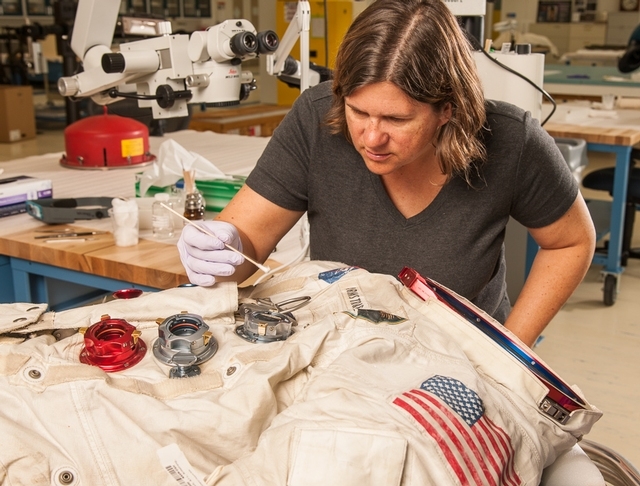 Lisa Young, objects conservator at the National Air and Space Museum, works on Neil Armstrong’s Apollo 11 spacesuit. (Dane Penland, courtesy of the Smithsonian Institution)
The Smithsonian is putting an iconic piece of America’s history in the hands of the crowd.
Ahead of the 50th anniversary of the Apollo 11 moon, the National Air and Space Museum has turned to Kickstarter to fund the restoration of Neil Armstrong’s spacesuit.
They are seeking an astronomical (so sorry) sum for a crowdfunding campaign: $500,000. Those funds, should they raise them, will go beyond simply conserving the suit, though. The Smithsonian promises to digitize it using a 3-D scan, build a climate-controlled display case, and publish their research about techniques for spacesuit preservation.
But why is a federally funded institution asking for the public’s help? Appropriations go toward the Smithsonian’s operating budget and core functions, they explained on the Kickstarter page. “Projects like Reboot the Suit aren’t covered by our federal appropriations, which means we can only undertake them if we can fund them some other way.” This is the institution’s first foray into crowdfunding, but it is the beginning of a multi-project partnership with Kickstarter.
Like other campaigns on the site, the Smithsonian promises to update backers about the project along the way.
“The public will have the chance to directly contribute to specific Smithsonian projects and follow the creative process from fundraising through completion, regardless of their level of support,” said Yoonhyung Lee, director of digital philanthropy at the Smithsonian.
Backers can receive a specially designed mission patch or 3-D scan data of the spacesuit’s glove all the way on up to a tour of the factory where the suit was made or one of the Smithsonian flags that flew on Space Shuttle Discovery.
If all goes according to plan, the suit will go on temporary display in time for the 50th anniversary in July of 2019 and permanent display when the “Destination Moon” gallery opens in 2020.
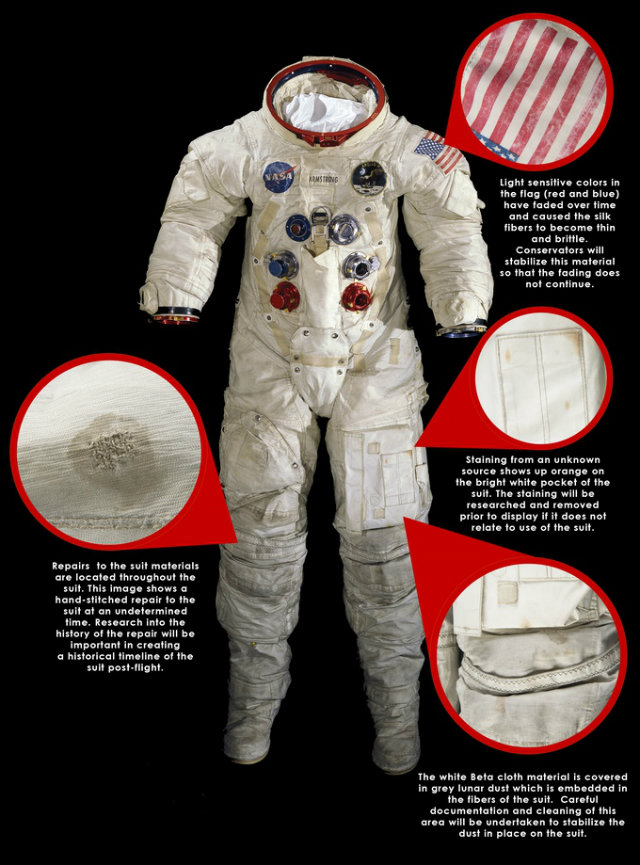 (Courtesy of the Smithsonian)