 Rachel Sadon
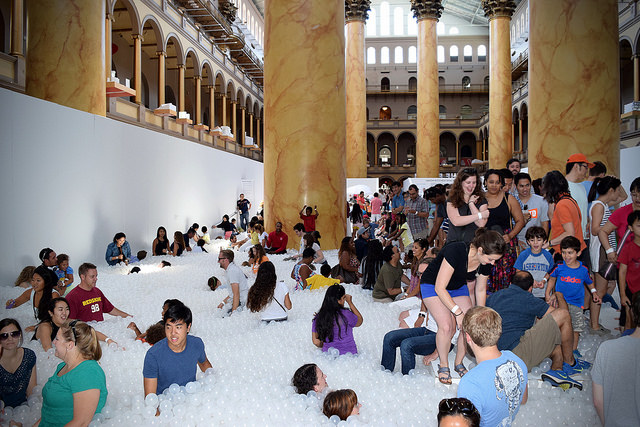 Photo by Kristine Marsh.
Of course there is a Brooklyn-based firm behind The Beach. Of course they are called Snarkitecture. Of course more than 100,000 people have jumped at the chance to jump into an adult ball pit.
In a behind-the-scenes video, The Creators Project gives a peek at the process by which the National Building Museum’s summer blockbuster came be, as well as the philosophy of the hybrid art/architecture company that envisioned it.
“Architecture is something that everyone experiences every day. It’s a ubiquitous thing, it’s something that we know and think about,” says Snarkitecture founder and visual artist Daniel Arsham. “For that reason, its very rich for exploration and altering people’s expectations about it.”
That perspective made the National Building Museum—which previously hosted a giant maze and two architecture-themed mini golf courses—a natural fit for their work. The architect behind the maze, Bjarke Ingels, made the introduction and soon thereafter, the curators basically gave Snarkitecture free reign to execute their particular vision. “We said it had to be enclosed, mission-related, summer time fun, and gave them some measurements,” museum spokesman Brett Rodgers said. But that was about it.
Snarkitecture’s answer was a football field-sized “beach” filled with nearly a million plastic balls.
“It’s a lot about reduction. We’re often taking things away rather than adding them,” Arsham said. “We often will make one statement, one gesture within a space and allow that to define it in its entirety.”
So they drained The Beach not only of the water, but of color.
The minimalist, all-white design is their signature. “Taking something familiar, in the case of a beach, reducing the color palette to all white transforms it to kind of an extraordinary experience,” says Snarktitecture architect Benjamin Porto.
And the spectacle has clicked with audiences. More than 110,000 people flocked to the scene as of last week, Rodgers said—greatly exceeding the museum’s expectations. It has also helped draw out-of-town visitors who normally stick close to the Smithsonian museums. “We’ve seen lots of visitors from outside the area, which is a little unusual for us,” he said. And despite one well-publicized report of pink eye, they haven’t had any other claims of ball-pit related illnesses, Rodgers added.
What they do have is a lot of stuff. Phones, jewelry, keys, wallets, sunglasses, spare change. Possessions float out of visitors’ pockets and sink to the bottom of the pit. Some have dived back in and successfully retrieved their items—like the woman who managed to get back her engagement ring and the person who successfully used Find My iPhone to track their device. Some of it has been returned to the lost and found. The rest is just lying there, waiting for the day when the translucent balls are drained.
As for that day, Rodgers says the National Building Museum hopes to organize a unique way of moving them, and they’ve been making arrangements to donate the materials to a local partner organization. “We hope the balls will be used in a cool, totally different way in the next year,” he said. “It would extend their life not as a ball pit but as an artistic project.”