 Rachel Sadon
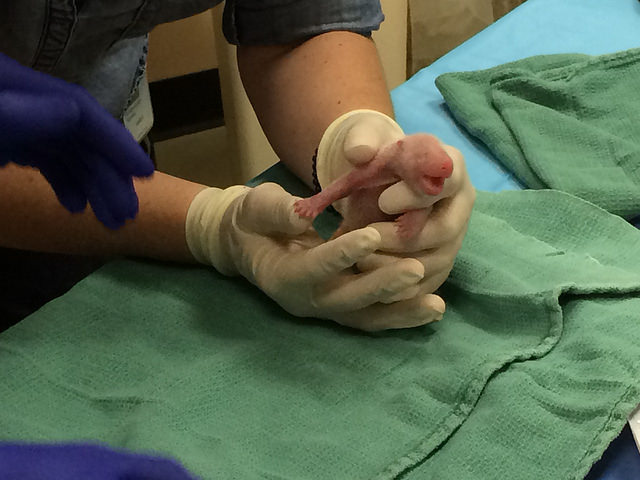 Zookeepers examine the first cub, which Mei Xiang is currently favoring. (Photo Pamela Baker-Masson, Smithsonian’s National Zoo)
Zookeepers are having a hard time getting Mei Xiang to switch cubs, with her favoring the larger one and refusing to set it down.
After a “challenging night” on Sunday, Mei hasn’t set the larger cub down to pick up the smaller one since 2 p.m. yesterday. The panda team has been intensely monitoring the little cub, hand-rearing it, and keeping it warm in an incubator. They are continuing to try to swap the cubs every few hours.
At birth, Butterstick I weighed 138 grams, and Butterstick II weighed only 83 grams. While the little cub’s behaviors are generally good—it is urinating and defecting well, and it hasn’t shown signs of respiratory distress— the Zoo is concerned about its fluctuating weight and possible aspiration. To that end, they are both tube- and bottle-feeding the cub and administering fluids under the skin.
As for the larger cub, zookeepers say they are “confident Mei Xiang is taking very good care of it.”
Nonetheless, the risk remains high for both cubs during this period. Tiny, fragile creatures at birth, panda bear cubs are the smallest in proportion to their mother of any placental mammal, the Zoo said. A panda mom is usually 700 times larger than her cub. With Mei Xiang at 238 pounds, the ratio between Mei and the larger cub is 1:783 and Mei and the smaller cub is 1:1,256.
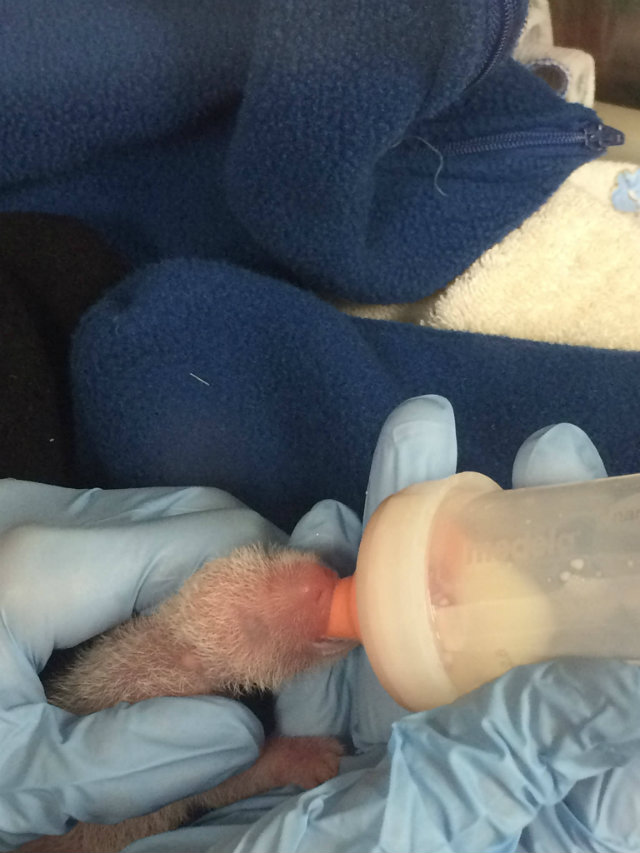 Zookeepers are hand-feeding the second, smaller cub. (Photo by Shellie Pick, Smithsonian’s National Zoo)