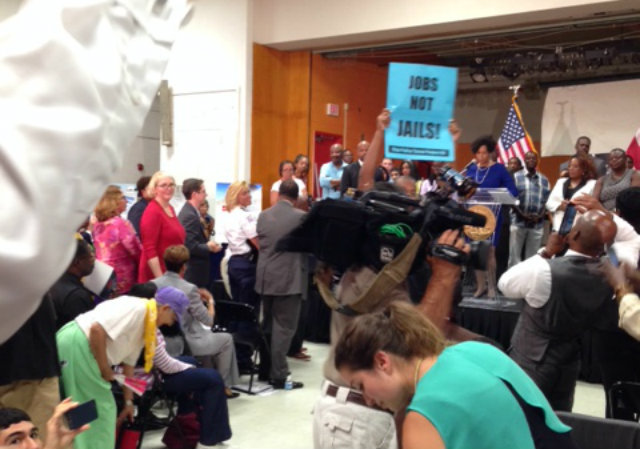
 Photo by Matt Cohen.
Dozens of activists identifying with the Black Lives Matter movement disrupted a press and community conference this morning in Congress Heights wherein Mayor Muriel Bowser outlined her administration’s police agenda for combating the recent spike in violent crime.
Amid chants of “We don’t need more police!” and “We want jobs!” a visibly frustrated Bowser struggled to deliver her speech that highlighted how her administration plans to combat violence in D.C. Among the new agenda measures announced is an increased police presence on the streets, especially in Ward 8 and other areas that have experienced a rise in violent crimes.
This is the scene right now. pic.twitter.com/3B5MxZdm7x
— Matt Cohen (@Matt_D_Cohen) August 27, 2015
This was met with vocal outcries from the activists in attendance who said that a larger police presence on the streets isn’t the answer to solving the problems of the District’s crime spike.
“The real issue is job training,” former Council candidate and local activist Eugene Puryear told DCist. “We know that job training in D.C. is completely broken and that thousands of people are going through job training and getting no jobs.”
Puryear said that the lack of proper job training is driving more young black men to the streets, where they’re more susceptible to become involved in violent criminal behavior.
Though Bowser said that D.C. has “experienced the same spike in homicides that many cities are experiencing,” she said that the D.C.’s current spike is unique. Many of the homicides committed this summer, she said, stemmed from everything from petty arguments to flare ups in long-standing rivalries, thus the need for a refocused strategy for addressing the issues.
Yesterday, Metropolitan Police Chief Cathy Lanier shared statistics on this summer’s violent crimes, revealing that there’s no single cause to attribute to it. A combination of more illegal firearms making their way onto the streets, the rise of synthetic drugs, and repeat violent offenders have all been attributed as contributing factors to this summer’s rise in violence.
Activist on a chair with tears streaming streaming down her cheeks. “This is not OK!” pic.twitter.com/cXpSvv3Wtc
— Matt Cohen (@Matt_D_Cohen) August 27, 2015
“From our perspective, on a cosmetic level, the mayor appears to be presenting a comprehensive plan, but when you get deeper into it, what you start to see is that her plan has many, many holes in it, it doesn’t address the root causes, and that it is also based on a loose understanding of what is going on in the streets,” Puryear said.
Among the other measures outlined in Bowser’s policy agenda, providing law enforcement with more tools to protect residents, harsher penalties for violent crime offenders—especially those who committed crimes in the public transit system or at parks and recreation centers—a community partnership to help support neighborhoods, and reformed legislation for police-community relations.
But the Black Lives Matter activists weren’t shy in telling Bowser that they don’t agree with her approach to the issues at hand and her understanding of them.
“I think that from the beginning the mayor has been completely aloof from the broader conversation that the Black Lives Matter movement has been driving, Puryear said. “I think that Cathy Lanier has done everything possible to undermine and discredit us.”