

 Photo by Christopher Patrick Ernst
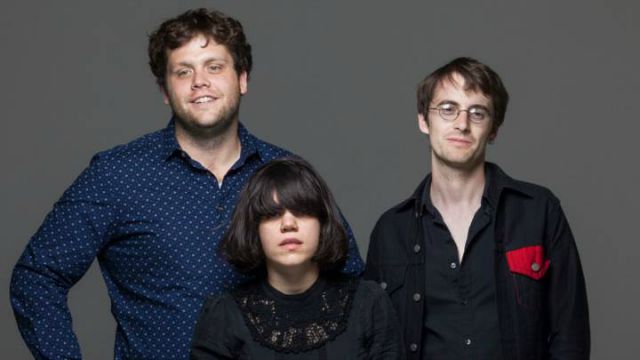
It’s entirely possible that over the course of the past ten years, intrepid rock show attendees may have come across the Screaming Females by accident. The trio of Marissa Paternoster (guitar/vocals), King Mike Abbate (bass), and Jarrett Dougherty (drums) have toured relentlessly since their inception and are just as likely to show up at a benefit show presented by Positive Force as they are at the 9:30 Club. Furthermore, they’ve appeared on the same stage as other touring workhorses like Against Me! and Ted Leo, further broadening their profile.
That said, one viewing of Screaming Females is really enough to burn them into one’s long term memory. Whether it’s Paternoster’s unabashed guitar solos or the band’s hardcore energy, this is a rock band that isn’t ashamed to rock. And with this year’s excellent Rose Mountain they’ve given us an album with hooks as memorable as their searing performance. Not that it’s easy to replicate Paternoster’s formidable vocal performance, but who’s to say it’s not worth trying.
In advance of tonight’s show at Rock n Roll Hotel, we talked with Paternoster about her hatred of math, the band’s slow, incremental changes, and the reasons she was able to relax while recording Rose Mountain.
DCist: I feel like without trying terribly hard I could probably see you all in D.C. three times a year and in Baltimore another two. How often do you actually go home?
Marissa Paternoster: It all depends on if we have a record out or not. If we have a record out, we’ll be traveling more. However, there were exceptions to that. We tour a lot because we do music for a living. I think on relative average we do about 100 shows a year. [Pause] Jarrett can confirm on average, we play about 100 shows a year. So, this is true, mathematically. We’re home for more than half the year.
DCist: So, is Jarrett the numbers guy in the band?
MP: They’re both better at math than me, so they’re both the numbers guys to me. Amongst other things. But, yeah, I can’t do math. Those guys are the calculators.
DCist: I learned that Rose Mountain, the namesake of your newest album is a rehabilitation center in New Jersey. Are there any other New Jersey references that also sneak into your music?
MP: The only lyric that makes reference to a specific place in New Jersey is probably “Rose Mountain.” I cannot seem to think of any other instance in which I cite anything that is specific to New Jersey, lyrically.
DCist: Does New Jersey affect your music in other ways?
MP: I mean, I suspect anyone’s immediate environment will affect everything that they do whether it be playing music or making a painting or doing math equations or making dinner or whatever you do. Your environment is going to have implications in that. We all grew up in New Jersey. I’m not sure how unique it is from a more objective perspective but in my mind, it’s a pretty interesting place to grow up. It’s interesting in that there isn’t really much available to someone who’s young and interested in music and art, which is weird because you live in this weird little niche state that’s in between two of the biggest cities in America. Both of those cities are hard to access when you’re really young and in the state that you live in, in your immediate area, there’s nothing to do except for loiter in a Target parking lot and hang out in the forest and throw rocks at stuff. It’s weird because you don’t live in a rural area but you kind of find that you’re bumming around as if you live off the grid. It’s a weird place.
DCist: Is there a local DIY scene that’s close to where you are now that resonates with you?
MP: I still live close to New Brunswick even though I’m not going to pretend like I know what’s going on with the punks there because I don’t. I’m out of touch. But I live in Philadelphia and there’s a lot of DIY shows happening there. We have a network of friends that extends across the country just from touring for so long. I think that we’re kind of privy to what’s going on in all of their little punk communities. Not as thoroughly as the people that live there are but we kind of know who participates in DIY shows and what bands play. We try to find out what bands are playing often and what people are interested in going to see. I think a lot of the DIY communities have a lot of their little similarities and little differences. But there isn’t one in particular that uniquely reminds me of New Brunswick. It’s been awhile since I’ve been going to New Brunswick shows on the regular.
DCist: You’re in a very interesting place wherein you still have a strong connection to DIY networks but you’ve been able to play some really big shows. Does anything feel like it’s changed seriously over the past ten years or does it still feel like you’re treading a similar path?
MP: We’ve always been interested in having our band operate in a way that we knew would be sustainable. So, I don’t think any of the changes that we’ve made have been these really big, tremendous changes that would usurp that sustainability. All of the changes that have happened over the course of the past ten years have been incrementally tiny. So, we could kind of stick our toes in the water and ask, “Is this going to be okay?” and then, “Yeah, it’s going to be okay. Let’s move forward.”
So, when it came to playing bigger and bigger shows, those things happened organically and over time. It’s not like we just threw ourselves over a cliff and started opening up for a huge band and then just all of the sudden started playing for 5,000 people. It kind of made sense when those bigger shows started happening. It was still exciting and scary in a lot of ways but we had kind of worked towards it.
DCist: Well, having listened to Rose Mountain, while it certainly sounds more well-produced, but it still sounds like you.
MP: Yeah. We did record it differently in that we recorded it to a computer whereas previously, with the exception of our first record, they’re all recorded to tape. Even that being said, we still just played the songs live. We did some overdubs, but nothing too extravagant. It’s another example of one of those tiny changes that we tried. We didn’t go, “This song’s going to have 1,000 guitar tracks and we’re going to record it without live cymbals and get a gospel choir!” They weren’t these tremendous transitions that would make or break the model that we’ve built, that we’re all pretty happy with. But still, we were trying something new.
DCist: And it had been reported that this was the first album where you didn’t cry in advance of going in. Was there something about recording that felt different this time?
It was the first time we flew somewhere to make a record. We were on the other side of the country. It was interesting. It was also the longest we’ve ever spent making a record, so, there was a lot of time to let ideas sit and I personally felt a little less pressured. I could try something and then if we were unsure, we didn’t have to immediately make a decision about it. And it was just nice! The weather was nice. It was really pleasant to work with Matt Bayles. The studios where we worked were really nice to be in. There was a lot of sunshine. For some reason the weather in Seattle was really awesome the entire time that we were there. I guess the planets aligned in a way. It’s so pretty! All the trees!


