 Rachel Sadon
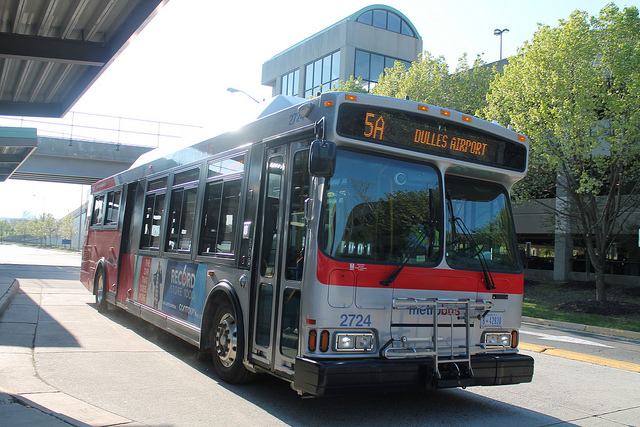 Photo by Elvert Barnes.
Bummed about the 5A going away? Excited about more service on the 79? Go tell Metro about your feelings.
The agency is holding a public hearing tonight at Metro headquarters (600 Fifth Street NW). An information session about the changes to dozens of routes will start at 6 p.m., and the hearing/airing of grievances will begin at 6:30 p.m. Riders can also submit their thoughts in a written statement (email writtentestimony@wmata.com by September 23).
The changes in the District include (but aren’t limited to) shortening the 54 route at the southern end and increasing services at the northern end, adding four buses in both the morning and evening to the 79, adding an evening bus to the A8, adding extra peak trips to the G8, rerouting the H6, adding two morning and one evening trip to the S9, extending some trips on the U8, adding two morning and evening trips to the X9, and eliminating the 5A, 93, B8, B9, D3, and N3.
In addition to service changes, the routes proposed for elimination in Maryland and Virginia are: J13, K11, R3, W19, 1E, 7H, 9A, 10R, 10S, 15M, 18E, 18F, 21A, 21D.
Perhaps the most contentious change is the proposal to stop running the 5A—the route to the eighth worst airport in the world. Leaving from L’Enfant, with stops in Rosslyn and Herndon, it is the only direct public bus to Dulles from D.C. It currently costs riders $7 a trip.
When the Silver Line opened, the Washington Flyer’s coach bus service relocated from the Orange Line’s West Falls Church station to the new Wiehle-Reston East stop. It was renamed the Silver Line Express, and they cut the fare in half to $5— plus, obviously, whatever it cost you to get out there. Metro writes that the Silver Line Express, plus the Fairfax Connector 981 (which also runs from Wiehle, and includes stops in Reston, Herndon and Udvar-Hazy), has eliminated the need for the 5A, saying “not as many people ride the 5A since the Silver Line opened.”
But the line still serves an average of 1,050 people on weekdays—a drop of only about 300 passengers since the Silver Line opened, according to The Washington Post. So what’s the real reason to end service on a still-popular route that many find people more convenient—and that doesn’t depend on finicky Metrorail service? Money, of course.
Although D.C. and jurisdictions in Maryland and Virginia have been contributing subsidies to the 5A for years based on the share of riders that come from each place, the Maryland representative on Metro’s board of directors recently argued that the state shouldn’t be paying for a route that doesn’t cross into its borders.
From the Post:
“This year’s budget [for the 5A] calls for an annual allocation of $990,000, Metro spokeswoman Sherri Ly said. She said the District contributes $405,900, Prince George’s $188,100, Alexandria $9,900, Arlington $79,200, and Fairfax $306,900
In May, however, when the Metro board of directors discussed Metro’s six-year capital program, Maryland representative Michael Goldman proposed an amendment to do away with his state’s subsidy for the 5A. Maryland shouldn’t have to pay for a bus route that starts in the District and ends in Virginia, Goldman said. The state pays for the B30 bus that runs from the Greenbelt Metro Station to BWI airport. …
Stunned by Goldman’s proposal, Fairfax representative Catherine Hudgins said that if Maryland wasn’t paying for the route, why should Fairfax County pay? After all, she said, the Fairfax residents are likely taking Fairfax Connector buses to Dulles.
“This is a regional system and I will put my money on the fact that there are Marylanders that are using it as well,” Hudgins said.
She offered a solution: If it’s serving D.C., let D.C. pay for it. Then the board agreed to put the route back on the docket for public hearing.”