 Rachel Sadon
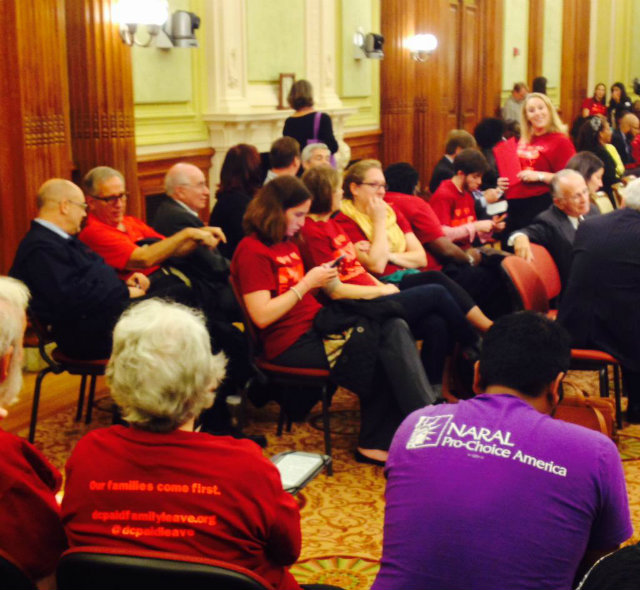 A group headed down to the Council to show support for the bill. (Courtesy of the DC Paid Family Leave Coalition)
Four months, paid.
If a bill introduced today becomes law, that is how long any District worker could take off for the birth or adoption of a child, to care for a sick family member, or to recover from a serious health condition.
Councilmembers David Grosso and Elissa Silverman introduced the bill and found co-sponsors in Charles Allen, Brianne Nadeau, LaRuby May, Kenyan McDuffie, and Mary Cheh. While D.C. has been at the forefront of offering paid sick leave (in this country anyway), the new legislation would be far more expansive than what is currently in place. And it would go well beyond what any state guarantees—Rhode Island, New Jersey, and California are the only ones that even provide paid leave.
The District began offering eight weeks of paid leave to government employees last year, D.C. has codified and extended protections afforded to workers after pregnancy, and the D.C. Family and Medical Leave Act guarantees up to 16 weeks of leave—but it is unpaid, and only mandated for employees who have worked for more than a year and have completed 1,000 hours at a company with 20 or more employees. In other words, a whole lot of workers—often the most vulnerable—are unprotected by the act.
The Universal Paid Leave Act of 2015, though, creates a whole new system for paid leave. Similar to unemployment insurance, the city would set up and administer a fund that all private employers would pay into at a sliding scale pegged to salary. At the highest end, employees who make more than $150,000 a year would contribute 1 percent to the fund and at the lowest end, minimum wage workers would contribute 0.6 percent. Federal government workers (who live in D.C.) and D.C. residents who work elsewhere could also contribute personally to the fund.
When a worker needed to take that leave, they would make a claim directly to the fund. Under the bill, the fund would pay out 100 percent of an employee’s salary for the first $1,000 a week. After that, it would pay out 50 percent, for a total of up to $3,000 a week.
All Washington residents are eligible, as are employees who live elsewhere but spend more than half their time at an employer in the District (the exception: workers who reside outside of the city and are employed by the federal government in D.C.).
“With this legislation, we once again position D.C. as a national leader on policies that bolster our families, workers, and employers,” Silverman said in a release.
While labor activists are cheering, some in the the business community have already expressed deep skepticism. In a letter to the Council, the D.C. Chamber of Commerce warned that the plan “would be unprecedented and make the District of Columbia dangerously uncompetitive,” The Washington Post reports.
Still, a handful of small businesses have already jumped on board. “I don’t have the revenue to offer paid parental leave out of pocket to my six employees, but I can do it as a contributor to a citywide pool,” Mike Visser, owner of Flying Fish Coffee and Tea in Mount Pleasant, said. “And I know my contributions are helping everyone in the city access paid parental leave. It’s a great deal for my business and for the District.”
Said Sharon Rose Goldtzvik, CEO of Uprise Communications: “Leaving a job with maternity and medical benefits to start my own business was a huge risk. For entrepreneurs and start-ups to flourish, we need to know we’re covered in case we or our families get sick. And it shouldn’t be impossible to start businesses and families at the same time – we’re losing out on talented women in the District who want to add to the vibrancy of our city but are afraid of losing maternity benefits, like I was.”