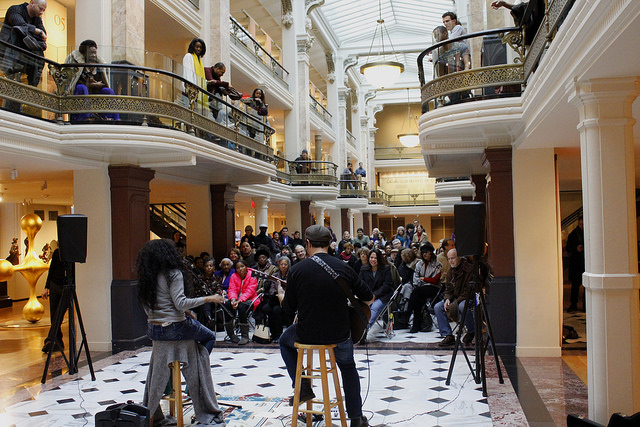
 Local singer Alison Carney performs at the Luce Unplugged series last year. Photo by The American Art Museum
By DCist Contributor Caroline Baxter
District residents and visitors alike notice the tension between the city’s staid, established roots and its entrepreneurial souls. Height restrictions and rising rents limit the number of spaces available for creative pursuits like independent art galleries and music studios. But the D.C. underground sometimes makes its own fun. Residents erect pop-up art installations in abandoned parking lots, or open up their homes to host community events. Bands are formed and reformed constantly.
This obsessive urge to create—grassroots and fostered by neighborhood cliques—can feel a world away from the establishments that provide D.C. its historical continuity: the Smithsonian galleries, the Kennedy Center, etc. But once a month, those who first heard their new favorite local band in a friend’s backyard can hear them play in an art-filled marble hall, and those who came for the art can hear what D.C. has been up to after much of the city commutes home. That’s all thanks to The Smithsonian Institution’s concert series, Luce Unplugged, put on by the Luce Foundation Center for American Art.
The series began in 2011 when then-curator Tierney Sneeringer invited local bands to play mini sets following a staff-led discussion of artwork on display. As Amelia Cornfield, the current curator, told DCist, the program is meant to “attract new audiences, engage local artists, and increase accessibility to the collection.” She has been instrumental in the program’s popularity, catering to the young urban set by programming the events as happy hours, complete with a cash bar. With additional help from local music blog DC Music Download in booking, logistics, and media promotion, the series also has a hip edge.
“I think people who frequent basement house shows get a kick out of seeing their favorite band in a more elegant and less sweaty space; at the same time, I think people who are used to going to more formal museum events appreciate the exposure to D.C.’s DIY creative spirit.”
Cornfield asks artists to select from over 3,000 works on view at the Foundation– including paintings, sculpture, folk art, miniatures, and large public sculptures. The musicians then compose a song inspired by their selected piece. One such band, Near Northeast, formed of Avy Mallik (guitar), Kelly Servick (violin and vocals), Austin Blanton (upright bass), and Andrew Northcut (drums), will play the second half of this Friday’s set. (You can read more about the band’s history, and their latest album here.) The band is a rising star in the indie-folk set. Servick, whose clear voice eerily echoes Liz Phair, is the band’s primary lyricist.
For this Friday’s show, Near Northeast chose the painting “Mr. and Mrs. America,” painted in 1969 by Rex Clawson.
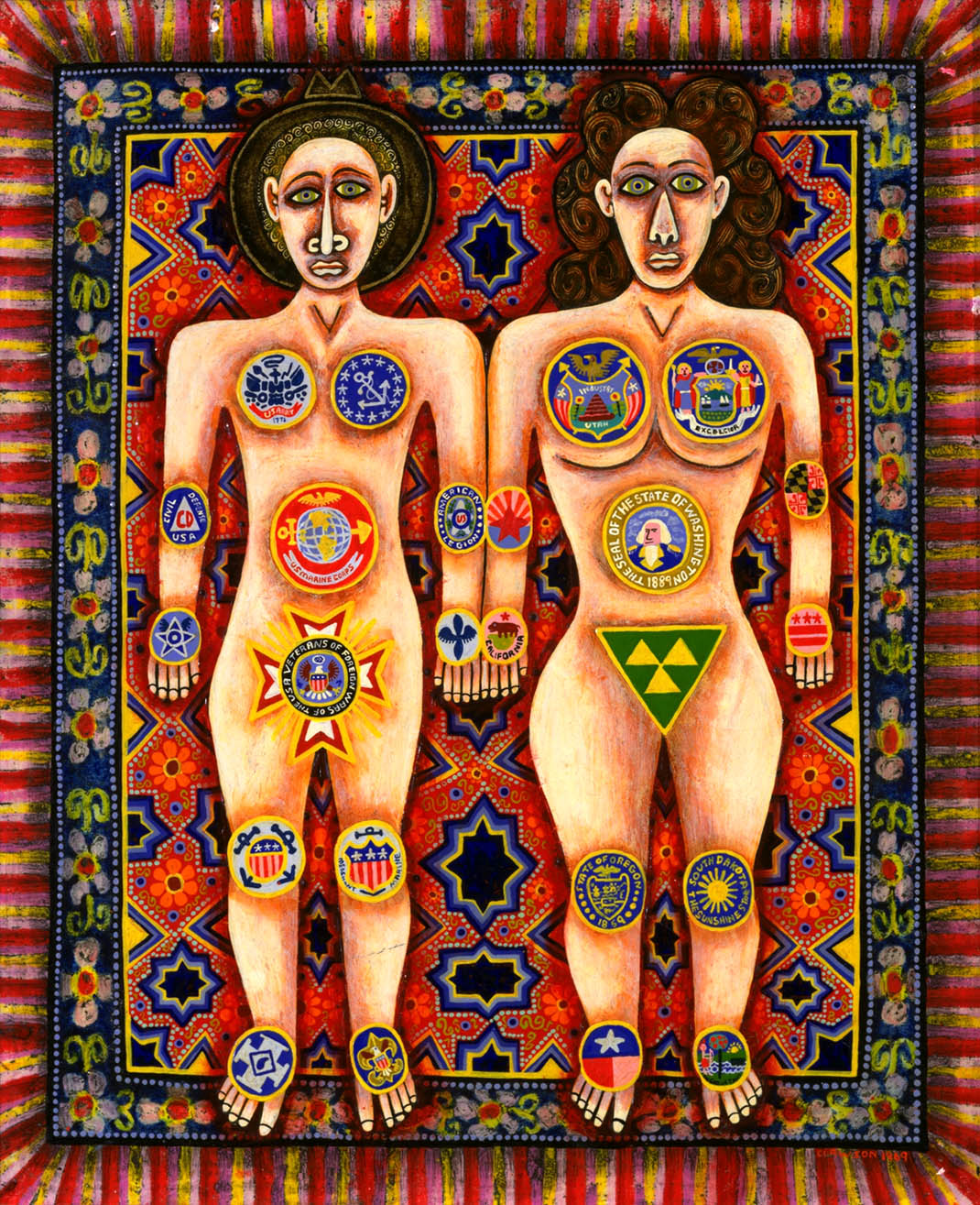 Rex Clawson’s “Mr. and Mrs. America” via the Smithsonian American Art Museum
Clawson painted the work as a protest to the Vietnam War, which, at the time, was in its 14th of 19 years and saw the peak of deployed U.S. forces. The feeling of that painting drove their creative process for this project.
DCist: How did you get involved in this?
Servick: I had seen some shows in the past. We thought it was a great series for bringing in the music scene and visual arts scene. We’d seen Ugly Purple Sweater, an old band in D.C, perform at Luce. And then they asked us to play!
DCist: What was the process you went through writing the song? How did this process differ from the other songs you’ve written in the past?
Servick: I think the sequence of events for songwriting it similar to how we’ve written before. Avy writes the chord progression and then we write our parts over time on top of that. But this is one of the first times we’d been at the piano, writing—we knew we’d have a grand piano in the atrium. Avi, the chords you wrote were pretty different, right?
Mallik: Yeah. We got really excited about the fact that there was going to be a grand piano [in the performance space]. It figured strongly into this songwriting process. I’m not a piano player by any stretch, but still, I had gotten a 300lb piano from Craigslist a few months before and hauled it into my living room. After the guitar licks I’d been writing weren’t turning out as I wanted, I started playing their approximation of their progression on that new piano.
That switch made it really come together. As it happened, only after we wrote the song did we ask the organizers whether we could use the atrium piano, and they said it was scheduled to be moved to the Renwick Gallery the day before our performance! We got them to push the date back.
Servick: I didn’t know that! Geez, good save, Avy.
DCist: Had you seen “Mr. and Mrs. America” before? What drew you to it?
Servick: We all saw about three or five things we liked in the gallery and ended up taking a vote on what piece of art to use. At first look [this piece] was so friendly and inviting, and I thought, “Oh, what a fun piece!” But then, the more you look at it, the more it changes. ‘What are those badges?’ ‘Why do they look like that?’ There’s something else going on.
Mallik: We looked into the history of the piece and looked into the artist—we knew its history as a Vietnam War protest piece. And Clawson looked like such an interesting and eccentric artist. But we tried to just look at the canvas and come up with our interpretation of what we were seeing.
DCist: Where does this song fit for you in the assortment of the other songs you’ve written?
Servick: I think the three of us are envisioning [it] differently. I’ve been thinking of it as a separate, special, one-off thing that we’re doing because the instrumentation is so different than what we usually do on stage. But we’re open to trying it again new.
Mallik: I would echo that. We have no expectations about that song. We write a lot of music and let it sit . We wrote a lot of songs that we didn’t use on Curios. We take our time with the songs. A lot of times we will return to a song we wrote a year ago and finally, by that point, it will be ready to work with.
Servick: Making the first album, you need to perform things a few times and let it simmer.
Near Northeast perform with Cruzie Beau (also featured on DCist) tomorrow night at the Luce Foundation Center in the Smithsonian American Art Museum. The event is free, all ages, and starts at 6pm.