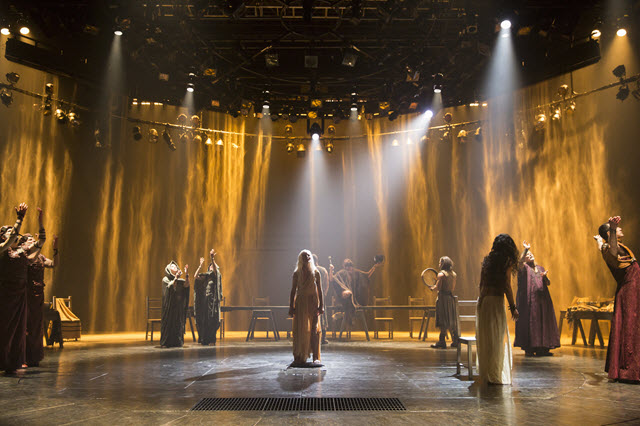
 The cast of Yaël Farber’s Salomé. Photo: Scott Suchman.
By DCist Contributor Missy Frederick
At one moment early on in Shakespeare Theatre Company’s production of Salomé, the stage lights up in golden hues and sand appears to come cascading down from the rafters. The audience Thursday evening murmured at the effect; some even gasped. This was clearly going to be a visually stunning production.
It’s also a challenging one. Yael Farber’s reinterpretation of Salomé’s story, first alluded to in the bible (if not by name) and then famously elaborated on by Oscar Wilde, is gorgeous and inventive, but also bleak and extremely slow-paced. Despite the play clocking in at less than two hours, the action moves as if in slow motion, often set balletically to chant-like singing. It’s an effect that requires patience and investment from the audience.
But that investment is rewarded with a beautifully staged, entirely new telling of the title characters’ driving forces and circumstances. Narrated by a much older Salomé, now the “nameless woman” (an imposing Olwen Fouere), the work shows the hell Salomé was put through both before and following her momentous act of calling for the head of John the Baptist (Ramzi Choukair) on a platter. It drives home the stark political motivations that eventually lead her to act; this innovative new feminist interpretation is appropriate for the Women’s Voices Theater Festival, of which it is a part.
As the younger version of the title character, Nadine Malouf may not summon the same sort of gravitas as her elder counterpart, but she brings a certain beauty and inner confidence to Salomé’s struggle, most thrillingly embodied in the show’s arresting baptism scene. Painting a more cryptic figure is Choukair, whose dialogue is conducted entirely in Arabic (and sometimes translated by Yeshua the Madman (Richard Saudi). T. Ryder Smith is both menacing and pragmatic as a power-hungry Pontius Pilate; as Herod, Ismael Kanater strikes an oddly comic tone that doesn’t seem to quite fit into the production’s sensibility, though he does lend appropriate brutality to a key, disturbing scene with Salomé.
The use of flashing light, gentle falling rain, and a rotating stage are just a few staging techniques that help bring about key scenes in Salomé. The woman herself has become most iconic to modern audiences for the Dance of the Seven Veils, and while this staging of the dance is still seductive in its own way, it also emphasizes the power behind that dancing, incorporating giant curtain-like veils that stretch nearly the entirety of the stage. It’s one of the production’s most impressive visuals in a play that’s packed with them.
Salomé runs through Nov. 8 at the Lansburgh Theatre. Tickets ($20-$118) are available online.