 Rachel Sadon
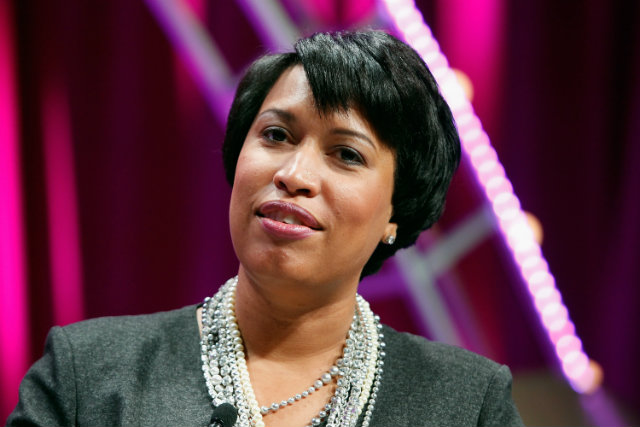 (Photo by Paul Morigi/Getty Images for Fortune/Time Inc)
After raking in more than a quarter of a million dollars—raising eyebrows and ethical questions—a pro-Bowser PAC is shutting down. Meanwhile, activists opposed to the Pepco-Exelon merger are calling for increased scrutiny of the “role of pay-to-play politics in her administration.”
FreshPAC capitalized on a campaign finance loophole that allows political action committees to take in unrestricted donations in non-election years. Developers and businesses with city contracts were among the donors giving sums of as much as $20,000 (the maximum allowable donation for a candidate in a ward-level race is $500 and $2,000 for the mayoral race), as tracked by WAMU.
The D.C. Council passed initial legislation to end the practice in late October, but FreshPAC is preemptively shutting down. Treasurer for the group Ben Soto—who also was the treasurer for Bowser’s mayoral campaign—told the Washington Post’s editorial board it had become a “distraction.” While Soto emphasized that the committee didn’t break any laws, he said the money will be returned.
It is an about face from remarks Soto made just a month ago to the Post. At the time, he said the group was aiming to raise $1 million by the end of the year and that it would limit contributions to $5,000 per person after that. The name was derived from the mayoral campaign slogan of a “fresh start” for all eight wards, Soto told the Post.
The mayor is currently on a trip to China, where she announced $155 million in foreign investments today, along with several top donors to FreshPAC.
“Regardless of the legality of the FreshPAC and its operations, the unchecked influence of large donors in campaigns undercuts the voices of everyday D.C. residents,” said David Grosso, who introduced the legislation to end the practice and also plans to reintroduce a bill to create a publicly financed campaign system. “Now that the Mayor’s supporters have shut down this FreshPAC, the city can begin to move forward to restore credibility with voters by removing even the appearance of conflicts between city business and our elections process by enacting stronger campaign finance protections.”
While campaign finance issues don’t generally become the focus of so much buzz, D.C. Attorney General Karl Racine said his office was flooded with calls about FreshPAC. And it even led to some collaborative public investigation, with Anya Schoolman, executive director of the Community Power Network, starting an editable Google spreadsheet calling on other members of the public to help link the donors and their city government-related projects.
“Like many D.C. citizens, I was sort of horrified reading about FreshPAC,” Schoolman says. She’s been advocating against the Pepco-Exelon merger and “trying to understand what happened and how the Office of the People’s Council, the Apartment & Office Building Association, and, of course, the mayor’s office changed their position [on the deal]. I really didn’t see enough in the merger itself to explain the change of position.”
So Schoolman and other community leaders began asking questions about the city’s other recent dealings with Pepco—which include a $25 million naming rights deal and one of the land swaps that are paving the way for the D.C. United stadium at Buzzard Point. They’re calling for the city to release information about the merger negotiations and an ethics investigation. At a press conference held today outside the Pepco substation at the site, they dubbed the affair “soccergate.”
But in the meantime, Schoolman has been digging around in the FreshPAC list, along with others who have contributed to the spreadsheet. “It’s kind of like shining a light on where all the secret rat warrens are in D.C.,” Schoolman says, noting that it goes well beyond regular campaign donations—which are capped and for a specific candidate. “Everyone I found has some major dealing with the District—real estate contracts, a board appointment, a hospital contract.”
“It’s a different class of person. It’s not like ‘oh my candidate is running and I’ll give her $250 because I think she’s the best candidate,'” Schoolman says. “It’s not for a campaign; it’s a generic fund. Who’s willing to fork up $10,000 or $20,000 like that?”