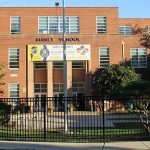
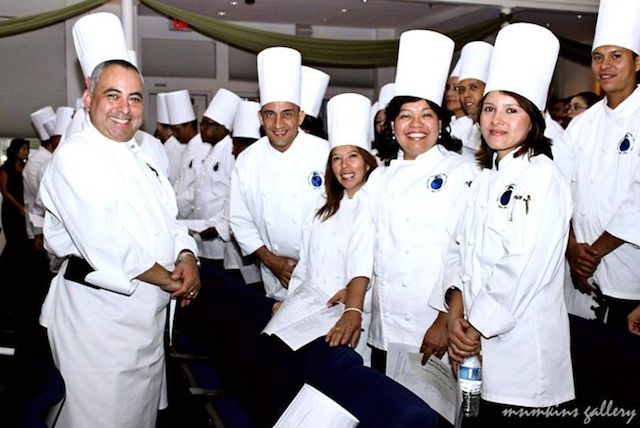
 Photo courtesy of the Carlos Rosario International Public Charter School’s Facebook page.
By DCist Contributor Johanna Mendelson Forman
Competitive celebrity chefs dominate this city’s restaurant scene, but there are still those who dedicate their lives to teaching the basics to a new generation of aspiring cooks. Meet Chef Benjamin Velasquez, the director of food services at the Carlos Rosario Charter School. For 29 years, Velasquez has worked with the school to help immigrants create a new life, beginning with their kitchen technique.
Chef Velasquez’s journey to this position began in 1982, when he was forced to flee his homeland of El Salvador. As a law student he was a target of the military, who suspected anyone studying at the university of sympathizing with the guerrillas fighting in a civil war with the government. When he moved to America, Velasquez switched his field of study to culinary arts.
“I had wanted to be a lawyer, but I realized Washington had many lawyers. And to be a good lawyer you have to use language perfectly. In the kitchen you do not need to be a William Shakespeare. A foreign accent in any other industry is very negative. However, I noticed that my accent in the kitchen worked in my favor. I benefited because Americans respected me,” Velasquez says.
Before teaching, Velasquez worked in kitchens like the Cosmos Club and the Washington Hilton. But it was his commitment to help lift others up through the power of breaking bread that led him to the Carlos Rosario Charter School. In the kitchen, he says, “people don’t feel intimidated.”
Every day, Velasquez oversees two training kitchens. One is on the main campus of the school on Harvard Street NW in Columbia Heights, and another at the Sonia Gutierrez Center on V Street NE. Both locations serve as a culinary arts training ground for immigrants, who learn about the basics of the professional kitchen and earn a GED high school equivalency degree. The students also gain a working knowledge of English and some computer literacy, all free of charge. They just need to prove residency in D.C.
Creating this model was not easy, Velasquez explains. Sonia Gutierrez, a Latina educator who worked at Carlos Rosario, along with current president and CEO of the school Allison Kokkoros, worked for more than a year without pay seeking foundation support to develop the program.
Today, the school runs three teaching shifts—morning, afternoon, and evening for its 2,500-strong student body. Many of the students enrolled in Carlos Rosario also have full-time jobs. In addition to ESL training, students can pick from three career paths: culinary arts, health care, and technology. The program has graduated more than 50,000 immigrants from all over the globe, and continues to provide services after graduation.
The majority of the students—60 percent—are Latino, but students who attend the school speak many languages and share very different cultural attributes from the new ones they find in their adopted home. Velasquez and his colleagues try to build a sense of teamwork, which is essential in professional kitchens.
A walk through the school with Velasquez demonstrates the camaraderie of the students. There are warm hellos, and a sense that everyone has a place and is respected. This model reinforces the belief that every person admitted to the school is treated as if they were in their own home. It’s an extension of the Spanish expression of hospitality “aqui tiene su casa,” or “Here, you are in your home.”
Johanna Mendelson Forman is Scholar in Residence at the School of International Service at American University, Washington, D.C. where she teaches Conflict Cuisines. ® She writes about Conflict Cuisines in the metropolitan area for the DCist.