 Rachel Sadon
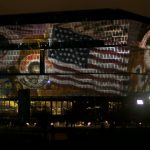
For the past three nights, the walls of the National Museum of African American History and Culture have spoken. In a seven-minute video loop, the bronze-coated facade told the stories of the end of slavery, the end of the Civil War, and the 1965 passage of the Voting Rights Act from the building’s prominent perch at 14th Street and Constitution Avenue NW.
The temporary installation, called “Commemorate and Celebrate Freedom,” marked another milestone: the completion of the exterior of the museum.
“We still have a lot of work to do but it’s nice to be able to pause and celebrate the significance of 2015,” says Jud McIntire, an architect and the project manager for the site.
Whereas acrimony and infighting have dominated other high-profile projects—notably the Eisenhower Memorial—the lengthy collaborative process (according to McIntire, they had 34 consulting party meetings alone) behind the design of the African American History Museum has borne out.
Then-President George W. Bush authorized the Smithsonian Institution’s 19th facility in 2003, and he joined President Barack Obama and then-Mayor Vincent Gray in breaking ground on the museum in 2012. Cranes and hard hats have since become familiar sights on the site—and photographers have captured the quotidian progress and large-scale drama of the building’s rise.
It has come a long way from the four-acre, 60-foot deep hole in the ground.
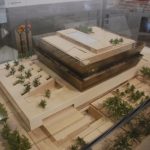
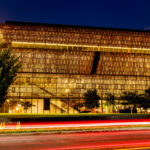
The exterior of the David-Adjaye-designed building is basically complete, according to McIntire, though the entrance is still comprised of a plywood door (it will eventually be replaced with glass). Crews have finished installing 3,600 panels—made of cast aluminum and finished in a bronze alloy in a pattern inspired by African American ironwork in the South—around the glass building in three tiers. Called the corona, the design was inspired by the crown on a West African figural sculpture.
The angle of the three inverted tiers, or trapezoidal shapes, that make up the corona are the inverse of the top of the Washington Monument at 17 degrees and they are laid in the same ashlar pattern as the monument’s stones, McIntire says, part of a concerted effort to make the museum to feel harmonious with the surrounding landscape.
About half of the museum is below grade, hiding much of the building’s mass and allowing for a multi-level history gallery. And Adjaye gave much consideration to how the site opens up to the monumental grounds next door.
“Conceptually, we have a pavilion freestanding on a rolling green landscape,” McIntire says. “When you view all this from 14th and Constitution, you get this open vista across the grounds. The landscape and the earth is kind of as powerful as the form of the building.”
But every angle and surface of the building has been considered—including the arrangement of the mechanical systems on the roof, which are visible from the Washington Monument and the planes flying into and out of National Airport. And there are strategically places cutouts in the corona, allowing visitors inside the upper galleries to orient themselves via the monuments and landmarks they face—including the MLK, Jefferson, and Lincoln memorials.
With the exterior largely behind them, the exhibit fabricators have already begun their work. The museum is set to open in September of next year.
“When it does become open to the public, it’s going to be a place where people want to come to see the wonderful exhibits, to sample the cuisine in the restaurant, and maybe even just to hang out because there are these wonderful views of the city,” McIntire says.