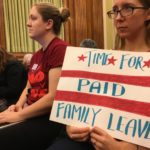
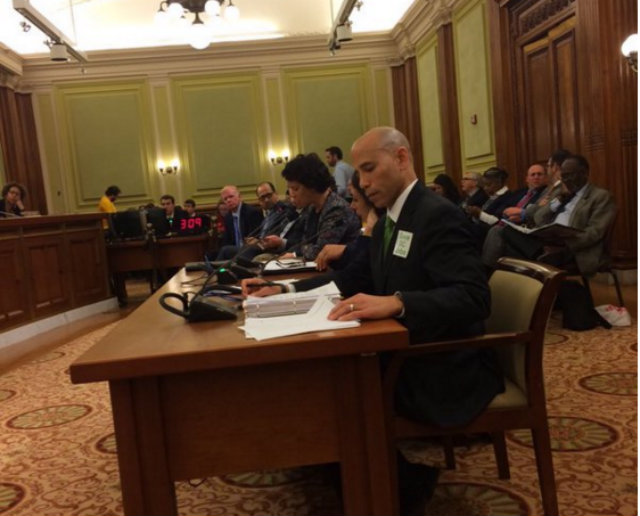
 Photo courtesy of the DC Chamber of Commerce
It’s more than five hours into a conversation discussing a paid family leave bill in the District, and there’s still a long way to go. Not only for today’s hearing, but in the coming months to determine the fate of the Universal Paid Leave Act of 2015.
With almost three dozen people on the testimony roster, proponents and opposers weigh in on the bill that would give 16 weeks of paid leave to all D.C. workers and District residents. This would be the lengthiest paid leave plan in the country.
The bill was introduced in October by At-Large Councilmembers David Grosso and Elissa Silverman. Workers can utilize the time off for a series of reasons.
Qualifying events include a baby born or adopted, or major medical operations for the worker or a family member. The bill’s definition of family and major events are inclusive of the diversity of D.C.’s workers and families, including low-income workers, single-parent households, caregiving for non-child family members, lesbian, gay, bisexual, and transgender individuals, and more.
Last year, another bill introduced by Grosso gave D.C. government employees eight weeks of paid leave for “the birth or adoption of a child or to care for a family member with a serious health condition.” If the new bill passes, D.C. government workers will get an additional 8 weeks, plus time off for themselves in a qualifying circumstance.
Under the proposed bill, the fund would pay out 100 percent of an employee’s salary for the first $1,000 a week. After that, it would pay out 50 percent, for a total of up to $3,000 a week.
Some proponents of the bill represent low-wage and minority workers, arguing that it would create equality of benefits for those who need it most.
“Low-income workers are the least able to survive without their wages, but the least likely to have access to paid leave,” said Jos Williams of the Washington Labor Council, AFL-CIO.
As a mother of three, Xiomara Flores had to leave her job for four months to take care of her sick child. She used vacation time and unpaid leave. “That drastically burdened my family with the income I was not receiving,” she said. Representing SEIU 32BJ, a union of property service workers with over 17,000 members in the region, Flores advocated for single mothers who, without paid leave, “are faced with the decision of maintaining an income or providing care for their families.”
While research shows that paid time off renders major health, familial and economic benefits to employees, one of the argument lies in who’s fronting the money.
As it stands, the city would set up and administer a fund that all private employers would pay into at a sliding scale pegged to salary. At the highest end, employees who make more than $150,000 a year would contribute 1 percent to the fund and at the lowest end, minimum wage workers would contribute 0.6 percent. Federal government workers (who live in D.C.) and D.C. residents who work elsewhere could also contribute personally to the fund.
Some opponents of the bill represent small businesses who say they aren’t able to foot the bill like larger corporations, and the “one size fits all” plan won’t work.
Other business associations complained that they weren’t given a seat at the table to hash over the bill. Grosso countered to the D.C. Chamber of Commerce—a major opponent of the legislation—that he met with them multiple times and solicited their feedback, only to get nothing.
But the bill has been questioned by more than the business community. Even Mayor Muriel Bowser told NBC4 she wasn’t sure how the policy would impact the D.C. government and its 30,000 employees.
Other concerns come from representatives from businesses outside of D.C., who’d have to provide the 16 week leave to employees who live in the District but not those who lived in surrounding states. They say there’s a large chance that they’d not hire District residents at all.
But according to Grosso, Maryland and Virginia businesses make out best, at least as far as the money goes. Under the bill, they aren’t forced to pay into the fund. District residents who work outside of the city will have to do that themselves.
“This is not the end point of the discussion, this is really a starting point,” said Councilmember Silverman, as more people take the stand to testify.