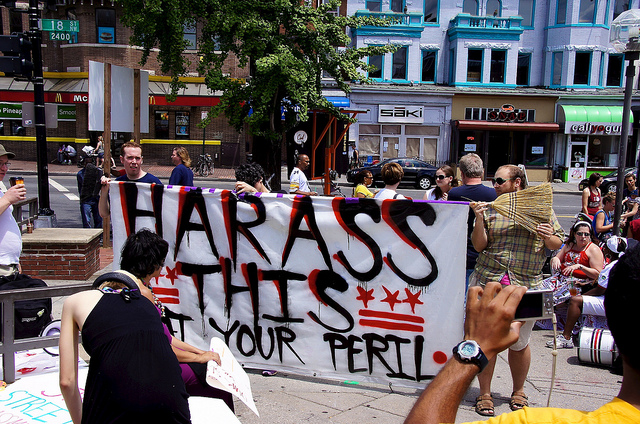
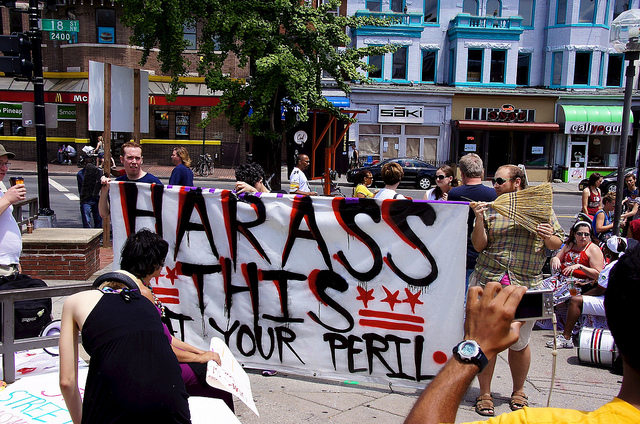
 Photo by Ted Eytan
A young woman says she was catcalled four times on the way to the city’s first-ever roundtable on public street harassment, where nearly three dozen victims of street harassment shared their experiences and recommendations. She prefers to remain anonymous due to concerns for her safety.
For the woman, a survivor of sexual assault, each catcall can trigger her post traumatic stress disorder. “Street harassment has caused me to live my life in a state of hypervigilance,” she said at today’s hearing.
Verbal harassment was just the beginning for Paris Sashay, who experienced an assault after rejecting a group of men’s advances while leaving a D.C. nightclub with friends two months ago. She was left with facial damage, a major head concussion, and the loss of her two front teeth.
“My assault and similar situations often get overlooked or unresolved,” Sashay said today at the roundtable discussion.
In her opening remarks, At-Large Councilmember Anita Bonds described street harassment as unwanted interaction between strangers where the harasser’s interaction is motivated by a person’s actual or perceived gender, among other things. It can happen not only on the street, but in parks, bars, and Metro stations—pretty much any public space. And it leads victims to become annoyed, angry, humiliated, frightened, or—as in Sashay’s case—physically harmed.
The meeting, which is still going on, is co-hosted by the Council’s Judiciary Committee and the Committee on Housing and Community Development.
Welcome @CM_McDuffie! & enormous thanks to superstar @BrianneKNadeau for elevating this issue in DC! #RaisetheBar pic.twitter.com/9OXa1gYxKx
— CollectiveActionDC (@SafeSpacesDC) December 3, 2015
Ward 1 Councilmember Brianne Nadeau shared her experiences of being catcalled while walking home from work. “Sometimes I was harassed every two blocks,” she said.
After asking one man to stop, he “spat on me and ran away,” she said. Another guy fired back with: “If you don’t want me to comment, why do you dress that way?” In reality, Nadeau said, it really doesn’t matter what you have on—you could be sweaty coming from the gym and get the same treatment.
It also doesn’t matter how you get around the city, said Nelle Pierson of the Washington Area Bicyclists Association, who spoke about her experiences being threatened on a bicycle.
“I’ve heard ‘hey baby, come over here’, ‘damn I wish I was that bicycle’ or ‘get out of the road you stupid bitch’… followed by a pickup line,” she said.
While there isn’t going to be a “one size fits all legislative fix,” to the problem, Bonds said, different agencies can choose their own paths for solutions. The first step, though, is listening “and that’s what we’re doing today.”
One of Pierson’s suggestions was to provide professional training in local high schools, “because accountability needs to start young,” she said.
Jessica Raven of Collective Action for Safe Spaces recommended training for individuals who are positioned to respond to sexual harassment such as police officers.
We must also keep in mind, Raven points out, that criminalization is not the answer. “The people at greatest risk of harassment—women, LGBTQ and gender nonconforming people, communities of color, and people experiencing homelessness—are also communities at greatest risk of incarceration and police violence. These are communities that may not view the criminal legal system as a viable option for support or justice,” she said.
To that end, she suggests trainings give officers “the tools they need to recognize and effectively respond to harassment.”
Bar staff can also be equipped with bystander intervention training, she continued. In partnership with the non-profit Defend Yourself, a program called Safe Bars has already begun training bar staff in the D.C. area.
And if D.C. agencies need guidance, they can look to WMATA, who has “set a great example for data collection efforts and community-based solutions to harassment on public transit,” according to Raven, adding that WMATA developed an online reporting system and trained transit staff and officers to respond to incidents.
Earlier this year, WMATA also installed anti-sexual harassment ads across the Metro system, which was the second phase of its awareness campaign. The ads feature hands representing different races and genders illustrating that harassment can happen to anyone. In 2014, WMATA reported, harassment on Metro declined 13 percent compared to 2013.
“What we’ve found through our partnership with WMATA and through our workshops with community members is that community education and bystander intervention training work together to equip people with the skills to stop sexual harassment and prevent assault,” Raven said.
In February, Reston, Va.-based non-profit Stop Street Harassment released data collected from 1,058 men and 982 women—the majority of whom (1,566) were white—about their experiences with harassment across the country in 2014.
More than half (57 percent) of all women had experienced verbal harassment, and 41 percent of all women had experienced physically aggressive forms of harassment, including sexual touching (23 percent), following (20 percent), flashing (14 percent), and being forced to do something sexual (9 percent). For men, 25 percent experienced street harassment, too, including 18 percent who experienced verbal harassment and 16 percent who experienced physical aggression.
This story was edited October 14, 2025 to remove personally identifying information.