Rachel Kurzius
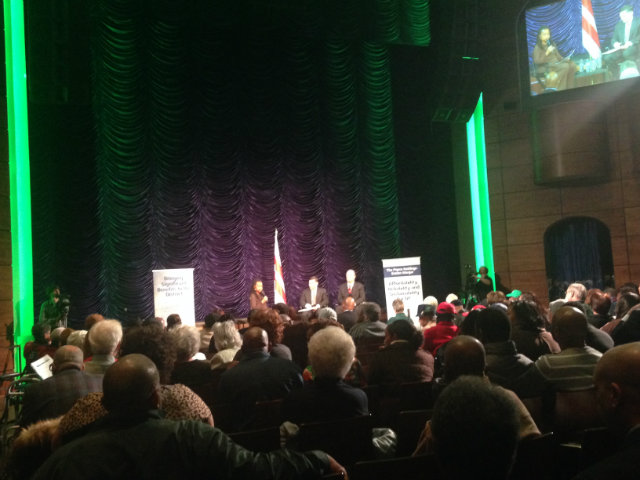 Photo by Rachel Kurzius.
On one side, you’ve got cocktail weenies, green baseball caps, and billions of dollars at stake. On the other side, you’ve got a 14-foot inflatable flashlight and the sense that something just doesn’t smell right.
Welcome to the endgame of the $6.4 billion Pepco-Exelon merger.
The Chicago-based Exelon has one final hurdle to clear before purchasing D.C.’s energy distributor and becoming the country’s largest electric utility company. It needs to gain the approval of the D.C. Public Service Commission, which rejected a previous iteration of the merger in August. At the time, the PSC said the proposed merger, “is not in the best interest of the people of the District of Columbia.”
The defeat was short-lived. By October, Mayor Muriel Bowser announced her support for a new deal in October, which she said, “puts District residents and ratepayers first—by delivering a public utility that is cost-effective, dependable and environmentally sound.”
And earlier this month, the General Services Administration—one of the final government critics standing—decided to stop voicing its opposition and forgo attendance at the PSC hearings.
In a demonstration today, activists protested in front of the Wilson Building to demand transparency into what they call a quid pro quo deal to get the mayor’s support for the merger. The 14-foot inflatable flashlight was intended to symbolize the need to shine a light on the interactions. Public Citizen has filed Freedom of Information requests to obtain Bowser’s communications with Pepco and Exelon.
Concerned citizens and group representatives want #pepco‘s 25 million #soccergate deal be be investigated pic.twitter.com/bcMaa7j7VS
— Public Citizen (@Public_Citizen) December 10, 2015
Activists point to Bowser’s dealings with Pepco—a $25 million naming rights deal and one of the land swaps that are paving the way for the D.C. United stadium at Buzzard Point—as the real motivation for her support of the merger.
Pepco and Exelon are trying to counter this narrative by engaging with members of the community about the benefits.Exelon paid for a town hall meeting on Tuesday night at Howard Theatre, replete with hors d’oeuvres and swag under the seats, to address citizen concerns about the deal.
But to get inside, attendees had to walk past folks from Power D.C., who were handing out flyers that said, “Exelon wants to raise your electric bill by $100 a year!”
“They need to show a clear public benefit, and I just don’t see one,” said Jesse Lovell, one of the activists passing out the flyers. “I like local control. I don’t like the idea of being controlled by some corporation across the country.”
During the town hall, Exelon Senior Executive Vice President and Chief Strategy Officer Bill Von Hoene wanted to show how corporate control would benefit D.C. residents. “We have three other commonwealth utilities,” in Philadelphia, Baltimore, and Chicago, he said. “All of our utilities enjoy the wisdom and resources of each utility.” If there were an outage in D.C., for instance, Pepco could call upon one of the other cities for help.
When moderator Denise Rolark-Barnes, publisher of the Washington Informer, brought up the flyer, Pepco conceded that eventually rates will rise.
“We have made commitments to improve reliability dramatically,” said Dave Velazquez, executive vice president of Pepco Holdings Inc. “We are going to have to make investments in the system to bring that reliability. Some of that is going to result in us needing to change rates.” Velazquez, who would become the CEO of Pepco Holdings if the merger goes through, says the rates would have a “fairly modest increase” after the five years of deferred raises.
In a letter to the PSC urging a rejection of the merger, At-Large Councilmembers David Grosso and Elissa Silverman, Ward 3 Councilmember Mary Cheh and Ward 6 Councilmember Charles Allen compare the so-called rate freeze to “signing a balloon mortgage, or having your rent permanently increase, but getting the first month at the old price.”
The other seven councilmembers have voiced their support for the merger.
Many of the concerns raised by residents involved Exelon’s involvement with nuclear power. “I cannot understand why you’re not worried about pairing with mega-corporation Exelon, who has peddled with some of the dirtiest kinds of power there is—nuclear,” one audience-member told Velazquez.
Von Hoene said that he understood how passionate people are about nuclear energy, but that without it the United States cannot curb carbon emissions. “We are among the greenest companies in the United States,” he said.
For the opposing councilmembers, the problem with nuclear energy generation has less to do with safety than with it being “a risky business.” The letter says that “Exelon is struggling economically…It needs to diversify and needs to acquire healthy, reliable sources of revenue to balance its otherwise risky portfolio. That’s where Pepco comes in.”
Exelon and Pepco point to the ring-fencing in the settlement—meaning Pepco is protected from liability over Exelon’s nuclear assets. To the four opposing councilmembers, though, “the very existence of the ring-fencing provisions is an acknowledgement that there is a significant risk of harm present in the deal.”
The other major concern is the manner in which the settlement was reached, which activists say happened behind closed doors.
Von Hoene described it differently. “We went to all of the parties involved to ask, ‘What will make it right for you?’ We engaged in negotiations to address concerns, and ended up with an entirely different package than we had on the table when the settlement was rejected.”
Most of the people at the town hall on Tuesday seemed supportive of the deal.
One woman at the town hall was wearing a “Support the Pepco-Exelon Merger” hat and a matching t-shirt that said, “Affordability, Reliability, Dependability.” When asked where she got the green swag, she replied, “I’ve been working at this for a while.”
Underneath every seat at the town hall lay a bag filled with a water bottle, a note pad, and an “I Support the Pepco-Exelon Merger” hat.