 Rachel Sadon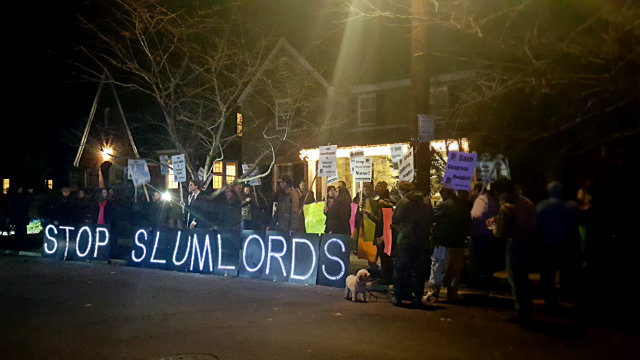
 (Photo by Rachel Sadon)
An unassuming house in Cleveland Park had some extra lights shining in front of it on Wednesday night, but they were not of the festive variety. About 50 activists placed lighted placards reading ‘slumlord’ at a politically connected developer’s home and demanded better conditions at a Congress Heights apartment complex.
“If you’re allowing rodents, mold, no heat, we don’t want you to be able to return to your nice house in a nice neighborhood and enjoy yourself,” says activist Eugene Puryear of Justice First, which organized the protest. “We’re not just going to sit back.”
The developer, Geofffrey Griffis, counters that those sorts of issues are exactly what his firm is trying to fix with a sizable new development. He pins the problems on the buildings’ owner, which his firm has partnered with on the planned project.
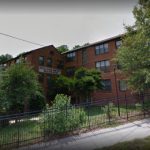
At issue is a complex of apartment buildings—four inhabited, one vacant—around the Congress Heights Metro station and across the street from a proposed pro-basketball arena on the St. Elizabeth’s East campus. Sanford Capital, which bought four of the buildings in recent years, has teamed up with Griffis of CityPartners to plan a gleaming new mixed-use apartment complex. But two major issues stand in their way.
First, there is the issue of the fifth building on the site, which is essentially under city control because of an unpaid loan and taxes. The Washington Post laid out the situation in an October article:
In 2008, businessmen Zed Smith and Kelvin Elmore purchased the property with a $920,000 loan from the D.C. Department of Housing and Community Development with a commitment to use the building to house District youth aging out of foster care. The redevelopment never happened, the debt was never repaid and the building remains vacant.
Legally, the city could now forgive the loan or take ownership of the property — something D.C. officials and developers say it rarely does.
[DHCD Director Polly Donaldson] said that the fate of the building was under internal review as part of a broader inspection of the District’s outstanding loans but that she hoped to make a decision “as soon as possible.”
In other words, the city could forgive around $1 million in loans and unpaid taxes to pave the way for the proposed development. Griffis says that it is in the city’s interest to do so because they have promised to build all 12 of the very low-income restricted units that Smith and Elmore had planned. Affordable housing activists, though, say if the city takes control of the building, it would be an opportunity to turn it into cooperatives and help Ward 8 residents build equity in their neighborhood before gentrification prices them out.
But even if the city does forgive the loan, there is the second roadblock: the remaining tenants at the complex would be entitled to purchase the building under the Tenants Opportunity to Purchase Act when the developers get a demolition permit. And that, activists say, is at the heart of the well-documented poor condition of the buildings. “They’re hoping to wait the tenants out,” Puryear says, until the electricity issues and rodents and trash and mold and leaks become so unbearable that they’ll leave before they get the chance to exercise their TOPA rights.
Tenants say their homes have become all but unlivable. Ruth Barnwell, who has resided at the complex for more than three decades, dates the problems to when Sanford Capital bought her building. Currently, she says, it remains infested with bed bugs despite complaints that date back to July. “I had to get rid of all my living room furniture,” Barnwell says, shaking her head before listing a litany of other complaints that ranged from safety to sanitation issues. After trying several avenues to get the issues fixed, the tenants filed suit in October with the Office of Administrative Hearings to try to get their rent reimbursed.
Still, the remaining residents—they occupy about a third of the sixty units, including the vacant building—say they aren’t budging and the developers should know that.
That’s what brought them, Congress Heights neighbors, and other activists from around the city to Griffis’ home in Cleveland Park on Wednesday. “We’re in solidarity with the tenants,” Puryear says. “They’re really being intimidated out of leaving the building so this gentleman can make millions.”
A sizable police presence, including three cruisers and several motorcycles, was also on hand even before the protest began.
A sizable police presence here too. pic.twitter.com/CnIu04OHrI
— Rachel Sadon (@Rachel_Sadon) December 17, 2015
Although Griffis is only one of several players, the activists put the former zoning commission official at the “center” of the deal.
“Sanford Capital chose Griffis for a very specific reason,” says Will Merrifield, the tenants’ lawyer, citing his close ties to city government. “He’s extremely politically connected to the Bowser administration. He’s the money man. He’s the guy who greased the political wheels to get a slumlord like this to do the project.”
From The Post:
There are a series of connections between members of the development team and Bowser’s campaign, and critics, such as neighborhood activist Eugene Puryear, say that those connections have stood in the way of city action.
CityPartners and members of the Griffis family gave $3,102 to Bowser’s 2014 mayoral campaign. Patrick Strauss, a principal of Sanford, and members of his family gave $3,753, according to campaign finance reports.
Griffis said in an interview he has known the mayor for years, considers her a friend and was a fundraiser for her mayoral campaign. Bowser recently appointed him to the National Capital Planning Commission. He dismissed any suggestion that his support was meant to produce political favors.
Two close Bowser allies in Southeast are also involved in the project: Phinis Jones, a prominent fundraiser and campaign coordinator for Bowser, and his business partner Monica Ray, who managed the campaign finances of Bowser’s pick to represent the local ward, Council member LaRuby May (D-Ward 8).
But Griffis found the protest baffling. He points out that he doesn’t own the buildings in question (his firm controls the part of the site at the Metro, which doesn’t currently have any residential units) and that the issues over their deplorable condition lie with Sanford Capital. “Is it a good situation? I don’t think it is personally, and that’s exactly what we’re trying to change,” he said. “CityPartners is based on doing good development in D.C. and we thought we would be able to provide a very positive change to that area.”
Griffis also dismisses the claim that his political activities have anything to do with favorable treatment around the deal. “I don’t have a personal relationship with the mayor,” he says, calling The Post’s description an obfuscation of their conversation. “I have hosted candidates for dozens of candidates. I’m a very active, committed person politically.”
But while Griffis makes the case that he’s simply an engaged citizen, Merrifield and others argue that the city hasn’t given the tenants the kind of help and attention they do developers.
“Too often, the city is in lockstep with developers and talk about public-private partnerships that has the city partnering with developers rather than with tenants,” Merrifield says. “We would argue the city should partner with the tenants in order to help them collectively purchase the building and turn it into cooperatives and allow people who have lived in Ward 8 all their lives to starting owning equity so they aren’t subject to the whims of companies like Sanford Capital.”
Citing Bowser’s oft-cited goal, Merrifield adds, “the path to the middle class starts with housing security and being able to build equity.”