Rachel Kurzius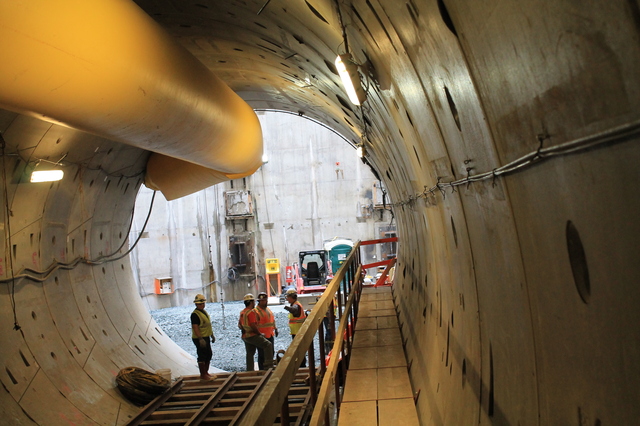
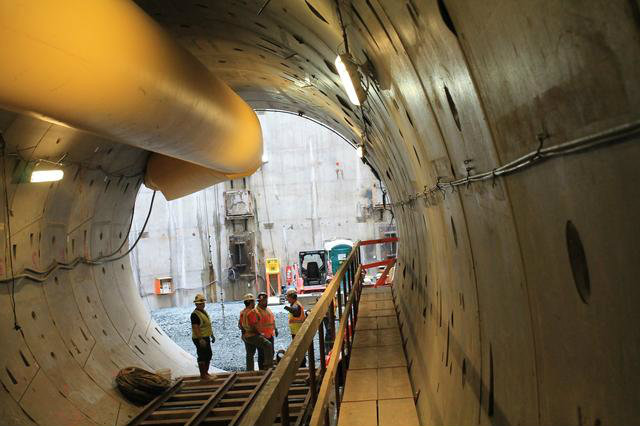 A view of the First Street Tunnel from just beyond its entrance. (Photo by Rachel Kurzius)
Tunnel boring machine Lucy Diggs Slowe finished work on the First Street Tunnel in Bloomingdale, as part of the First Street Tunnel Project.
I started mining in July. 552 rings and a half mile later, I’ve arrived at 1st and RI Avenue, NW. pic.twitter.com/7e3R4zD5I4
— Lucy Diggs Slowe (@LucyTBM) December 21, 2015
The First Street Tunnel is 2,700 feet long and 23 feet in diameter, built under First Street NW from Rhode Island and First Street, to the southwest corner of the McMillan Street. The machine has been creating about 50 feet of tunnel per day. Named after a local activist who was the first Dean of Women at Howard University, Lucy Diggs Slowe began digging in July.
“As long as she’s been mining, December has been our target” deadline, says John Lisle, D.C. Water’s chief of external affairs.
While the tunnel is a wrap, stage one of the project isn’t done until the tunnel is fully connected to existing sewers with diversion chambers, shafts, and adits (essentially mini-tunnels). That way, the tunnel will serve as storage for excess storm water.
The First Street Tunnel is part of the Clean Rivers Project, a plan D.C. Water says is the largest infrastructure project in the city since the Metro was built. It’s a network of storm water storage facilities to assist the city’s century-old sewers during heavy storms, when polluted runoff dumps into the Potomac and Anacostia Rivers.
According to Lisle, substantial completion of the First Street Tunnel Project is expected by June 1. Earlier this fall, D.C. Water projected it would be completed by the spring. The FAQ section of the website still projects an end to construction operations in March 2016.
“Some aspects of the project are behind schedule,” he says. “We are still hoping to make up some of that time and get it done sooner. ”
For instance, work was delayed at the construction site at the intersection of Adams Street and Flagler Place when contracted Skanska Jay Dee workers had to unexpectedly change out a water main.
Once stage two is completed by around 2022 or 2023, storm water will be piped to the Blue Plains Advanced Wastewater Treatment Center, where it will be cleaned to near-drinking water quality before its release into the Anacostia River. For now, it’ll be sent to a temporary pumping station.
Some parts of Lucy Diggs Slowe—namely the shield and cutterhead—”are not going anywhere,” says Lisle. The rest of the 1,600 ton machine will be disassembled and taken out of the ground; Lisle says 99 percent will be recycled. The machine previously performed a job in Dubai.
This will be the second tunnel boring machine to finish work on the Clean Rivers Project. Lady Bird was decommissioned in July. while Nannie is digging a launch shaft near RFK Stadium.
Put a bow on me – that’s a wrap! Tunnel is complete. Only thing I’m digging now is eggnog. pic.twitter.com/ypqzcptcHF
— Lucy Diggs Slowe (@LucyTBM) December 21, 2015