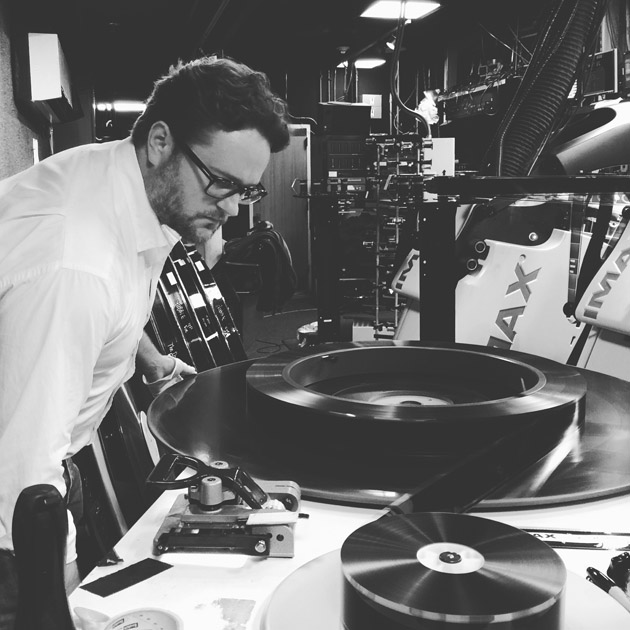
 Director of Smithsonian Theaters, Zarth Bertsch, prepares Star Wars: Episode VII before the movie opens in the Air & Space Museum’s IMAX theater. Courtesy: Zarth Bertsch
An unusual holiday convergence treated area moviegoers to what may be one last gasp in the film vs. digital wars. Last month, a handful of multiplexes in the area brought in 70mm projectors (installed by Boston Light and Sound) to screen the roadshow version of Quentin Tarantino’s The Hateful Eight. Staff at AMC Potomac Mills, which a reliable source tells me did a great job projecting 70mm film, told me that the analogue equipment would removed at the end of the engagement, which concluded last night. (Note: the AFI Silver continues to show the 70mm Roadshow version of The Hateful Eight). But just as Tarantino brings film back to the multiplex, albeit for a limited time, one of the great film experiences in the area is about to make the switch to digital. I spoke with Zarth Bertsch, Director of Smithsonian Theaters, about converting the Air and Space Museum’s Lockheed Martin Theater from 70mm to IMAX with laser digital projection. His answers to my questions have been edited for clarity, and to minimize the number of times I said “Wow.”
DCist: First off: where do you stand in the film vs. digital debate?
Zarth Bertsch: Well I’ve always been a very passionate supporter of film. We are strategically making the change to digital at a time when it makes the most sense in terms of quality of technology and industry factors, in particular the availability of new content. We have really waited until the optimal convergence, and laser is the first significant fundamental change or improvement in digital technology since the advent of digital projection. Now, you can have a real debate about whether 70mm film or IMAX laser digital is better. Before, no one would ever say they chose conventional digital because of quality—that choice was made because of cost or versatility or content; but in this case I sincerely believe you can argue that laser is a step forward in a number of technical attributes. While not every filmmaker is necessarily going to agree, it’s still a viable case to make. I personally am very enthusiastic about the laser.
DCist: Tell me about the new technology—are the files that you’re delivering the same as a commercial theater would be presenting but with a new projection technology?
ZB: It’s both a different file and a different projection technology. Let me make a quick reference to the Steven F. Udvar-Hazy Center’s Airbus IMAX Theater. It made the list of Wired Magazine’s “Top Seven Screens in the US to Watch Star Wars: The Force Awakens”. Coincidentally that’s an IMAX laser installation, and that’s why it’s considered one of the top places to see it. [The Force Awakens director] J.J. Abrams has said the best way to see it is in IMAX laser or in 70mm on a giant screen.
Now, when you are projecting laser you have all of the technical attributes of laser projection technology, like color gamut, resolution and contrast ratio, and the density of the blacks. The reason I particularly mention density of the blacks is that this is one area where laser truly blows out even 70mm film as well as conventional digital.
As much as I love 70mm film—and trust me, it’s gorgeous—when you’re projecting it on a screen, black is more of a gray. With conventional digital, it’s more of a cold gray and with film it’s more of a warm gray, but it‘s still a dark gray, and you can see that relative to the masking of the screen when the lights are off. With laser digital you can get a density of black that is almost indiscernible from the masking around the theater. What the filmmakers can do with that is exceptional, particularly if the content is space related, be it documentary or in this case Star Wars. When you have a true white on one end of the spectrum and a full density black on the other, what you can do in between instantly changes. It really impacts everything. That’s one area in which it blows film out of the water.
DCist: Wow.
ZB: When you get to things like sheer resolution there’s a lot of debate on what the equivalent would be of IMAX 15-perf 70mm film in digital resolution. Sure, 70mm in sheer resolution would still be the leader. But when you get into other technical attributes you could really make the case that laser is better. I’m someone whose background has long been in film, and for the first time I don’t feel that we would be compromising at all. Other than the fact that’s there a certain visual warmth to film (an artistic preference, not necessarily a strength), in a number of respects we’re actually taking a notable step forward.
Getting to your other question about whether or not the files are different, the files are different because they are both mastered for a 12-channel IMAX sound system, which includes ceiling speakers (which makes a real difference), and they go through a process where directors basically trust and hand their material off to the IMAX post-production group. You are getting a level of quality that is notably higher; the size of the files are different, the content is literally different.
One other attribute in which the laser is a tremendous step forward is the 3D. For the first time you really have 3D that’s properly bright. By definition, with 3D you have to have two images and you’re effectively putting sunglasses on, so you need more than twice the brightness. If you see Star Wars: The Force Awakens in laser IMAX 3D, those desert scenes are just as bright in IMAX 3D as they are in the 70mm 2D experience that we have here on the National Mall. Which is really cool.
People are understandably passionate about 70mm film—I’m very passionate about it [I am too]—I really take a lot of pride in our decision to wait to convert till the right time. And I think laser will absolutely blow you away.
The final screenings of Star Wars: The Force Awakens on 70mm film at the Air & Space Museum’s Lockheed Martin IMAX Theater are this Sunday, January 10. The theater is closing on January 11th to make the switch to IMAX laser; it will reopen in early March.
Watch an IMAX featurette here: