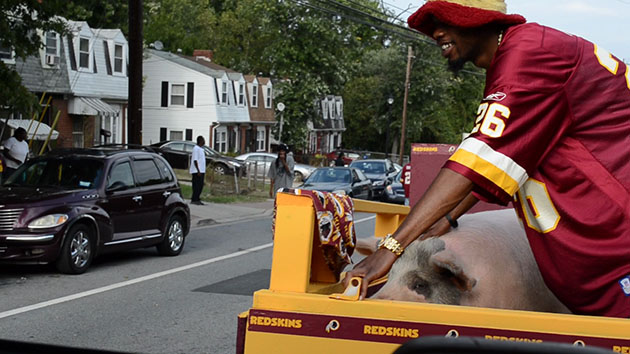
 A still from Sweaty Betty (Breaking Glass Pictures)
Indie comedy Sweaty Betty has only opened in a few markets, but it’s already earned good marks from the New York Times and Indiewire. The low budget, amateurish movie was shot in low-income neighborhoods in Cheverly and Landover, and observes the daily life of two single dads and a thousand-pound hog. First-time directors Joe Frank and Zachary Reed are Prince George’s County natives, and give audiences a look into a side of the Washington area that most moviegoers will not be familiar with. DCist chatted with Reed about the film. His answers have been edited for clarity.
DCist: How did you stumble on the Charlotte the pig story? Did you know Floyd (the pig’s owner) before you started making the movie?
Zachary Reed: We met Floyd on Route 202/Landover Road. We used to see the pig in our neighborhood and wondered, “Who has a pig?” We saw it walking around the neighborhood like a dog. That’s how we found it.
DCist: Why did you make the movie in Cheverly?
ZR: My co-director Joseph lives in the heart of the town of Cheverly, and I live in an apartment there. Scooby and Rico crossed over and came to our basketball court, so we met at school. I grew up in an apartment right behind Scooby’s house.
DCist: The movie is described as a mix of documentary and fiction. At one point Scooby tells a heartbreaking story about his baby’s mother dying in a car crash. Did that really happen?
ZR: That’s the truth. Scooby was actually in a coma for five days and we had to stop the movie for a little while just hoping that he’d make it through.
DCist: How did you and Joe meet and start making movies?
ZR: We went to middle school together. He went to Eleanor Roosevelt and I went to Fairmont Heights. The movie thing came about … we have a lot of good friends and family and we’ve seen a lot of good moments that we wished we could have put on film. So we said, let’s come up with an idea so we can put it on film. Joe would step back and analyze things and think things through. We kind of modeled our film after Larry David’s Curb Your Enthusiasm.
DCist: I’ve read about some of the movies that influenced you guys—can you tell me what influenced you about [director Takeshi Kitano’s Sonatine?
ZR: We’ve had our differences. [Straight Outta Compton director F] Gary Gray is more my style, while Joe’s style is more Sonatine—that’s probably why he used subtitles to help people understand our slang.
DCist: At the beginning of the movie, Rico talks about wanting to bring hope to the hood. How do you feel your movie and the attention it’s getting is affecting the community?
ZR: We’re kind of overwhelmed at the moment. We’re thankful and appreciative, though we’re not getting too much attention outside of the DMV. We’re striving to show young people that there’s other things to do than rapping. Even if it reaches just two or three people, that would be awesome.
DCist: What was the hardest part about making the movie?
ZR: The hardest part was that I couldn’t be as much a part of it as I would have liked to. Not being able to be involved with the film as much was hard. But Joe would bring footage to my house and we worked on material together—team team team! We took pride in being opposites. Joseph was more like, “I don’t think we can do this,” and I was more, “C’mon Joseph we can do this!” I was hoping for the best and he was more “I don’t know …” I just wish I was more a part of the filming aspect.
Throughout the whole process it was a great learning experience. For the next film I’m hoping I’ll have more free time, and the next film will be a lot better.
DCist: Will you keep filming around your community?
ZR: For the most part. It depends on our backing. This film was paid out of pocket and we’re hoping we can get some kind of distribution next time, not necessarily to pay for the whole thing but for help.
DCist: How much did it cost to make?
ZR: Around $15,000 to $18,000.
DCist: It’s great to see the real P.G. County in a movie.
ZR: It’s a different view of P.G. County. It has a high crime rate, but we wanted to do something different—we don’t want our community to be viewed in that nature all the time.
DCist: Is the neighborhood changing at all?
ZR: Slowly but steady. People can’t change unless there’s change around them.
Sweaty Betty is available on DVD and VOD.