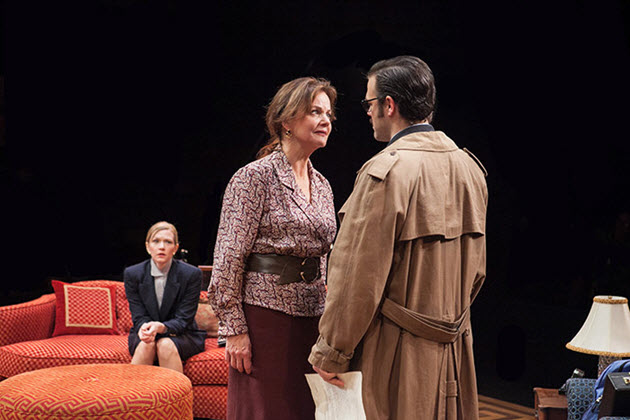
 Caroline Hewitt (seated), Margaret Colin, and Michael Simpson in City of Conversation at Arena Stage. Photo: C. Stanley Photography
The City of Conversation, the latest offering from Arena Stage, centers on Georgetown hostess and socialite Hester Ferris. The play follows her family from the end of the Carter administration through the Reagan years and to President Barack Obama’s inauguration. Now that this very D.C. play is having its Washington debut, DCist sat down with two of the production’s actors: Michael Simpson and Caroline Hewitt, who play Hester’s son and his conservative girlfriend, respectively.
How do you think contemporary Washington audiences will react to seeing three decades of their history on stage?
Caroline: I think it will be exciting for them. Our playwright, Anthony Giardina, has done a brilliant job of expressing the ups and downs of living in a place so influenced by the tide of politics. And I think it will be really satisfying for people who live here to see that played out in the show.
Michael: I should admit that I am answering this question after having just come off stage from our first preview. I can tell you that people are always humbled, eager, and grateful to see themselves reflected back to them. It’s one of the central ideas behind what makes theater powerful and relevant. Washington, D.C. is no exception in this case—that was the most engaged preview of my entire career. It felt like everyone’s bloodstream was carbonated.
This production is also kicking off an election year. Do you think City of Conversation will be—forgive me—a conversation starter for audiences as we approach the presidential primaries?
Caroline: Yes! It’s been fun in previews to feel the support of the audience while various political arguments are made on stage. With so much response during the show, I can only imagine that the dialogue between audience members will continue well after they have exited the theater.
Michael: In my personal opinion, that’s the goal. That’s the great brass ring for any play… that it should start a conversation that could potentially begin a shift. Human beings, regardless of their place in history, have always thought something needed shifting. And theater has always acted as either a spark plug or compass for just that very thing. I think this play does both.
Caroline, as your character Anna is a conservative Republican, have you derived any inspiration from the field of 2016 Republican candidates?
Caroline: To be totally frank, I have not. But having researched politics in the ’70s and ’80s, which I had previously known very little about, it has been incredibly interesting to see the ways the current Republican candidates are influenced by, and respond to, politics from that time. I recently heard Chris Christie mention that he wants to be like Reagan and that politicians in D.C. are out of touch with the rest of America—so, it’s interesting that the arguments in the play are still so present in current politics.
Have either of you had a chance to visit Georgetown, the central setting of the play, while you have been in Washington? If so, what were your favorite parts or most interesting observations?
Caroline: I have visited briefly, and was overwhelmed by the quaintness and staggering amount of high-end shopping available! My character is from a small town in Minnesota, so I enjoyed imagining the awe and intimidation that she would feel driving through such a luxurious neighborhood in the moments before the play starts.
Michael: I’m personally struck by its architectural beauty, a singular aesthetic—as if Norman Rockwell and Tim Burton co-created it. The secret and elusive inside of the Georgetown home is the real prize. Unfortunately, I have yet to be granted entry.
In “The Ruins of Georgetown”—the 1996 New Yorker article which inspired playwright Anthony Giardina, Sidney Blumenthal argues that the “death of privacy” and a “lack of trust between press and politicians” damaged Washington society. Would your characters, Colin and Anna, agree that there is a strained relationship between the press and politicians?
Michael: In the words of my character: “Don’t answer that…”
Michael, you are reprising the role of Colin from the original New York production. How has it been to return to this play and your character?
Michael: I love this question because I’ve been telling everyone the answer to it before they even asked. Creativity is my favorite thing in the world. The opportunity to see certain minds that I’ve come to adore illuminate new ideas in familiar territory is a particularly rare privilege, and I wouldn’t have missed it for the world. I’m fully aware of how sappy and obnoxious these statements sound, but if I said anything else it would be a lie. The great nuance here is that this production is a combination of new and returning co-conspirators. [Director] Doug [Hughes], [Costume Designer] Catherine [Zuber] and John Lee [Beatty, Set Designer] are all realizing brand new choices this second go-round, and they’ve inspired me to do the same. I think every actor should immerse themselves in this type of a reprisal if they get the chance. The whole experience for me has been like the best version of a Masterclass—except that I’m getting paid instead of the other way around.
What do you hope audiences will gain from City of Conversation?
Michael: A heroic dosage of novelty [and] the ability to second guess and reconsider what is most likely their already firmly established ideas—whatever they may be. And the ability to refrain from dismissively vilifying those very ideas that oppose their own.
Caroline: I enjoy playing a character who feels differently about a lot of political issues than I do. Seeing people try to negotiate divergent points of view on stage is exciting in part because it reminds us that conversations are possible even when the stakes are tremendously high. And while we may not agree with those we are arguing against, we can still understand them. I have felt so lucky to have had the opportunity to approach my character in this way, and I hope the play will encourage such empathy.
The City of Conversation runs at Arena Stage through March 6. Tickets are available online and over the phone at 202-488-3300.