Rachel Kurzius
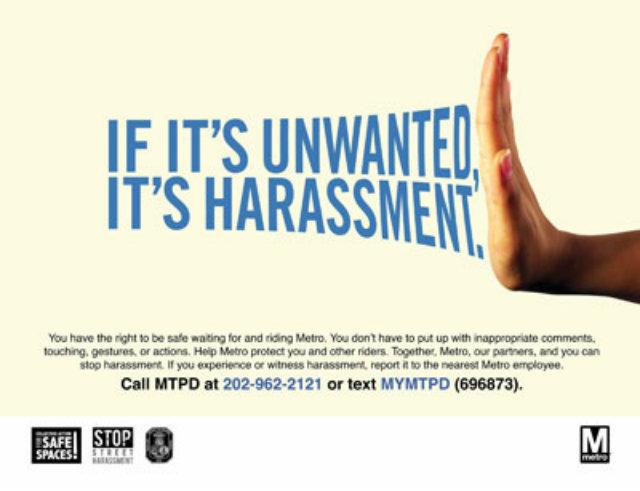 Via WMATA.
It’s easy to find people complaining about Metro, but advocates against sexual harassment sing a very different tune.
“They have been so fantastic,” says Jessica Raven, interim executive director of Collective Action for Safe Spaces.
“Washington D.C. is doing the most of any transit system in the country to address this issue,” says Holly Kearl, founder of Stop Street Harassment.
Metro has committed to a new wave of anti-sexual harassment advertisements for 2016. Both groups are working to develop advertising that puts a focus on bystander intervention, according to Raven.
The two previous phases of the ads had different aims: the first focused on validating the experiences of people who have been harassed, while the current ads target potential harassers. “The goal is to create a culture where we’re showing harassers that their behavior isn’t tolerated,” says Raven. “We’ve always accepted this as a part of our lives, so people don’t report it. But you don’t have to experience harassment.”
Raven says that WMATA has already seen an uptick in reported incidences in harassment—32 in 2015 as compared to 28 in 2014. (Both she and Kearl say the number of incidences is much higher than reported.)
Where the new ads will go and precisely what they’ll say depends on the results of a survey that Metro conducted with the help of CASS and SSH.
“We kept saying that we would love to have data, to see if people remember the ads,” says Kearl. “It’s expensive to get a representative survey done. We were surprised and thrilled” when Metro offered to help.
Raven says that advocates “were going to canvass at Metro stops,” and she was relieved when the transit agency stepped in with an assist “to collect data and guide solutions.”
“We hope to gain a regional perspective and use this tool as an additional measure of success,” says Morgan Dye, a Metro spokesperson. Dye says that the survey focused on three major components: whether customers experience sexual harassment or assault on Metro; if riders know how to report those incidents; and the impact of the previous ad campaigns.
Metro Transit Police tracks all reports of sexual harassment, even if they’re not technically considered crimes.”Most of the incidents are simple assault, involving some sort of sexual touching or indecent exposure,” says Dye.
The transportation agency wasn’t always such a willing partner for these advocacy groups. Back in 2012, when CASS spoke in front of the D.C. Council about harassment on Metro, a WMATA spokesperson Dan Stessel said, “One person’s harassment is another person’s flirting.”
But it may have been that controversy which led to the partnership between Metro and opponents of sexual assault. “They called three weeks later and they’ve been great to work with ever since then,” Kearl says.
And Metro isn’t the only one taking a look at sexual harassment. Mayor Muriel Bowser’s Vision Zero plan—which aims to eliminate fatalities and serious injuries to people using D.C. transportation systems—includes the establishment of a task force to “develop policies and practices that thwart street harassment.”
Potential solutions are not limited to task forces, though. Following the D.C. Council’s first roundtable discussion about street harassment in December, At-large Councilmember David Grosso asked the D.C. Commission on the Arts and Humanities to consider funding grants for artists to address the issue using murals.
DCCAH Executive Director Arthur Espinoza said in response that, “The arts can serve as a catalyst for change and bring healing to a community. I am happy to explore what options may exist with regard to DCCAH participation to help remedy this serious problem.”
Others are using humor to address it. Local comedians recently released a video where they heckled dogs to point out the ridiculousness of catcalling.
Last year, SSH released a national survey that found 57 percent of women across the country had experienced verbal harassment, and 41 percent of all women had experienced physically aggressive forms of harassment. For men, 25 percent experienced street harassment, too, including 18 percent who experienced verbal harassment and 16 percent who experienced physical aggression.
If you have been harassed, threatened, or assaulted on Metro, you can: call (202-962-2121), text MyMTPD (696873), or fill out an online form.