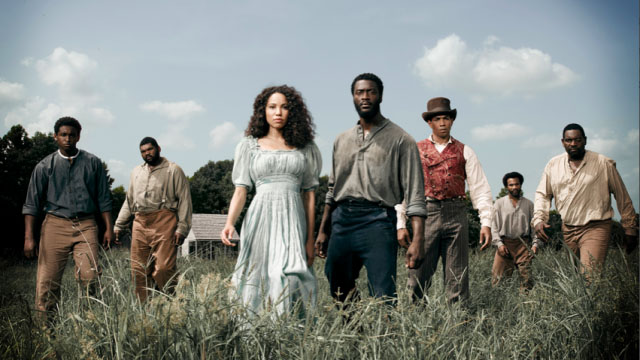
 Renwick Scott, Theodus Crane, Jurnee Smollett-Bell, Aldis Hodge, Alanom Iller, Johnny Ray Gill, and Mykelti Williamson (WGN America)
By DCist contributor Dominic Griffin
On the surface, WGN America’s latest series Underground may seem like another PBS regurgitation of American history. But there has probably never been another show like this on television. A multifaceted exploration of the Underground Railroad, the series is a snapshot of a horrific period in this country’s past, with a distinctly contemporary approach.
“We wanted to be bold in our storytelling.” said co-creator Misha Green, hours before the pilot screened at the White House last month. The inaugural episode opens with the screeching blast of Kanye West’s “Black Skinhead” as series lead Noah (Aldis Hodge), a runaway slave, hides in the woods from captors. Noah’s labored breathing is timed to mimic West’s exhalations, and it’s not the last time the show uses anachronistic music.
Green and writer Joe Pokaski met working on “Heroes,” where they initially cooked up the concept. Underground is set on a plantation run by Tom Macon (Reed Diamond), and the cast sprawls out from his vast operation. Ernestine (Amirah Vann) is the head house slave who goes to extreme limits to protect her children, namely Rosalee (Jurnee Smollett-Bell). Out in the fields, Noah is a slick operator who feigns ignorance while masterminding a complex escape plan. At the fringes of the narrative, John Hawkes (Marc Blucas) and a mysterious farmer named August (Chris Meloni) are men who seem bound to cross the paths of the Macon crew.
You might expect a level of tear-jerking and handwringing from this setup, but this isn’t that kind of show. There is a long-accepted cinematic vernacular for dramatizing American slavery, and Underground subverts those expectations.
“It is not, in any way, a Merchant/Ivory movie,” said executive producer and Academy Award winner Akiva Goldsman. “It is about genre. It is a show that moves you through a narrative with a genre-like pace. Don’t come to school, but still leave having learned something.”
Red Tails director Anthony Hemingway helmed the first four episodes, and from the show’s opening moments he commits this world to a breathless, bravura pace that edges right up next to absurdity—without crossing into parody. There are sweeping camera movements, operatic montages, and a startling lack of restraint. The art house torture porn with which director Steve McQueen imbued 12 Years A Slave is all but missing, as Hemingway relies on a sustained sense of dread punctuated by pulpy excursions into action and adventure. Tonally and structurally, “Underground” has far more in common with “Prison Break” than “Roots.”
 Aldis Hodge and Jurnee Smollett-Bell (WGN America)
More happens in this show’s first four episodes than some series accomplish in their entire freshman season. Plots are built on a series of successive turns, each flashier and more gasp-worthy than the last. This may be the first mainstream narrative about slavery that feels tailor made for wine-soaked livetweet sessions and early morning watercooler chatter than solemn tragicomfort. The show’s creators did copious research into the time period and chose to focus on its most melodramatic elements. Pokaski name checked Gone with the Wind a lot when asked about cinematic influences, and it shows.
Underground is far from perfect. Though its pulp leanings are unexpected, there’s something a little rote about the soap opera storytelling, and a number of twists seem shocking simply because you wouldn’t think a show about the Underground Railroad would find such prurient delight in trashy romance tropes. But once you’re fully immersed in this world, each orchestrated moment of outrage feels as calculated as anything you’re likely to see in Shondaland. For every harrowing scene where a field slave drowns her newborn child so she doesn’t grow up a slave, there’s a comic scene of a slave forced to seduce an elderly woman in exchange for the theft of a revolver.
Dissenters may argue the show’s irreverence equals exploitation, but the show remains the voice of a woman of color in a world where such voices often drown in a sea of white male nerds. If Quentin Tarantino can turn the horrors of slavery into his own personally fetishized rock opera, why can’t a black voice mine that same era for thrills? For all its foibles, the show provides a bevy of fantastic roles for black actors. In Ernestine, Amirah Vann has the breakout role of the television season, falling somewhere between the assertive power of Taraji P. Henson’s Cookie Lyon on Empire and the scenery chewing gravitas of Joe Morton’s Eli Pope on Scandal.
Vann herself relished the opportunity to take on this challenging character. “You get to be sexy. You get to be passionate. You get to be spiritual,” she said. “You cover the whole gamut of a human being.” Her co-stars share similar sentiments. Alano Miller, who plays Cato, was attracted to the pilot script, asking, “When do African Americans get to play these characters?” It’s a fair question.
“Underground” debuts tonight at 10 p.m. EST on WGN America.