 Rachel Sadon
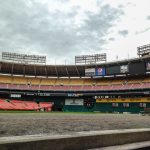
After leaking plans to The Washington Post and the Wall Street Journal, Events DC went to the community last night to unveil long-awaited plans for the future of the land at RFK Stadium. Around four hundred people showed up, eager to hear what lay in store and to share their many, many opinions about it.
Star architecture firm OMA and consultants offered up two overarching concepts for the site, one which reconfigures the street grid (dubbed the North-South Axis) and another which leaves the current road structure roughly intact (called Stitch). From there, each option was further envisioned with a 65,000 seat NFL stadium, a 20,000-seat arena, and “no anchor.” All of the plans included a significant amount of green space, increased integration with Kingman and Heritage islands, and community amenities.
After D.C. United vacates the current stadium for their new home at Buzzard Point, the site’s 190 acres (much of it currently parking lots) will be opened up to a whole host of possibilities. But they are constrained by the terms of the lease with the National Park Service, which expires in 2038 and mandates the land be used for a stadium, “recreational facilities, open spaces, or public outdoor recreation opportunities,” or similar public uses. As for bringing back the Washington Football Team, Secretary of the Interior Sally Jewel has made it clear that she won’t allow it while the racist name remains in place.
So as Ward 6 Councilmember Charles Allen put it: “The elephant in the room is is there going to be a stadium or not?” But although he expressed his opposition to that use of the site (drawing scattered applause), Allen encouraged the crowd not to get bogged down by the debate over the site’s long-term future. “What would be a waste of this is for another decade to go by while they make this decision.”
Events DC president Gregory O’Dell said that three general principles guided the conversation: activities that fit within the current lease structure, family-friendly programming, and short-term options to “get something done now instead of fretting about what we can’t do and can’t control.”
To that end, OMA’s presented plans included both a short-term and a long-term scenario for each of the options. Potential programming over the next few years could include an ice-rink, indoor track center, band shell, splash park, sports fields, and an amphitheater.
In the long-term, both of the overarching designs featured options for a stadium, arena, or neither. While the stadium and arena plans are more concrete, the “no anchor” option was vague, with mention of some possible “cultural use” like an aquarium or science museum. During the discussion and Q&A phase, one woman pointed out that “calling it a ‘no anchor concept,’ branding-wise there might be a better name for it.”
Most people seemed to prefer the North-South Axis design to the Stitch concept.
Many of the concerns raised were focused on transportation, parking, Metro integration, and the general accommodations for the tens of thousands of people who could possibly be visiting the site at once. In the North-South concept, the plans include approximately 8,700 parking spaces under the 65,000-seat NFL stadium scenario and 6,900 for the 20,000-seat arena scenario.
Having enough parking was among the concerns of Deputy Mayor for Greater Economic Opportunity Courtney Snowden, who was seated at a table with Allen and Ward 7 Councilmember Yvette Alexander. She favors a large-scale sports facility of some kind. The site “needs a stadium or an arena,” Snowden said. “I think we need an anchor—one that produces good paying jobs.”
Other people brought up the environmental impacts of the plans, especially considering the infilled marshland and the site’s proximity to the waterfront.
“One hundred year flood plains aren’t one hundred years any more, they’re more like ten,” said Toby Mues, a fan of the football team who lives about five blocks from the site.
Although he was wearing a red-and-gold t-shirt, Mues isn’t quite sure if he’s in favor of another stadium or not. “I would like it if it worked—I’d love to be able to walk to a game—but I don’t want [a stadium] to be just it,” he said, pointing out that the fields on major stadiums and arenas don’t get used by the public.
Residents also frequently mentioned accessibility to the site’s amenities, especially given the possibility of a Chelsea Piers-like facility. Fees at the Manhattan sports-and-entertainment complex range from a $10 pass to go ice skating to a $175/month membership to the sports center.
“We don’t have enough details on any of this stuff yet,” said Meredith Holmgren, who lives in Kingman Park and also expressed concern over the kinds of retail that might come along with these visions. “The Verizon Center is credited with this economic upturn in D.C. but the local businesses and the Chinatown community can no longer engage … these tacky anywhere America type of businesses, we wouldn’t want that.”
As for what the crowd would want: there was also a healthy mix of supporters of a stadium or an arena and those that were opposed. Suggestions for alternatives ranged from the plausible (a world-class aquarium or science museum) to never-going-happen (moving the National Zoo and repurposing the land in Woodley Park). Several people mentioned that they would prefer if the city worked to change the terms of the lease with NPS to allow for much-needed housing. Yes, someone also mentioned a velodrome.
“This is a once in a lifetime effort to reimagine this site,” said Max Brown, the chair of Events DC.