By DCist contributor Bridget Dicosmo
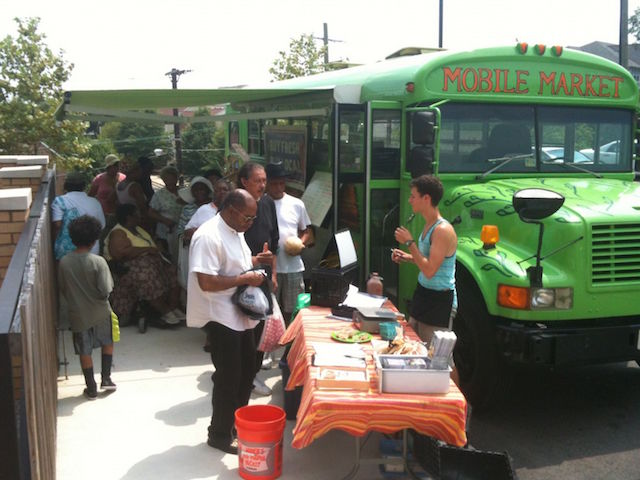
Potatoes and apples topped out 2015 as the products most purchased with WIC vouchers at Mobile Market, D.C.’s rolling farm stand, according to data provided by Arcadia Center for Sustainable Food and Agriculture.
That seems insignificant, until you consider that grocery stores often deem similar data proprietary, says Arcadia’s executive director Pamela Hess. Mobile Market’s new point of sale app is opening up access to that type of information.
“What we want to do is find out why” people purchase what they do, Hess says. Understanding how people use nutrition assistance programs such as WIC (the Women, Infants, and Children federal grant program) may help tackle food access challenges by facilitating a closer look at what drives purchases.
The popularity behind potatoes and apples might be that they are relatively cheap and shelf-stable, or that WIC shoppers save produce vouchers toward putting together a nice Thanksgiving spread, Hess notes. If researchers figure out how to motivate purchases of nutrient-dense produce like cabbage and kale, it can help fuel ideas to ease formation of healthy habits.
In 2010, food policy researchers documented an inadequate number of full-service grocery stores in Ward 8, with just one grocery store per 23,000 residents, a marked difference when compared to Ward 3, which boasted one grocery store for every 7,300 residents.
Today, the number has dwindled from seven stores in Wards 7 and 8 to a meager three, according to Beverley Wheeler, DC Hunger Solutions director. The organization is expected to update a six-year-old report later this month, which should amplify focus on the widening “grocery gap”.
“The disparity has worsened for Wards 7 and 8,” Wheeler says in an email. The newer data shows a stark contrast in the sociodemographic and socioeconomic disparities between the parts of the city that have and do not have grocery stores, she says.
The gaps remain despite continuing efforts aimed at improving food access in these wards. That includes passage of the FEED Act, which targets food access in low-income neighborhoods, and the formation of D.C.’s own Food Policy Council, which was established over a year ago to coordinate citywide efforts to improve food access and grow the local food economy.
And improvements in data could further spur incremental successes in getting healthy food to the District’s “food deserts”, areas defined by the Centers for Disease Control and Prevention as lacking access to affordable produce and other components of a healthy diet. They are commonly linked to disproportionate rates of chronic illness, including diabetes and hypertension.
“The diabetes rates in Ward 8 are more than five times higher than in Ward 3,” says Lauren Biel, executive director of DC Greens. “The fact that food-related chronic illnesses are plaguing communities of color in the nation’s capital is shameful.”
During U.S. House Committee on Agriculture hearings on SNAP earlier this year, Hess says lawmakers raised questions over access to data on what users of the federal nutrition assistance program are buying.
Data collected from the point of sale system could supply some of that information, an unexpected win for what started out as an app to expedite transactions at 19 Mobile Market stops. “It’s bringing a new approach to data,” Hess says, respecting privacy while still allowing researchers and policy makers to examine purchasing behavior. Arcadia is seeking to get the app in the hands of at least 25 different vendors in the District to expand the dataset.
Another somewhat unexpected win has been for DC Greens’ Fruit and Vegetable Prescription program, which works with health care providers to get low income patients with high risk for obesity-related illness better access to fresh produce. The program lets doctors issue “prescriptions” to be filled at farmers markets, or “farmacies”, with the aim of increasing family members’ daily servings of produce.
But the program appears to provide an unexpected incentive — fresh fruits and veggies — for people to maintain regular doctors’ visits, Biel says.
In the first year, the cooperating clinic saw more than a 61 percent jump in patient retention among those participating in the FVRx program. In terms of a carrot-and-stick approach, “I joke that it’s a literal carrot to go see your doctor,” Biel says.
Guaranteeing a healthy food stream for all D.C. residents is likely to require an increased city investment, according to Biel, but in the interim, some are starting to eye bigger picture goals.
DC Central Kitchen, for instance, is looking at identifying future sites for addressing what chief development officer Alexander Moore calls a “critical gap” in infrastructure for food processing and distribution — which could help in taking advantage of surrounding farms and urban agriculture. “There’s a lot of missed opportunity in getting healthy food to the right places and the right people,” he says.