 Rachel Sadon
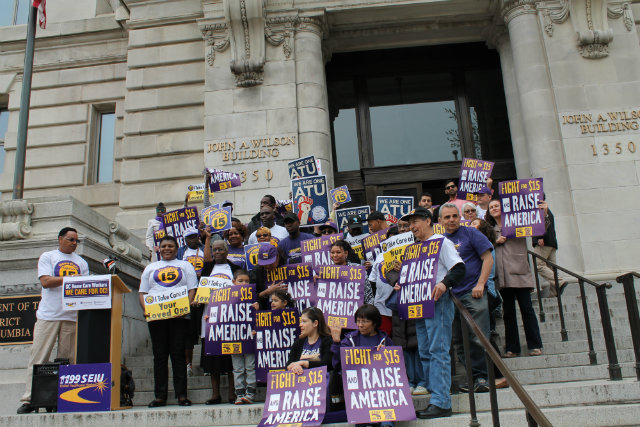 Photo by Rachel Sadon.
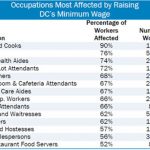
Amid a national debate over the $15 minimum wage and two competing proposals for implementing it in the District, a new report found that 14 percent of the D.C. workforce would be directly or indirectly affected by such an increase. And of the estimated 114,000 people who would benefit, 80 percent are workers of color, according to the Economic Policy Institute study.
A 2013 law gradually raised the wage from $8.25 up to $11.50 in 2016 (the final pre-determined hike goes into effect on July 1, and from there on out, the wage is tied to the increase in the Consumer Price Index). But with the city’s wage gap between the rich and poor at a 35-year high, activists say it isn’t enough—and Mayor Muriel Bowser agreed.
Bowser proposed raising the minimum wage to $15 by 2020, with a corresponding increase for tipped workers to $7.50 by 2022. Meanwhile, a ballot initiative (Initiative 76) that has been in the works for over a year would also raise the minimum wage to $15 by 2020, but it would also extend that wage to tipped workers by 2024.
Seven in 10 District residents said they would support a $15 wage, according to a January D.C. Vote-Washington City Paper poll. Should either proposal pass, as is widely widely expected, the city’s wage floor would be about 20 percent higher than it would be otherwise.
The EPI report looked at exactly who would benefit, finding that more than half (52.6 percent) are women and the vast majority (97.5 percent) are adults.
It would also disproportionately affect workers of color. While African Americans account for about one-third of the District workforce and Hispanic workers represent 11 percent, combined they make up nearly three quarters of the population that would be affected by a $15 minimum wage.
After a complicated situation with the Board of Elections, a coalition backing Initiative 76 says it is well on its way to collecting the necessary signatures (5 percent of registered voters, or about 21,500) for it to appear on the November ballot. On a press call, Delvone Michael, the executive director of DC Working Families and a co-chair of DC for $15, said they have 20,000 raw signatures; a small sampling showed about half of those are valid. Contrary to a report in PoPville, activists affiliated with the coalition say they are paying signature-gatherers $15 an hour; another group is paying $2.25 per signature.
Meanwhile, Bowser remains committed to her proposal, which would significantly raise tipped workers’ base wage but keep a tiered wage structure in place. “Most tipped workers make more than $15,” Bowser said in an interview with NewsTalk earlier this week. “I’m concerned about what would happen if we eliminated tips.” The Restaurant Association blasted even the $7.50 base as a “worrisome game changer.”
The report, though, uses the example of states that already guarantee the same minimum for tipped workers to argue in favor the single wage.
“This is not some radical new idea. There are eight states that have already eliminated their tipped minimum wage,” said David Cooper, the author of the report and a senior analyst at EPI, adding that all but Hawaii have data going back decades. The report cites a study that showed tipped workers made 20 percent more per hour (measuring both base pay and tips) in states that had a single minimum wage in 2013, in comparison to those that used the federal tipped minimum wage of $2.13 per hour.
Jessica Wynter Martin, a tipped worker, compared her experiences working front of house jobs in San Francisco and the District. Despite similar costs of living, she found a “dramatic downward shift in my standard of living” after moving to D.C., which has a minimum wage of $2.77 for tipped workers.
Should either the initiative or Bowser’s legislation pass, an estimated 70,000 people would be directly affected and another 44,000 people would likely get a raise as a result of a “ripple effect.”