Rachel Kurzius
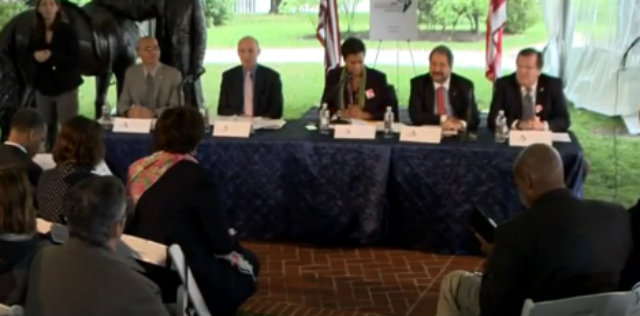 The members of the New Columbia Statehood Commission release their draft constitution.
You can’t run a marathon without taking your first step, and you can’t achieve statehood without a constitution.
Hence Mayor Muriel Bowser’s release of a draft constitution this afternoon, which outlines how the state of New Columbia would function in the city’s ongoing bid for full autonomy as part of her announcement that she’s pushing for a statehood ballot initiative in November.
Flanked by the other members of the New Columbia Statehood Commission—D.C. Shadow Senators Michael Brown and Paul Strauss, U.S. Shadow Representative Franklin Garcia, and D.C. Council Chair Phil Mendelson—Bowser noted that the event taking place at Lincoln’s Cottage, where the president penned the Emancipation Proclamation, was of special significance.
“This is a very exciting day for the District of Columbia, soon to be the 51st state,” said Strauss. “I am so excited, I am literally getting chills.”
Other than a small carve-out of federal land for the U.S. Capitol, White House, Supreme Court, Union Station, the Kennedy Center, the Navy Yard, and the Joint Base Anacostia-Bolling, the rest of the current city would become its own state.
The constitution, which is now available online, is open for comment in meetings and online. All of the public libraries will also have copies.
In the draft, the state becomes “New Columbia”—a name voted on in 1982 by the last constitutional convention, though it’s open for change. “I am personally not opposed to a discussion about the name,” said Bowser. “I think we could have a couple of bites of that apple.”
New Columbia would have one voting representative in the House of Representatives and two senators.
The constitution builds off existing government structures in outlining the new state government. The mayor would become the governor of the state, representing the executive branch. Bowser wanted to be clear that her effort wasn’t about getting more power for her own office, though. “This is not about me,” said Bowser. “I have a lot of the powers that governors do.”
The body currently known as the D.C. Council would become the legislative branch, called the House of Delegates. It would have the same number of people, 13, and be comprised in the same manner—with one from each district, four at-large members, and one chair.
This legislative branch is significantly smaller than other states, though Bowser aide Beverly Perry and Strauss explained that it was to “make the transition from colony to sovereign state rule as easy as possible,” in Strauss’ words.
As far as the judicial branch goes, New Columbia would start picking up the tab. The governor would also nominate judges, something that the president does currently. Residents would continue to elect an attorney general, as they began doing in 2014.
The commission’s legal advisory committee drafted the Constitution. In November, people will be able to vote for or against this constitution (which will is likely to be amended from its current form), but not have the option of voting for the 1982 constitution, which, as WAMU reporter Martin Austermuhle points out, guaranteed every resident a job and fair wage.
“The 1982 constitution outlined many aspirational hopes, but it did not guarantee us the rights of statehood,” said Strauss.
The constitutional convention will occur during the weekend of June 17 and 18, where Washingtonians can give testimony. Because there was no time to elect delegates, all D.C. residents will be delegates at the constitutional convention in June.
The plan is to have D.C. voters approve of the constitution this November, and then petition to Congress for admission as a state, using the model of Tennessee in 1796.
Of course, there is a lot of opposition to D.C. becoming a state, as explained by former GOP presidential candidate John Kasich: “What it really gets down to if you want to be honest is because they know that’s just more votes in the Democratic Party.”
But Shadow Senator Brown said that the statehood movement has become “like the Tower of Babel,” with people promoting a number of different visions for autonomy, from full statehood to retrocession. He said that approving of the constitution ” is our opportunity to speak with one clear voice that statehood makes D.C. whole.”
Most of the questions at the release revolved around the name of the state. Some attendees thought it was not as local-sounding as options like Potomac or Anacostia. One person opposed it on the basis of its namesake Christopher Columbus, preferring to honor a person of color like Sojourner Truth or Frederick Douglass.
While Brown reaffirmed that the name was up for discussion, he took a moment to defend Columbus. “He talked a woman out of her jewelry so he could buy a boat, and that’s not an easy thing to do.”