Rachel Kurzius
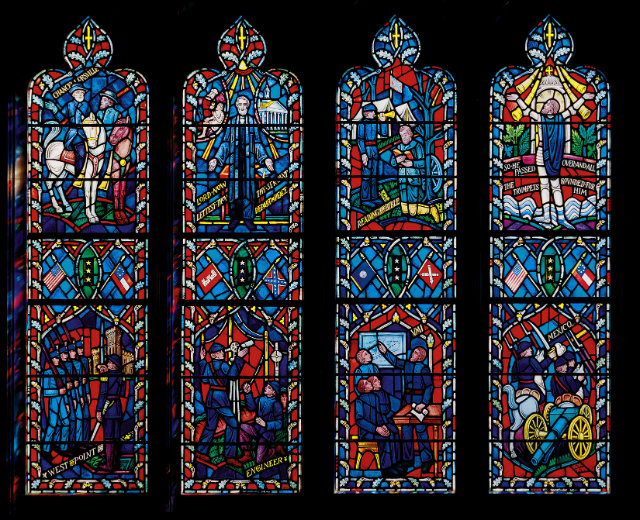 Photo courtesy of the National Cathedral.
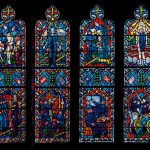
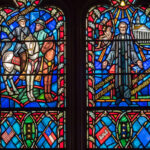
By the end of the summer, if not sooner, the Washington National Cathedral will remove the Confederate battle flag from its stained glass memorial to Robert E. Lee and Stonewall Jackson.
That’s just the first step in a larger consideration of the future of the windows, which were installed in 1953 “in a move that could help obliterate the Mason Dixon line,” as a press release said at the time. Over the next two years, the cathedral is planning programming to discuss “issues of race and the legacy of slavery that the windows represent,” according to the National Cathedral.
“It would be easy to simply remove these symbols and go on with business as usual,” says Rev. Dr. Kelly Brown Douglas, the cathedral’s canon theologian and a professor at Goucher. “We take down offending symbols all the time but never do anything about the culture that gave birth to them.”
This comes a year after now-retired Reverend Gary Hall issued a statement calling on the cathedral to remove the Lee-Jackson windows and “commission new windows that would not whitewash our history but represent it in all its moral complexity.”
Hall spoke out shortly after the shootings at a historic black church in Charleston, when shooter Dylann Roof was pictured with the flag. Hall called it “the primary symbol of a culture of white supremacy that we and all Americans of good will must repudiate.”
While Hall did not have the authority to immediately take down the windows, the Chapter (the cathedral’s board) established a five-person task force to figure how to move forward.
Last week, the task force came back with a series of recommendations, beginning with keeping the windows for now.
Brown Douglas, a member of the task force, says it “became very clear early on that the windows were a catalyst for discussions of race, race relations, and slavery.” The task force unanimously decided to maintain the windows in the near-term. “They’re going to be the foundation of our conversation,” says Brown Douglas. “Without true truthtelling, there is no reconciliation. It’s just cheap grace.”
In addition to programming, which kicks off July 17 in conjunction with the 2016 March on Washington Film Festival, the National Cathedral is conducting an audit of all its art and iconography “to see what other stories are being told or not told through the artwork,” says Kevin Eckstrom, a spokesperson for the cathedral.
But while the windows will stay for now, the cathedral is removing the Confederate battle flag “as soon as they figure out how and what to replace it with,” says Eckstrom. They’ve already contacted a stained glass artisan to help with that process after the Chapter unanimously decided that “the Confederate flag is as problematic, racist, and hateful as we thought it was,” according to Eckstrom.
Brown Douglas sees the removal of the flag as “a signal of our true commitment to writing a different narrative about race and examining the cathedral’s own history in this regard.”
The task force’s report (available in full below and worth reading in its entirety) details the decades of back-and-forth that led to the commissioning of the Lee-Jackson windows. While the plan always included Lee, the question of who should join him was complicated.
“My sister, Mrs. Coleman, put it in these words: ‘It would be most probable that people who are more emotional than intelligent would suggest that because we are a re-united country, Lincoln or Grant should be memorialized side by side with Lee.’ How often we have heard such as this!” wrote UDC historian general Mrs. Ferguson Cary in 1948.