 Rachel Sadon
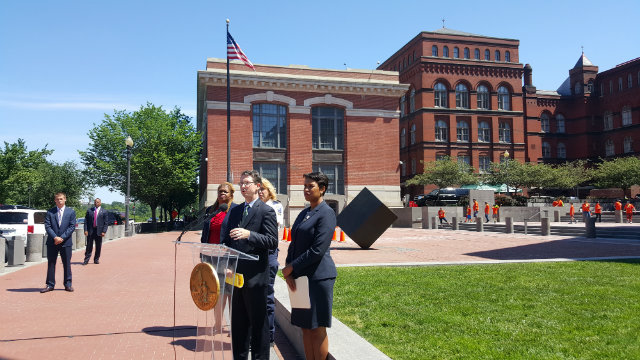 Deputy Mayor for Public Safety and Justice Kevin Donahue speaks at a news conference outside the Holocaust Museum. with Department of Consumer of Regulatory Affairs Director Melinda Bolling, Police Chief Cathy Lanier, and Mayor Muriel Bowser. (Photo by Rachel Sadon)
After two deaths in the custody of special police officers last year, Mayor Muriel Bowser and Metropolitan Police Department Chief Cathy Lanier are proposing changes to require enhanced and increased training.
“We believe [those officers] were up to date on the requirements and we believe that they need to be updated,” Mayor Muriel Bowser said at a news conference this afternoon.
There are more than 17,000 licensed special police officers and security officers employed by more than 120 companies in the District of Columbia. Of those, 7,700 are special police officers who are currently awarded arrest powers after 40 hours of training; the remainder are security officers who have the power to detain suspects but not make arrests.
The administration and MPD are now proposing doubling the required initial training for special police officers to 80 hours and tripling the yearly recertification training from eight to 24 hours. Nearly 60 percent of special police officers are also licensed to carry firearms, and their yearly firearms training would be doubled from eight hours to 16 under the proposal. The new regulations will be submitted to the Council, likely after the summer recess ends.
“They are saving lives and preventing crimes and doing really good security work; they are very, very necessary” in supplementing the police force, Lanier said last year after the second death in special police custody last fall.
In the November 1 incident, body-worn camera footage, which was released to the public for the first time, showed police officers arriving at an apartment complex in Southeast to find a winded security guard with his knee on the back of an unconscious man in handcuffs. Alonzo Smith was later pronounced dead at a local hospital. The medical examiner’s office has ruled the case a homicide, but no charges have been filed. The case remains open, Lanier said today.
In the September incident, a 74-year-old man left MedStar Washington Hospital Center without being discharged. When two security guards encountered the patient, James McBride, a struggle ensued. McBride died two days later of “blunt force injuries of the neck.” D.C.’s chief medical examiner ruled the death a homicide and the two officers, Clifton Montgomery and Charles Brown, were recently indicted on involuntary manslaughter charges.
But in holding the news conference outside the Holocaust Museum, the administration sought to highlight the heroism of special police officers, too.
“Our special police officers are often the first line of defense in an emergency. With our growing and changing community, it is critical that they have the knowledge and training to handle real-world scenarios,” Bowser said in a release.
Security guard Stephen Tyrone Johns died after being shot at the museum in 2009 by a rifle-wielding white supremacist. Two other special police officers, Harry Weeks and Jason “Mac” McCuiston, were able to subdue the suspect.
“Had it not been for the training, I wouldn’t have been able to be as successful as I was,” Weeks said today.