 Rachel Sadon
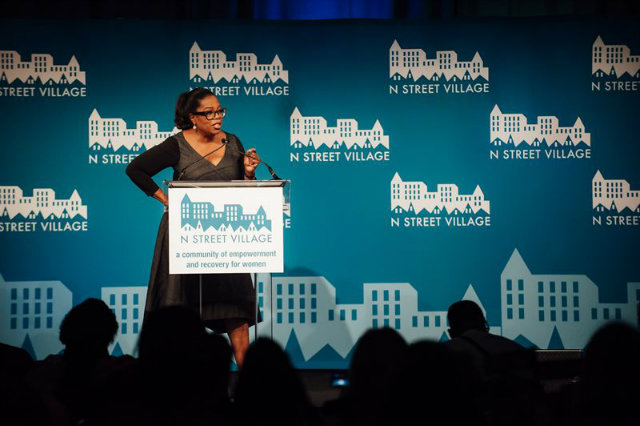 (Photo courtesy of Paul Kim for N Street Village)
One of the city’s oldest and largest non-profits serving homeless women got a major boost from Oprah Winfrey yesterday.
The media mogul and empowerment champion pledged $1 million to N Street Village at an annual luncheon.
“In life, we all want to know: Do you hear me? Do you see me? Everyone who works at N Street Village understands that principle,” Oprah told the crowd. “They know that every woman who comes through those doors wants to be seen, heard, and to know that her life matters.”
N Street Village is best known for its flagship location at 14th and N Streets NW, where it offers housing and a daytime center that often sees upwards of 80 women a day. It’s a place where homeless women can find two meals, shower and restroom facilities, social activities, addiction services, and a medical center in a supportive environment.
“It is a comprehensive service model, trauma informed, with a sense of individualized and dignified welcome and hospitality,” explains Schroeder Stribling, N Street Village’s executive director. “We’re here to walk with them, not for them.”
In addition to two smaller facilities, N Street Village is also the operator of the eighth shelter pitched as part of Mayor Muriel Bowser’s HomewardDC strategy to end homelessness. The plan to replace two women’s programs at the Federal City Shelter with a new women’s shelter actually dates back to the Vincent Gray administration but was incorporated into the “all eight wards” strategy that Bowser has championed.
While the debate raged on over the site selection and cost of the seven new family shelters, plans for the women’s shelter at the Patricia Handy Center in Chinatown were already well under way. The center held a ribbon cutting in February and began the process of moving in April. The facility has been up and running nearly at full capacity for about a month now.
Though the organization has more than 40 years of experience, this is the first time that N Street Village is providing emergency services. They proposed “a transformative model” in the sense that there is significantly more staff and wraparound services, much of it informed by their experiences at N Street, according to Stribling.
“We know that many, and definitely most, of the people we serve have experienced some kind of traumatic circumstances. It could be childhood abuse, multiple foster care placements, adult victimization, maybe partner violence, or frankly the experience of being homeless,” Stribling says. An active part of their program is looking at how the environment responds to trauma.
They also advocated for more medical respite space—a place were women who don’t need to be in the hospital but do need some kind of medical help can go for a “safe place to sleep and stay and rest.”
The organization is still trying to figure out exactly how Oprah’s donation will be used, according to spokeswoman Stuart Allen, but it comes at an “opportune time.” With the Patricia Handy Center, N Street Village has doubled the number of women they serve and they’re also in the middle of an effort to make building improvements to their flagship location.