 During my last semester at Hampton University, I volunteered for the school newspaper as a section editor. One day, in The Hampton Script office, Mychal Denzel Smith, our editor-in-chief, stood on top of a chair (or maybe it was a table) and fervently said what was on his mind. The staff was silent; the room was still.
Up until taking the top spot of the paper, Smith had been a scrawny kid with glasses who penned his frustrations as a writer, and later editor, for the The Script’s opinion section. I can’t recall what his issue was on that particular day—maybe he was taking his writers to task or perhaps his target was the school’s administration? But what I do know is that those of us in that room witnessed one of the millennial generation’s greatest minds learning to exercise his voice.
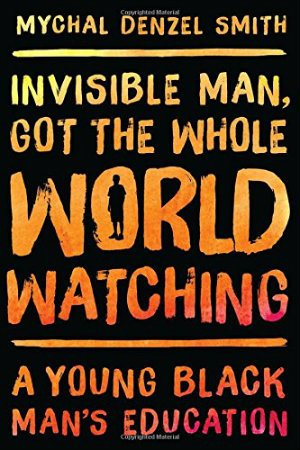
You can now hear Smith as he frequents TV and radio shows to discuss the racial and cultural news of the day. His musings can also be read in The Nation magazine. And now, at 29 years old, he has released his first book, Invisible Man, Got The Whole World Watching: A Young Black Man’s Education—which he’ll talk about at Politics & Prose Bookstore on Thursday.
At the book’s end, Smith says that he began writing with one question in mind: “How did you learn to be a black man?” Unpacking his answer within the pages of Invisible Man, Smith analyzes society through political, cultural, and social lenses. He questions the beliefs of his long-time heroes; he examines his familial upbringing; and he exposes his vulnerabilities—all while challenging readers to do the same.
Smith begins the book by examining his intellectual and cultural core. He revisits the historical black leaders he studied in his youth, from Malcolm X to Huey P. Newton. These were men who sparked a revolutionary spirit in him. Many of his biggest influencers were also hip hop legends. In particular, Mos Def (who inspired the book’s title) released an album called Black on Both Sides that delves into corporate greed, racial double standards, addiction, and more. It “felt like it was handcrafted with me in mind,” Smith says. He also gives nods to some of the most thought-provoking and trendsetting African-Americans who, in his lifetime, have made breakthroughs in popular culture—from Dave Chappelle to Lebron James.
Smith writes about how decisions made by George W. Bush shook him to his core. He also grapples with President Barack Obama’s legacy, which his says has, in part, allowed for “[enough] white people to be comfortable with America’s history of racism.” He writes about how that present-day racism has appeared in the killings of Trayvon Martin, Jordan Davis, Michael Brown, Freddie Gray, and other black youth— “one after the other, with little time to breathe in between.”
He uses these familiar characters as the book’s backdrop, allowing readers the space to reflect. But as the book unfolds, the most pressing story that Smith tells is his own.
He is the son of a Navy man who served twenty years in the military because “the options for him as an eighteen-year-old high school graduate who had grown up poor in southeast, Washington D.C., were basically nonexistent.” His parents set out to raise sons who “would defy all stereotypes associated with being a black man.”
At Hampton, he was challenged to speak and grow his mind inside of the classroom. This began his path to becoming a feminist. Outside of the classroom, he navigated around issues of homophobia, masculinity, and mental health.
If there is such a thing as writing with eloquent anger, Smith does it. He also brings forth humor, hope, and possibility in his coming-of-age story of trying to become an “honest black man and a good black writer.”
When I worked alongside Smith at The Script in the fall of 2007, I was a pregnant student with a few short months left to enjoy the freedom of early adulthood. The next semester, I would be back at home in D.C., preparing to become a new mother, unsure if I’d ever write again. So I didn’t attend class. I didn’t complete final projects. I abandoned classmates on group assignments. And I didn’t care because all that I wanted to do was write for the school paper. All that I wanted to do was be around other passionate writers, led by a passionate leader.
A leader who, as Smith shares in his book, was battling with things that few of us knew about. He dealt with the types of things that, although often go unspoken, plague thousands of boys born in black bodies. And those boys, if given the opportunity to become adults, will grow up navigating around the social ills that America has yielded them.
As a parent of an eight-year-old black male, frightened for his future, I will share with him tools for his survival. This means that one day, I will hand him a copy of a book written by a scrawny kid with glasses that I knew in college, who grew up to become an honest black man and a good an impeccable black writer. And I will tell my son to use this literature as a guide for life.
Smith will be at Politics & Prose at 7 p.m. on June 23; the event is free.