Rachel Kurzius
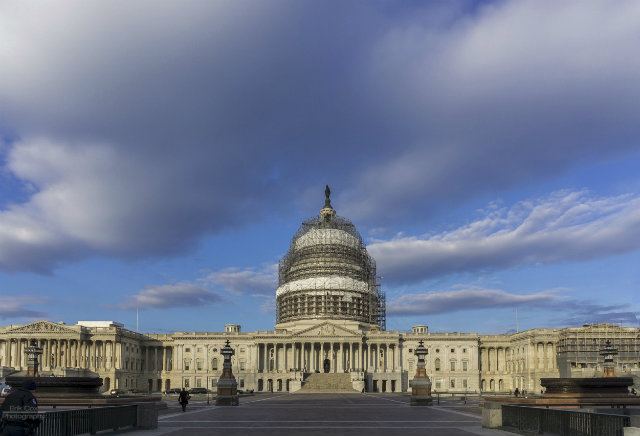 Photo by Erik Cox Photography.
Update: President Barack Obama has come out against the riders in the budget that repeal D.C. budget autonomy, and limit the District’s ability to use local funds on marijuana legalization and abortions.
A new statement of policy says the president “strongly opposes” the provisions and “urges the Congress to adopt provisions included in the FY 2017 Budget request that would permanently allow the District to use local funds without congressional action.” His senior advisors say they recommend he veto the bill.
The president also issued a veto threat over separate legislation that seeks to overturn D.C. budget autonomy.
“Once again, the White House has in strong terms opposed all undemocratic interferences into D.C.’s local affairs by unaccountable Members of Congress, and we are grateful,” D.C. Congresswoman Eleanor Holmes Norton said in a statement.
Original: The Financial Services bill is a must-pass piece of legislation that funds the government.
This year, it passed the House Appropriations Committee with provisions that repeal D.C.’s Budget Autonomy Act and restrict spending on abortion, marijuana legalization, and needle exchanges in the District.
And now, a Kentucky congressman wants D.C. residents to be able to carry around handguns without a permit, whether open or concealed. Meet Thomas Massie, the Republican from the state’s fourth district.
The only thing that stops a bad guy with a gun is a good guy with a gun – responsible AR-15 owner for 20 yrs #2A pic.twitter.com/AsGU51nTEv
— Thomas Massie (@RepThomasMassie) June 18, 2016
Amendments he introduced to the bill would prevent D.C. from spending its funds to enforce laws and prevent enforcement of gun-free zones. In a statement, Massie claimed that these changes would prevent a mass shooting like the one in Orlando last weekend, which left 49 dead.
“Gun control is not the solution,” Massie said. “The only practical way to have prevented this tragedy is by eliminating gun-free zones where security is inadequate to protect law-abiding citizens who are otherwise capable, willing and endowed (by their Creator with the right) to defend themselves. I introduced these amendments to reduce the likelihood of a similar tragedy in D.C.”
You might remember Massie from 2014, when he similarly introduced amendments to gut D.C.’s gun laws. These passed in the House, though were removed from the Senate bill.
D.C. Congresswoman Eleanor Holmes Norton is not pleased. “Representative Massie recklessly envisions people carrying, openly or concealed, guns in the nation’s capital, risking the lives not only of our residents, but of the countless high-profile national and global figures who frequent our streets and public places,” she said in a statement.
But Massie is not the only Republican lawmaker looking to tinker with D.C. gun laws. David Schweikert (R-AZ) introduced an amendment that would stop D.C. from enforcing its “good reason” law, which designates where handguns can be carried in public by licensed owners. (two cases about this law are currently winding their way through federal court).
“Representative Schweikert must have forgotten what district he represents, but I intend to keep reminding him the more he tries to dictate the local policies of my district,” Norton said in a statement.
Nor are gun laws the only thing on the table. Congressman Gary Palmer introduced an amendment that would prevent the District from enforcing its Human Rights Amendment Act and block funding for the Reproductive Health Non-Discrimination Act, which prevents employers from discriminating based on reproductive health decisions. Palmer has since revised his amendment to only block RHNDA.
Palmer’s office did not respond to requests for comment. The House voted to overturn RHNDA in 2015, though the bill still became law in D.C. when the Senate never took up a vote.
“Instead of promoting discrimination against D.C.’s LGBT students, Representative Palmer should have the decency to support the devastated LGBT community after last week’s heinous hate crime and terrorist attack,” said Norton.
Norton introduced her own slew of amendments, which focus on keeping D.C. budget autonomy, striking the abortion rider, and striking the anti-cannabis rider. Both the abortion and cannabis amendments add the word “federal” so, while no federal funds would be available, D.C. could use its local funds.
Kaitlyn Boecker, policy coordinator for the Drug Policy Alliance, says the vote over the anti-cannabis rider, co-introduced by Norton and Dana Rohrabacher (R-CA), is going to be very close.
“Everyone saw [the anti-cannabis rider] as blocking legal implementation but that’s not what it did,” says Boecker. “We have legal marijuana in D.C. and they are interfering with our ability to fix problems. There’s a recognition that they have inadvertently created a public safety problem.”
Now the Rules Committee decides which of the amendments are in order this evening, and they will be voted on by members later this week. After that, the Senate will craft its own version of the bill.
Updated to reflect that Palmer revised his amendment to only block RHNDA, and that the House voted only on a disapproval resolution for RHNDA, not HRAA in 2015.