 Rachel Sadon
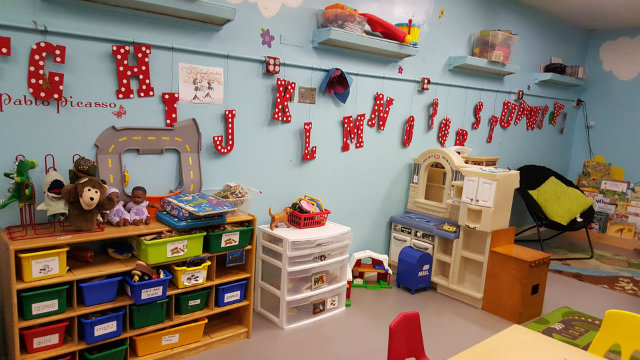 The Homeless Children’s Playtime Project’s area for kids 3-7 in D.C. General. (Photo by Rachel Sadon)
As politicians dithered for years about how to close D.C. General, a nonprofit spent that time working to give the hundreds of children housed there opportunities for safe and creative play, including building a new playground and a center for teenagers on site. So what happens now that the city finally has a plan to replace the crumbling facility with smaller family shelters?
Details still need to be worked out, but The Homeless Children’s Playtime Project expects to remain involved and is already thinking about ways to adapt to the smaller sites. “It’s been clearly expressed that they desire for us to be involved, and we desire to be involved,” says Playtime Project spokesman Micah Bales. “It is obviously going to be different from D.C. General, where we have relatively large spaces to work with and quite a bit of dedicated space. [In smaller facilities] it tends to be much more intimate.”
Playtime Project was founded in 2003 by social worker Jamila Larson and lawyer Regina Kline with the goal of giving children the freedom to play, even in the midst of a chaotic shelter. After developing programming for at D.C. General, the group lobbied hard for a playground. It was a difficult fight, but the city eventually agreed and it opened in 2014.
The group next set its sights on a space for their teenage programs separate and independent from areas devoted to babies and children. It is a “place for teens to dream, to heal, to connect, to plan, to do,” Larson said at the ribbon cutting. But Playtime also hoped—and planned—for the space to be a temporary one.
After much back and forth, the city finally came to an agreement last month to close D.C. General and another temporary shelter (at 1433 and 1435 Spring Road NW) and replace them with seven smaller facilities. The director of the Department of General Services estimates that the new shelters will be completed in 2019. Although Mayor Muriel Bowser initially said they all must be finished before closing D.C. General, the administration will weigh the possibility of closing the facility in stages once the plans for the new buildings are further along, according to DGS Director Christopher Weaver.
And until it is actually closed, Playtime Project is committed to keeping its programs running. “It’s going to be at least three years, and that’s a long time in the life of a child or a family,” Bales says.
Meanwhile, the long process of closing D.C. General has given the group an opportunity to regroup and think about how best to fulfill its mission. “It’s allowed us to think about how we can use the knowledge and skills we already have and refocus on where the need is greatest,” Bales says. And one place that they plan to focus on next is the D.C. and Maryland hotels where hundreds more homeless families are being housed.
During a six-week experimental program at the Days Inn last summer, the organization saw firsthand just how great the need is. Confined to small rooms with little public space, children have few opportunities for play. Playtime Project is still working out the details, but hopes to add programming at the motels early next year. “We’re being deliberate about how we do this because the motels are a different environment than any we’ve been in before,” Bales says.
And in addition to programs at D.C. General, the nonprofit also works in four transitional housing facilities that are much more akin to the new shelters than the sprawling former hospital. “We’re feeling really optimistic. Based on our experience working in those sites, they are much better for families,” Bales says. “[The closure of D.C. General] means change for us—but it’s not about us.”