 Rachel Sadon
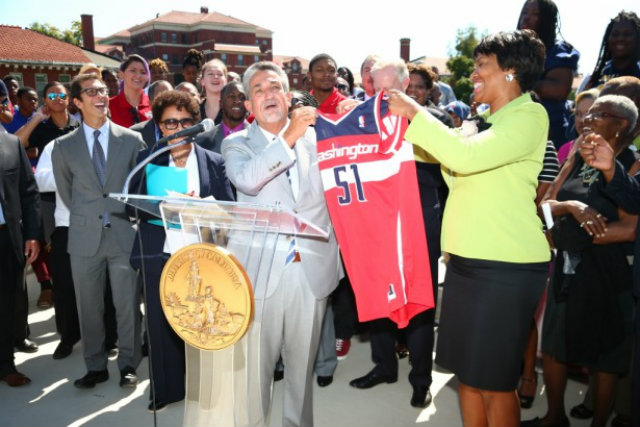 Ted Leonsis and Mayor Muriel Bowser unveil plans for the practice facility in September. (Courtesy of Monumental Network)
A new plan from the city’s sports and events authority would add $10 million to the cost of a largely taxpayer-funded arena at the St. Elizabeths East campus.
Events DC has submitted a $65 million budget that would also reduce the number of seats from 5,000 to 4,200 at the planned practice facility for the Wizards and home for the Washington Mystics, The Washington Post reports.
Ted Leonsis’ Monumental Sports & Entertainment was already footing less than 10 percent of the original $55 million bill; the remainder is split between Events DC (which is funded by hotel and food and beverage taxes) and the District government. The additional cost will be borne by the sports and events authority, which is some comfort to D.C. Chairman Phil Mendelson.
“I’m slightly disappointed. Not surprised. I believe we should continue to support the project. While Events DC’s money is public dollars it’s not general fund dollars so that’s some consolation,” he told The Post.
Events DC President Gregory O’Dell said the agency would make up the difference—rather than asking Monumental to spend more than $4.5 million on the facility—because the design changes were made to make it better for entertainment purposes.
A new split-level seating formation “will allow us to move seats more close in and more vertical to a concert stage,” O’Dell told the Post.
But it also means 800 fewer seats, and Mystics fans have already expressed frustration at the team’s move from the 20,000-seat Verizon Center to a much smaller venue.
“As long-term fans, this is not okay,” Neena Chaudhry, told ThinkProgress when the facility was first proposed. The move “shows a real lack of confidence in the Mystics and their fans.” According to the publication, average attendance last season was 7,710, with the biggest crowd at more than 17,000. Leonsis told The Post those numbers are overinflated by sponsors who have blocks of seats that go unused, and argued that a full smaller stadium will make for a better fan experience than a largely empty Verizon Center.
The sports and entertainment facility is part of the first phase of development at St. Elizabeths East campus, which also includes 60 townhomes, 250 mixed-income apartments, a 171,000-square-foot office building with 47,000 square feet of retail, and 100 underground parking spaces. When all is said and done, the completed renovation will house 1.8 million square feet of offices, 206,000 square feet of retail, 1,300 residential units, and at least two hotels in Congress Heights.
All of that has a number of activists and area residents deeply worried about the potential for displacement. About three dozen people protested a groundbreaking for the project.
“People see it as a facility for one team—that they are going to be getting all the benefit and paying nothing. That perception is unfortunate because it is not accurate. But they are clearly a primary beneficiary,” Mendelson told The Post.
Indeed, many have been critical of the amount of taxpayer funding that is going into the project, a concern that is sure to deepen as the costs have risen—and may continue to go up. Councilmember Elissa Silverman tried to enact a cap on city spending for the project, but the measure failed. Meanwhile, officials are trying to figure out how to come up with $400-$500 million for a badly needed new jail.