
 Rachel Kurzius
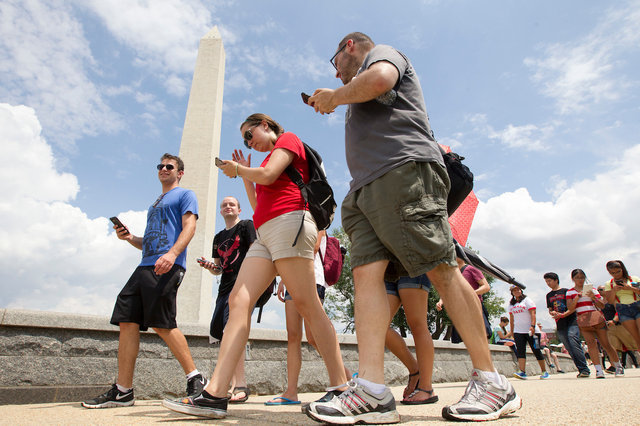 Players search for Pokemon near the Washington Monument. (Photo by Alex Edelman)
It’s not just stores to purchase healthy foods, broadband internet connection, or spaces for safe physical activity—there’s a new gap in access in the District. Call it the Pokemon Go desert, and like the others, it largely exists in Wards 7 and 8.
A new study by the Urban Institute looked into “Pokemon redlining” in D.C., the notion that it’s harder for players to find the tools they need for the wildly popular app in neighborhoods where most residents are minorities.
 Image courtesy of Urban Institute.
The conclusion from researchers Shiva Kooragayala and Tanaya Srini? Yep, there are more than two times as many PokeStops (where players must visit for supplies to catch the digital creatures) and gyms (where participants pit their pets against one another) in majority-white neighborhoods than majority-black neighborhoods in the District: 58 portals to 26 portals. Even when researchers accounted for population density, the share of millenials in an area, and nonresidential areas like the National Mall, which are hotbeds of Pokemon activity, the gap remained.
 Image courtesy of the Urban Institute.
This has a lot to do with how Pokemon Go was designed, the Urban Institute explains. The app, designed by Niantic uses mapping technology from the company’s previous program, Ingress.
Ingress used to allow players to suggest relevant portal locations in their areas, but because Ingress players tended to be younger, English-speaking men, and because Ingress’s portal criteria biased business districts and tourist areas, it is unsurprising that portals ended up in white-majority neighborhoods.
This also explains why portals exist at places like the Holocaust Museum and Arlington National Cemetery where visitors have been asked to refrain from catching ’em all.
The report notes that this isn’t just a problem for folks trying to be the very best there ever was. Pokemon Go is the beginning, but certainly not the end, of what’s being called “virtual placemaking,” which allows people to interact with their world anew with an assist from technology. But the ability to fully participate, it seems, is currently hindered by geography.


