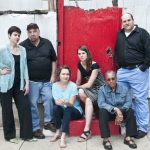
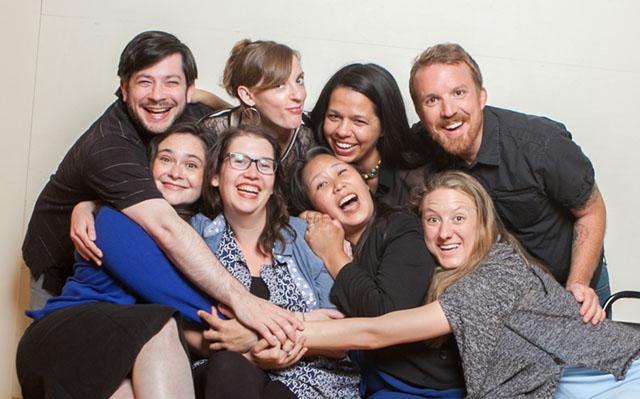
 The New Welders are (top, L to R) Producing Playwrights Brett Ableman, Rachel Hynes, Annalisa Dias, and Lead Producing Playwright Stephen Spotswood. (bottom, L to R) Creative Producer Ronee Penoi and Producing Playwrights Hannah Hessel Ratner, Deb Sivigny and Alexandra Petri. Photograph by C. Stanley Photography.
By DCist contributor Seth Rose
Back in 2013, a group of D.C. playwrights set out to solve a problem plaguing the local theater scene: very few plays are produced by playwrights living in the District. They came up with the idea of a collective, The Welders—wherein each writer gets six month to helm the group as artistic director. Now, having completed the cycle, they’re passing the torch on to a new group of writers.
The group takes its name from a poem by Cherrie Moraga that embodies their ethos.
“I am the welder
I understand the capacity of heat to change the shape of things
I am suited to work within the realm of sparks out of control.
I am the welder.
I am taking the power
into my own hands. ”
Through The Welders, playwrights suddenly had an autonomous voice. The writers each serve as the artistic director for their own production and they have the final say over how the work is presented on stage. This model allows playwrights to conceive, promote, and produce their own work without fear of outside meddling—while supporting and being supported by their fellow artists.
Welders 1.0 consisted of playwrights Allyson Currin, Caleen Sinnette Jennings, Bob Barlett, Renee Calarco, and Gwydion Suilebhan, along with Jojo Ruf, who served as executive and creative director for each of the productions.
“It’s about recapturing the idea that playwrights can run institutions,” said Suilebhan, “That’s a position that we inherit from Shakespeare.”
The Welders operate as a functional nonprofit, with most of the internal mechanics, marketing structure, and day-to-day workings operated by the group.
It didn’t take long for this approach to bear fruit. The Welders’ shows have had good press, and the group quickly became a fixture of the local theater community. Over their three-year run, the first generation of Welders received three separate arts grants and earned the John Aniello Award for Outstanding Emerging Theater Company at the 2016 Helen Hayes Awards.
The Welders took inspiration from New York’s 13P, a group of 13 playwrights who produced 13 of their own pieces over nine years and promptly disbanded. Unlike 13P, The Welders have no intention of fading away.
Handing the company off every three years to a totally new group of playwrights is a core part of their initial charter. “Passing the torch” is not just a way to give younger generations the spotlight. It’s a process that ensures that the group’s work remains fresh and able to adapt to the changing artistic environment of D.C.
“We get to take this group of young people and see them take the reins of a thriving nonprofit, budget and all,” said Suilebahn. “That’s something that almost never happens.”
The group does not take this handover lightly. The official ceremony transferring control to the next generation of Welders was the culmination of a process that involved group applications, extensive interviews, and a period during which the chosen successors shadowed the founders for over a year.
By the time the transfer finally happened on Sunday, Welders 2.0 had already been tightly woven into the operational fabric of the group. Like their predecessors, the new generation started as a loosely connected group of artists who didn’t know each other.
“The thing that excites me the most about the new group is how artistically different we all are,” said Hannah Hessel Ratner, dramaturg and writer of what will be the fifth show of Welders 2.0.
In addition to Ratner, Welders 2.0 includes the playwrights Brett Ableman, Rachel Hynes, Annalisa Dias, Deb Sivigny, Alexandra Petri, and Stephen Spotswood, along with creative producer Ronee Penoi.
The original Welders would experiment to a point: Suilebahn’s contribution Transmission, for example, was billed as an “immersive, participatory ‘performance sermon’” designed for 20-person audiences. But the new generation hopes to make pushing boundaries a bigger part of their core mission.
Sivigny, for example, describes her still very much unfinished show as a mostly devised, design-driven piece inspired heavily by Punchdrunk’s long-running immersive theater piece Sleep No More, and Abelman has plans for a show set in space (not literally, but anti-gravity is still the aim).
“It’s about us redefining the word ‘playwright’ for ourselves,” said Spotswood, whose show Girl in the Red Corner opens in November. “It doesn’t have to be someone cloistered away just typing up a script to be produced by someone else.”
This statement of purpose applies to the group’s artistic sensibilities and to the legacy of collaborative work left to them by the founders. For The Welders, a lonely playwright plugging away at laptop keys only to hand their creation off to a producing company is the very paradigm they exist to fight. When they describe themselves as a collective, they mean it: every success and failure of the group is built and shared by every other member in equal measure.
Said Penoi: “Part of our work’s DNA is that it does not belong to one person.”